





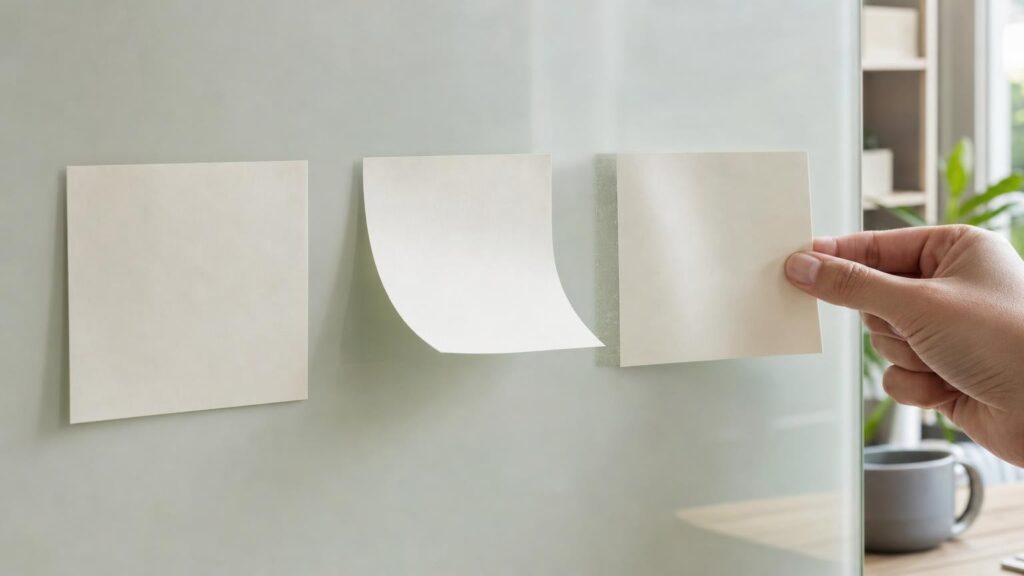
A sticky note has to perform a careful balancing act. It must attach with enough force to remain useful, lift without damaging an ordinary surface, and ideally stick again somewhere else. At the same time, its paper should stay flat rather than curling away and pulling the adhesive loose.
These qualities do not come from stickiness alone. They depend on the design of the pressure-sensitive adhesive, how much of the sheet it covers, the behaviour of the paper and the condition of the receiving surface. Removal technique, humidity and storage also help explain why two apparently similar notes can behave very differently.
Why a sticky note can stick, lift and stick again
Repositionable notes normally use a deliberately low-tack pressure-sensitive adhesive. Unlike a glue that must dry or cure, a pressure-sensitive adhesive forms a bond when it is pressed against a surface. The pressure helps it make closer contact with that surface.
The bond is intentionally limited. It should be strong enough for everyday temporary attachment but weak enough to separate without behaving like permanent tape. This is why a note may work well on a smooth desk, monitor surround or document while being unreliable on a rough wall or dusty noticeboard.
The adhesive is only one part of the system. The paper acts as a flexible backing, and its stiffness and shape can either support the bond or work against it. The receiving surface supplies the final part of the contact. If any one of these elements is unsuitable, a note may lift even when the adhesive itself is not defective.
Microsphere adhesive: contact without a permanent bond
Many repositionable adhesives use microscopic adhesive spheres rather than one uninterrupted film of glue. When the note is pressed down, these tiny spheres touch the receiving surface at numerous separate points. Together, the contact points provide useful holding force, but gaps remain between them.
This structure helps limit the total contact area. The spheres can grip under light finger pressure without flowing into every microscopic hollow in the surface. When the note is removed, the individual contacts can release in sequence instead of forcing an entire continuous adhesive layer to separate at once.
That helps explain three familiar characteristics of sticky notes:
- Pressure matters: smoothing the adhesive area firmly against the surface creates more effective contact than merely dropping the note into place.
- Repositioning is possible: limited contact generally allows the note to be lifted and placed again, although performance may decline as the adhesive collects fibres, dust or skin oils.
- Holding force is deliberately restricted: a repositionable adhesive is not intended to provide the security of a permanent label or mounting product.
Clean removal is a design aim, not an absolute promise for every material. Delicate paper, unstable paint, coated finishes and aged surfaces may react differently. Testing an inconspicuous area is sensible when the finish matters.
Adhesive coverage changes how a note behaves
The familiar format has a strip of adhesive along one edge. This leaves most of the sheet free for writing and makes the note easy to lift. It also creates a natural hinge: the unsecured portion can move, flutter or curl, especially on a vertical surface.
A broader adhesive band supports more of the paper. It can reduce movement and spread the holding force across a larger area, but it may require slightly more care when removing the note. The amount of completely unobstructed writing area may also be relevant if the note is small or used with pressure-sensitive writing tools.
Full-coverage formats place repositionable adhesive across most or all of the back. These are more likely to lie flat and are useful where exposed corners would otherwise catch on hands, pages or moving air. They can also suit curved objects better, provided the curve is gentle enough for the paper to follow. Their larger contact area may make them less convenient for rapid lifting and repeated shuffling.
Coverage is therefore a practical choice rather than a simple measure of quality. A narrow strip suits quick reminders and frequent movement. Broader or full coverage may be preferable for indexing, planning boards, vertical display or documents that are handled repeatedly.
Paper grain, stiffness and curl
Paper is a network of fibres, and those fibres tend to have a prevailing direction created during manufacture. This is known as the grain. Paper usually bends more readily in one direction than the other, so sheet orientation can affect how a note flexes, peels and curls.
Thickness and stiffness matter too. A light, flexible sheet can conform well to a smooth surface, but its free edge may flutter or develop a curl. A stiffer sheet may remain visually flat under ordinary conditions, yet it can exert greater leverage against the adhesive if it has already taken on a curved shape.
Moisture imbalance is a common cause of changing paper shape. Paper fibres absorb and release moisture from the surrounding air. If one side or one region changes more than another, the sheet can curl. Exposure to damp air, drying heat or rapid environmental changes can therefore alter how a note lies.
Stronger tack cannot always solve this problem. If the paper continually tries to spring away, the adhesive must resist an ongoing peeling force concentrated near an edge. A product with more adhesive coverage may cope better, but correcting storage and handling is often more effective than simply seeking the strongest possible glue.
Removal and placement techniques that reduce curling
The way a note is taken from its pad can set its shape before it reaches the wall or page. Pulling the loose edge sharply upwards bends the sheet back against the adhesive strip. The resulting curl can direct the free edge away from the receiving surface.
A gentler method is to lift the free edge and draw the note sideways along the plane of the pad, allowing the adhesive strip to release progressively. This places less of a tight bend into the paper and can help the sheet remain flatter.
When positioning the note, place the adhesive edge first and smooth across it with clean fingers. Firm, even pressure is more useful than repeatedly tapping one corner. Avoid creasing the adhesive area, because a crease reduces the portion that can sit flush against the surface.
Orientation also matters. On a vertical surface, placing the adhesive edge at the top lets the note hang from its bonded area. If the adhesive strip is at the bottom, the weight and stiffness of the paper may continually encourage the upper section to fall away. In frequently handled locations, position the bonded edge so that hands, sleeves and turning pages are less likely to catch the free corners.
The receiving surface matters as much as the note
Adhesive can only grip where it makes real contact. A smooth, clean and dry surface gives the microspheres many opportunities to touch. On a rough or heavily textured surface, the adhesive may rest on raised points while gaps remain underneath. The visible size of the adhesive strip can therefore be much greater than its effective contact area.
Porous materials can present a similar problem. Fibrous cardboard, unfinished timber and some wall finishes may offer an irregular or weak top layer. The note might attach only to loose fibres, or removal might lift part of the surface rather than releasing cleanly.
Dust creates a barrier and can transfer onto the adhesive, reducing its ability to work after repositioning. Oil, cleaning residue and moisture also interfere with close contact. Even a smooth surface can perform poorly if it is contaminated.
Curvature adds another challenge. A flexible note may follow a broad curve, but a tight cylinder forces the paper to bend continuously. Its stiffness then creates a persistent outward pull. More adhesive coverage can help, although a smaller note or a format intended to conform over a wider area may be a better match.
Residue-free removal should not be assumed on every finish. Adhesive behaviour can change with long contact times, heat and the condition of the underlying coating. Recently painted, fragile, valuable or unknown surfaces deserve particular caution and a discreet test.
Humidity, heat and storage affect the whole pad
A pad is a stack of paper and adhesive layers, both of which can be influenced by its surroundings. High humidity may encourage the paper to absorb moisture and change shape. Very dry conditions can lead it to release moisture. Uneven exposure is especially likely to produce curl because the outer sheets and edges respond before the protected centre of the pad.
Temperature can also affect how an adhesive feels and flows under pressure. Prolonged heat may change tack or encourage unwanted transfer, while cold conditions can make some pressure-sensitive adhesives less able to form immediate contact. Exact behaviour varies by formulation, so normal indoor storage is generally the most predictable choice.
Keep unused pads flat and covered where possible. Avoid leaving them open in dusty work areas, damp rooms, direct sun or close to a prolonged heat source. A closed drawer or clean stationery container also protects exposed adhesive edges from fibres and dirt. Heavy objects should not distort the pad, although light, even storage pressure can help prevent loose sheets from warping.
How to judge the right performance trade-off
Maximum stickiness is not automatically better. A stronger bond can make repositioning less convenient and may increase the risk of marking vulnerable surfaces. The useful question is whether the note balances secure temporary hold with the intended frequency of movement.
Consider the adhesive area
Choose an edge strip for quick removal, temporary reminders and low-contact use. Consider broader or full coverage when flatness, edge security or resistance to handling is more important.
Look at paper stiffness and note size
Larger notes place more paper beyond the adhesive area, giving air movement and handling more leverage. Stiffer paper may feel substantial but can resist tight curves. A flexible sheet may conform more easily while being more prone to flutter. The best combination depends on where the note will be placed.
Match repositionability to the task
For planning sessions or page markers, easy repeated movement may matter most. For a notice expected to remain upright for longer, wider adhesive coverage and resistance to curl may take priority. If permanent security is required, a repositionable note is the wrong category regardless of its initial tack.
A simple diagnosis for notes that lift, curl or stop sticking
When a note performs poorly, the symptom can help identify the cause:
- The free edge curls immediately: try removing the next sheet sideways rather than peeling it sharply upwards. Check whether the pad itself has warped.
- The adhesive edge lifts: clean and dry the receiving surface, then apply firm pressure across the full adhesive area.
- The note works on glass but not on a wall: surface texture or a weak, dusty coating is probably reducing effective contact.
- A previously reliable note no longer sticks: dust, fibres, oil or repeated handling may have contaminated the adhesive.
- The note falls from a curved object: paper stiffness may be overcoming the limited bond. Try a smaller note or greater adhesive coverage.
- Several sheets in the pad are curled: review storage conditions and look for humidity, heat or uneven pressure.
- The note leaves a mark: stop using it on that finish and test alternatives discreetly. The surface, contact time and environment may be contributing.
Reliable performance comes from the note, the surface and the handling method working together. A low-tack microsphere adhesive makes repositioning possible, but it cannot cancel out severe paper curl, contamination or an unsuitable finish. Shoppers who consider adhesive coverage, paper behaviour and intended placement can choose more confidently than those who judge a note only by how sticky it feels.
Continue exploring on Frowse
Best Sellers · Top Rated · Under £50 · Fresh Finds
Explore products on Amazon
Looking for products related to this guide? to enter your own search term.
Discover More Frowse Insights
- Why Terracotta Pots Darken, Develop White Deposits and Sometimes Crack
- Why Mechanical Pencil Leads of the Same Diameter Perform Differently
- Why Staples That Look the Same Do Not Fit Every Stapler
- How an Electric Kettle Knows When the Water Has Boiled
- Why Salt and Pepper Mills Need Different Grinding Mechanisms