





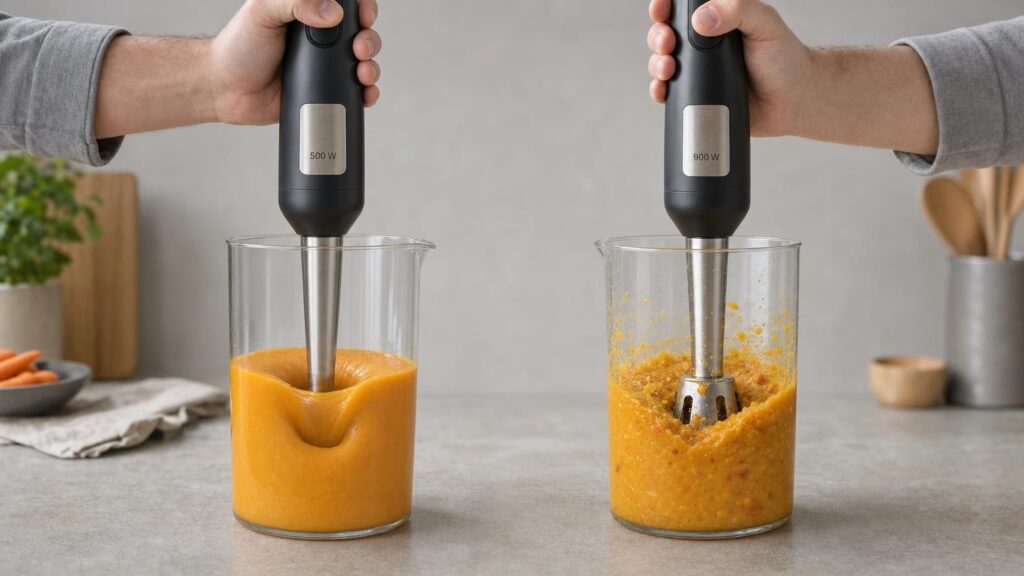
A hand blender with a larger wattage figure can look like the obvious choice. It sounds more powerful, so it should blend faster, produce smoother results and cope better with difficult ingredients. In practice, that number tells only part of the story.
Wattage is principally an electrical input figure or rating. It does not show how efficiently a blender turns electrical power into useful movement at the blade, how well it maintains speed when food resists it, or whether its blade and guard circulate ingredients effectively. Those factors help determine whether a blender works smoothly or simply makes noise, pushes food around and overheats.
To compare hand blenders meaningfully, treat wattage as background information rather than a performance score. The motor, controls, coupling, shaft, blade, guard and recommended operating pattern all matter.
What the wattage number can – and cannot – tell you
A wattage rating can provide broad context about a blender’s electrical design. It may also help distinguish models intended for relatively light use from those positioned for more demanding work. However, it does not directly state the mechanical power reaching the blade.
Some energy is lost through heat, electrical resistance, friction and the transmission between the motor and shaft. Motor efficiency and mechanical design influence how much of the input becomes useful blade movement. Two hand blenders with the same rated wattage can therefore deliver different results.
Wattage alone also does not reveal:
- how much torque is available when the blade meets resistance;
- whether blade speed falls sharply in a thick mixture;
- how effectively the blade cuts rather than pushes ingredients;
- whether the guard draws food towards the blade;
- how controllable the blender is at lower speeds;
- how long it can operate before heat becomes a concern.
A higher-powered model might perform well, but the number itself does not prove that it will be faster, smoother or easier to control. A well-designed lower-wattage system may use its available power more effectively.
Motor design and speed under load
A hand blender can spin quickly in the air yet slow substantially when placed in a dense soup, dip or purée. This is the difference between no-load speed and useful performance under load.
Torque is the turning force that helps the blade continue moving against resistance. Gearing, motor construction, electronic control and the quality of the drivetrain all influence torque delivery. A blender that maintains an appropriate speed under load may process difficult ingredients more consistently than one that starts at a dramatic speed but quickly bogs down.
Speed control matters too. Some tasks benefit from a gentle start, while others need a higher speed once the blade is fully immersed. Well-judged variable control can make the available power easier to use. It can reduce sudden surges, improve precision and help limit splashing.
Published specifications do not always describe behaviour under load. When information is available, look for clear operating guidance and descriptions of speed control rather than assuming that maximum wattage or maximum speed settles the comparison.
Blade geometry and guard shape do the cutting and circulating
The motor supplies movement, but the blade and guard determine how that movement interacts with food. Blade diameter, angle, edge shape, number of cutting surfaces and position within the guard can all affect performance.
Effective blending depends on circulation. Ingredients need to move into the cutting zone, pass across the blade and then return for repeated processing. If food remains in dead zones or is pushed away from the blade, the motor may be working without producing an evenly blended result.
The guard surrounding the blade is central to this process. Its openings influence how food enters and leaves the cutting area. Its shape can affect suction, vortex formation and the tendency of fibrous material to collect around the blade. The distance between the blade and guard also influences engagement with ingredients at the bottom of a vessel.
No single blade or guard design is best for every food. A design that circulates liquid soup efficiently may behave differently in a small quantity of thick paste. The important point is that geometry can have as much practical influence as the motor rating.
Why some hand blenders splash more than others
Splashing is not simply a sign of excessive power. It results from an interaction between blade speed, guard design, immersion depth, vessel dimensions and technique.
A blade positioned close to the surface can throw liquid upwards or pull air into the mixture. Starting at full speed may create a sudden vortex before the guard is properly immersed. A wide pan or shallow bowl can make it harder to keep the blending head covered, even when the blender itself is well designed.
For better control, place the head into the food before starting, keep the guard submerged where the recipe allows and begin at a moderate or low speed if the controls provide that option. Use a vessel deep enough to contain movement without being so narrow that the head cannot circulate food.
Guard openings and blade depth also affect splash behaviour. A thoughtfully designed blending head can direct flow within the mixture instead of upwards. For frequent soup, sauce or emulsion preparation, this everyday controllability may be more valuable than a higher maximum wattage figure.
Shaft construction, rigidity and blending depth
The shaft connects the motor unit to the blending head, so its construction affects more than appearance. Length determines whether the blender can reach comfortably into tall jugs or deep pans. Rigidity and blade alignment influence vibration and stability, particularly when ingredients are uneven or resistant.
Detachable shafts can simplify storage and cleaning, but the coupling between the motor body and shaft becomes an important part of the drivetrain. A secure, well-aligned connection helps transfer movement consistently. It should also be straightforward to attach without encouraging accidental misalignment.
Metal shafts are often valued for rigidity and their suitability around warm foods, subject to the manufacturer’s instructions. Plastic can be lighter and may reduce the chance of marking some vessels. However, material names alone do not establish quality. Grade, thickness, construction, joints and intended use all matter.
Consider where you blend as well. A long shaft can be useful in a stockpot but feel cumbersome in a small beaker. A large guard may circulate a family-sized batch effectively yet struggle to engage a very shallow portion. Dimensions should match your vessels and usual quantities.
Duty cycle and overheating in demanding mixtures
Hand blenders are commonly intended for intermittent operation rather than unlimited continuous blending. Their motors and couplings generate heat, especially when the blade is working against a thick or sticky mixture.
Heat build-up depends on more than wattage. Batch size, ingredient density, blade resistance, operating speed, ventilation and run time all contribute. A mixture that barely moves may place more strain on the system than a larger quantity of free-flowing soup.
Higher wattage does not remove the need to follow the product’s operating guidance. If instructions specify short operating periods, cooling pauses or restrictions for particular foods, those details are more useful than assumptions based on the headline power rating.
Technique can reduce unnecessary strain. Work in manageable batches, add liquid when appropriate to the recipe, stop to release trapped ingredients and avoid forcing the head through a mixture that is unsuitable for the appliance. If performance drops or the motor body becomes unusually hot, stop and consult the instructions rather than continuing solely because the blender has a high power rating.
Match the blender to the foods and vessels you actually use
Smooth soups and sauces
For soups, circulation, shaft reach and splash control are major considerations. The blender needs to move ingredients repeatedly through the cutting area while remaining comfortable to manoeuvre in the pan. A high wattage rating cannot compensate for a head that is awkward in your usual cookware.
Small portions and emulsions
Mayonnaise, dressings and small servings benefit from good low-level engagement and precise speed control. The head should work with an appropriately sized vessel so that the blade remains covered and can draw ingredients into a stable flow. A gentle start may be more useful than maximum speed.
Thick mixtures
Dips and dense purées test torque delivery, coupling strength and duty cycle. They may require pulsing, repositioning or added liquid where the recipe permits. Check that the manufacturer describes the appliance as suitable for the intended task rather than inferring suitability from wattage.
Fibrous ingredients
Fibrous foods reveal how well the blade cuts and whether material catches around the shaft or guard. Blade geometry and circulation are especially important. Pre-cutting ingredients can also produce more even engagement and reduce strain.
A hand blender is not automatically a substitute for every countertop blender, food processor or mixer. Crushing very hard ingredients, kneading heavy dough or producing highly uniform results from demanding materials may call for a different appliance design. Choose according to the task, not the desire for one tool to do everything.
A better specification checklist than wattage alone
When comparing hand blenders, use the wattage number as one detail within a broader checklist:
- Speed range: Look at the number and type of controls, including whether low-speed operation appears easy to manage.
- Performance under resistance: Seek credible descriptions of speed maintenance or suitability for the foods you prepare, without treating vague power language as evidence.
- Blade and guard design: Consider openings, blade position and whether the head appears suited to both circulation and splash control.
- Shaft dimensions: Check length and guard diameter against your pans, jugs, bowls and typical batch sizes.
- Coupling construction: For detachable models, consider how securely and simply the shaft connects.
- Operating guidance: Review instructions on run time, pauses, food temperature and unsuitable ingredients.
- Ergonomics: Weight, grip, button pressure and control placement affect comfort during repeated use.
- Cleaning: Check which components detach, which can be immersed and how easily food can be removed from around the guard.
- Attachments: Judge accessories by whether you will use them and whether the motor unit is intended for those tasks, not by quantity alone.
This approach keeps the comparison tied to real needs. Someone blending deep pans of soup has different priorities from someone making small dressings or occasional dips.
Treat wattage as context, not the verdict
Blending performance comes from a complete system. The motor must deliver useful movement, the controls must make it manageable, the coupling and shaft must transmit it reliably, and the blade and guard must turn that movement into effective cutting and circulation.
Wattage can help describe a hand blender, but it cannot tell you how smoothly it will blend, how much it will splash, how it behaves in thick food or how long it can work under resistance. Compare design, controls, dimensions and operating guidance against the foods and vessels you actually use. That will produce a more informed choice than simply buying the largest number on the box.
Continue exploring on Frowse
Discover More Frowse Insights
- Why an HDR Badge Does Not Guarantee a Convincing HDR Picture
- Ballpoint, Rollerball and Gel Pens: How Tip and Ink Design Change the Writing Experience
- Why Tennis Balls Come in Pressurised Cans – and What Changes After Opening
- How Denim Weight, Weave and Stretch Change a Pair of Jeans
- Roller Skate Wheels Explained: Diameter, Hardness, Profile and Hubs