





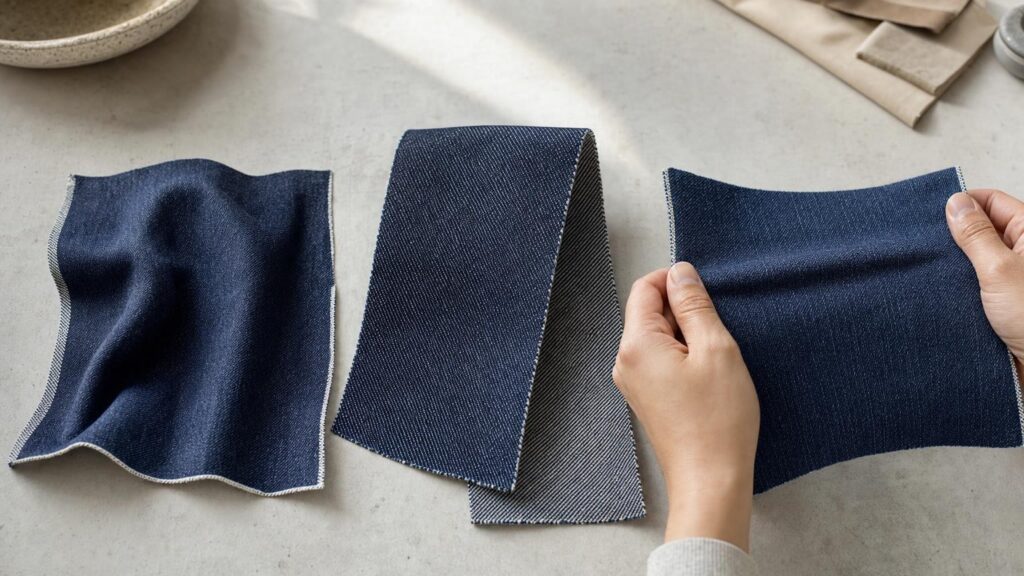
Denim weight is one of the most visible specifications when shopping for jeans, but it is not a simple quality score. A heavier fabric may feel substantial and develop pronounced creases, yet it is not automatically more comfortable, better made or longer-lasting. The behaviour of jeans depends on a system of yarns, weave, fabric density, stretch fibres, finishing, fit and construction.
Understanding these elements helps you anticipate how jeans will feel on the first wear, how closely they will follow the body, how long they may take to soften and how their appearance may change. It also makes it easier to choose for your climate and routine rather than assuming that more ounces or less stretch must be better.
How Denim Construction Creates Its Character
Denim is usually a twill fabric made by interlacing lengthwise warp yarns with crosswise weft yarns. In traditional blue denim, the warp yarns are indigo-dyed while the weft yarns are left pale or undyed. This is why the outside of blue jeans looks predominantly blue while the inside often appears much lighter.
Unlike a plain weave, twill arranges yarn crossings to create diagonal ribs across the surface. These ribs contribute to denim’s familiar texture and can help the fabric combine strength with enough flexibility for clothing. The direction and arrangement of the twill also affect appearance and feel:
- Right-hand twill has diagonal lines rising from lower left to upper right when viewed on the fabric face. It is a common construction and can develop a defined surface character.
- Left-hand twill runs in the opposite direction. Depending on the yarn and finishing, it may feel somewhat softer or have a different visual texture.
- Broken twill alternates direction, interrupting the continuous diagonal. It can produce a more balanced-looking surface and may reduce the tendency for the legs to twist after washing, although construction and finishing also matter.
Yarn characteristics are equally important. Yarn thickness, twist, evenness and fibre length influence texture, drape and resistance to abrasion. Irregular yarns can create a visibly slubby surface, while more uniform yarns tend to produce a smoother appearance. Neither is automatically superior: texture is partly an aesthetic choice, and durability cannot be judged from surface irregularity alone.
What Denim Weight Actually Tells You
Denim weight describes the mass of fabric over a given area, commonly stated in ounces per square yard or grams per square metre. It does not mean that the finished jeans weigh the stated number of ounces. Pockets, hardware, size, cut and seam construction all affect the finished garment’s total weight.
Weight can still provide useful clues about likely behaviour. Lighter denim generally feels more flexible from the start, drapes closer to the body and can be more comfortable in warm conditions. It may form softer folds rather than sharply defined creases. However, its performance depends on weave density and yarn quality, so light does not necessarily mean flimsy.
Mid-weight denim often offers a compromise between structure and ease. It may feel substantial without demanding a lengthy break-in period, making it adaptable to regular, year-round wear in many climates. The category is broad, however, and two fabrics with the same stated weight can feel very different after weaving and finishing.
Heavier denim usually feels denser and stiffer when new. It may hold a structured silhouette, stand slightly away from the body and form strong crease lines at the lap, knees and behind the knees. It can also feel warmer, restrict movement initially and take longer to soften. For shoppers who spend long periods sitting or live in a warm climate, that substantial feel may be a disadvantage rather than a mark of quality.
Weight labels should therefore be treated as directional information, not rigid classifications. Washing, softening treatments, weave density and stretch can make one heavy fabric feel more pliable than another fabric of lower stated weight.
Why Heavier Denim Is Not Automatically More Durable
More material can improve resistance to some forms of wear, but thickness alone does not determine useful life. Durability also depends on the quality and twist of the yarns, how tightly they are woven, how the jeans fit and how seams and stress points are constructed.
A dense, well-balanced lighter fabric may withstand repeated flexing better than a thick fabric made with yarns that abrade or break easily. Conversely, a very stiff heavy denim can concentrate stress at fixed crease lines. If the fabric repeatedly folds in exactly the same place, friction and fibre fatigue can eventually produce thinning or holes along that line.
Fit has a particularly large effect. Jeans that are tight through the thighs, seat or rise experience greater tension when the wearer sits, bends or climbs stairs. Loose fabric can also wear where it repeatedly rubs against itself. Common friction zones include the inner thighs, pocket edges, hems, knees and areas around hard objects carried in pockets.
Garment construction matters as well. Seam type, stitch consistency, reinforcement and the placement of pockets all contribute to longevity. Fabric weight cannot compensate for a seam that is poorly executed or a fit that continually pulls against one area.
Care and wearing habits complete the picture. Frequent high-friction washing, strong heat and tumble drying can change fibres, colour and stretch performance. At the same time, avoiding washing indefinitely is not a universal route to longer life, because accumulated dirt and grit can contribute to abrasion. The practical goal is appropriate cleaning according to the care label, followed by drying methods suited to the fabric.
Rigid, Comfort-Stretch and High-Stretch Denim
Rigid denim usually refers to fabric without an elastic fibre. It is often predominantly or entirely cotton, although the exact composition should always be checked. Rigid jeans can feel firm at first and may require wear before they conform to the body. They are often chosen for a structured silhouette and for visible creasing and fading, but they provide less give during sitting and movement.
Comfort-stretch denim contains a relatively small elastic component or uses another construction designed to provide modest flexibility. It aims to retain much of the look and handle of conventional denim while making everyday movement easier. This can be useful in straight, tapered and moderately close fits where completely rigid fabric would feel restrictive.
High-stretch denim is engineered for greater extension and is commonly used in close-fitting cuts. Its ability to follow the body can improve immediate comfort and mobility, but extension is only half the story. Recovery describes how effectively the fabric returns towards its original dimensions after being stretched.
A larger elastane percentage does not by itself guarantee better recovery. Yarn engineering, fabric construction and finishing all influence whether jeans retain their shape or develop looseness at the knees, seat or waistband. Elastic fibres can also fatigue over time, particularly when repeatedly exposed to high heat. Following the care instructions is therefore especially important for stretch jeans.
Drape, Fit and Sizing in Real Wear
The same labelled cut can feel different in different fabrics. A lightweight or highly stretchable denim tends to follow contours and collapse into softer folds. A dense rigid fabric may stand away from the legs when new, making an otherwise similar pattern feel straighter or more spacious.
Stretch direction matters too. Some denim mainly stretches across the body, while other constructions allow movement in more than one direction. A product description that simply says “stretch” may not explain the degree, direction or recovery of that stretch.
Finishing can further alter the initial fit. Pre-washing and softening can reduce stiffness, while untreated or minimally processed denim may change more noticeably after wear or washing. Do not assume that rigid jeans should automatically be bought uncomfortably tight in the expectation that they will expand perfectly. Stretching and shrinkage vary with fabric, finishing and care, and the waistband, rise and thigh should permit normal movement from the outset.
Break-In, Fading and the Look of Ageing
Break-in is the process by which firm denim softens and begins to reflect the wearer’s movements. Rigid or minimally softened fabrics often develop defined folds at the lap, knees, pockets and behind the knees. Friction removes some surface dye from the raised parts of these folds, creating contrasting wear patterns.
Softer, lighter or stretchier fabrics may crease less sharply and fade more evenly. Factory washing, abrasion or colour treatments can also create an aged appearance before purchase, reducing the visual contrast between new and naturally worn areas.
Fading and damage are related but not identical. Indigo loss changes colour, while broken yarns and thinning fabric indicate structural wear. A visually dramatic crease may eventually become a weak point if it experiences repeated friction, so personalised fading should not be interpreted as proof that the fabric is becoming stronger.
Some colour transfer can occur with dark denim, particularly when it is new. Shrinkage is also possible, but the extent depends on fibre content, finishing and washing conditions. Labels such as pre-washed, rinsed or sanforized can offer context, yet shoppers should still follow the garment’s specific care instructions rather than expecting all denim with the same label to behave identically.
Reading a Jeans Fabric Description Critically
Product descriptions are most useful when their details are read together. A practical review can follow these steps:
- Check the complete fibre composition. Identify cotton, elastane and any other fibres. Remember that composition indicates ingredients, not softness, recovery or overall quality.
- Look for a stated fabric weight. Use it to estimate likely warmth and structure, but do not treat it as a durability rating.
- Assess the stretch wording. Terms such as rigid, comfort stretch and high stretch are helpful categories, but they are not perfectly standardised. Look for information about recovery or stretch direction where available.
- Read the finishing language. Raw, rinsed, pre-washed, garment-dyed, softened and distressed fabrics can have different starting textures and ageing patterns. These terms still do not predict every change after washing.
- Consider the cut alongside the cloth. A close cut in firm denim may feel more restrictive than the same nominal size in stretch denim. Compare the rise, thigh and leg measurements where they are supplied.
- Review the care instructions. They provide a better guide to washing and drying than general denim rules, especially when elastic fibres or special finishes are present.
Be cautious about drawing broad conclusions from a single percentage or technical term. Two fabrics with identical fibre compositions and similar weights can differ because of yarn design, weave density, dyeing, finishing and garment construction.
Choosing the Right Balance for How You Wear Jeans
Start with your routine rather than a hierarchy of fabric specifications. For warm weather, travel or frequent movement, lighter or moderately stretchy denim may offer better comfort. If you spend much of the day sitting, check that the rise and thighs allow movement without excessive pulling.
For a crisp, structured silhouette, denser rigid denim may be appealing, provided you are comfortable with initial stiffness. If you prefer a close fit, stretch and good recovery may matter more than high fabric weight. For low-maintenance daily wear, a pre-washed fabric with moderate structure may be easier to manage than denim that demands a deliberate break-in process.
Shoppers interested in personalised fading may favour rigid or minimally processed denim, while those who want a consistent appearance may prefer a softer, pre-finished fabric. Neither choice is inherently more authentic or better. The right option is the one whose comfort, appearance and care requirements suit how you will actually wear it.
Conclusion: Judge Denim as a System
Denim weight can suggest warmth, stiffness and drape, but it cannot independently predict quality or lifespan. Yarn properties, twill construction, weave density, stretch, recovery, fit, seams, finishing and care all interact.
When comparing jeans, focus on four practical questions: how comfortable should they feel initially, how much structure do you want, how should they age, and how much care are you willing to give them? Judging denim as a complete system leads to a more useful choice than simply selecting the heaviest fabric or the lowest elastane percentage.
Continue exploring on Frowse
Discover More Frowse Insights
- How Backhaul Determines Mesh Wi-Fi Performance
- What Pouch Thickness, Roller Design and Temperature Change in a Laminator
- Single-Coil, Humbucker and Active Pickups: How the Hardware Shapes the Signal
- Why a Desk Lamp’s Lumen Rating Does Not Reveal How Well It Lights a Work Surface
- Foil vs Rotary Electric Shavers: How the Cutting Mechanism Changes the Shave