





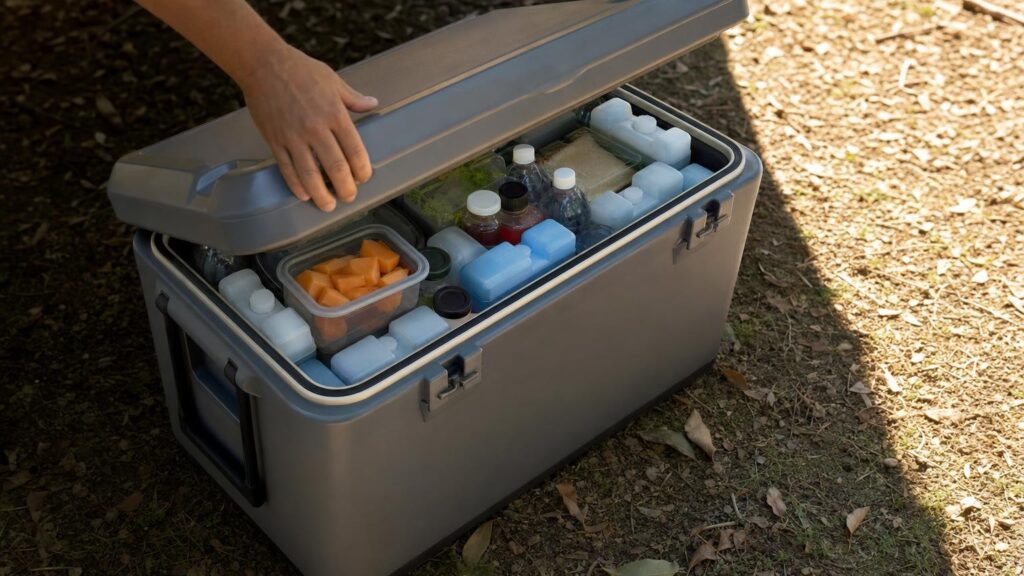
A passive cool box does not create cold. It slows the movement of heat from the surroundings into chilled food, drinks, ice or freezer packs. How long it remains usefully cold therefore depends on a complete system: the construction of the box, the amount of stored cold inside it and the way it is packed and used.
This is why one specification cannot reliably predict performance. Thick walls may be undermined by a poorly sealed lid, while an efficiently designed box may warm quickly if it is placed in direct sun and opened frequently. Headline ice-retention claims can be informative, but only when the test conditions resemble the way you expect to use the box.
How heat gets into a passive cool box
Heat enters a cool box through several routes. Understanding them makes it easier to assess construction details and compare designs.
- Conduction through the body: Heat gradually moves through the lid, walls and base. Insulation slows this transfer but cannot stop it completely.
- Air leakage: Gaps around the lid allow warmer outside air to enter and cold internal air to escape. Wind and movement can make leakage more significant.
- Thermal bridges: Hinges, fasteners, handles, drains, seams and areas with little insulation may provide easier paths for heat to cross the structure.
- Lid opening: Every opening exposes the contents to warm air. Searching through the box with the lid raised also allows heat to reach food, drinks and cooling media directly.
These routes interact. Excellent wall insulation cannot fully compensate for frequent opening, and a tight seal cannot overcome a body with substantial gaps in its insulation.
Insulation type and thickness: what each can and cannot tell you
Insulation contains pockets of gas and restricts heat flow. In otherwise comparable designs, a thicker, continuous layer generally gives heat a longer and more difficult route into the box. However, thickness is only part of the picture.
Different insulating materials and structures transfer heat at different rates. Density, cell structure, manufacturing consistency and the presence of voids can all affect the finished result. Insulation also needs to cover the box evenly. A thick section in the centre of a wall provides limited reassurance if corners, the lid or fittings contain much less.
Be careful when interpreting a quoted wall thickness. It may describe the entire wall, including the hard outer shell and internal liner, rather than the actual insulating layer. Curves, recesses and moulded features can also make the insulation thinner in some areas than others.
Thicker construction introduces practical trade-offs. It can increase external dimensions and weight while reducing internal capacity. If storage space, car-boot room or portability is limited, the largest and thickest box may not be the most useful choice. Look for a sensible balance between insulation, usable space and the distance you need to carry it.
Wall geometry, corners and thermal bridges
A cool box is not made from flat insulated panels alone. Its corners, rim, base, hinges and fittings complicate the path of heat. Corners can be difficult to insulate evenly, while seams or changes in material may create locally weaker areas.
A thermal bridge is a relatively conductive route across an insulated structure. Metal fasteners are an obvious example, but moulded recesses, attachment points and reduced-insulation areas can also act as bridges. Their importance depends on their material, size and connection to the inner and outer surfaces. The presence of a fitting does not automatically indicate poor performance, but numerous interruptions can make nominal wall thickness less representative.
Some interruptions have clear practical value. A drain can make it much easier to remove water from a large, heavy box, and robust hinges may improve durability and lid alignment. The relevant question is not whether a box has fittings, but whether they appear thoughtfully integrated without creating unnecessary weak points.
The lid and seal: controlling warm-air exchange
The lid is often a vulnerable part of a cool box because it must move, align with the body and form a repeatable seal. It may also have a different internal construction from the walls. An insulated lid slows conduction through its surface, but that does not necessarily mean it seals effectively around its edge.
A gasket can help close small gaps between the lid and rim. Its performance depends on alignment, contact around the full perimeter and enough closure pressure to compress it consistently. A rigid lid and rim can support an even seal, whereas distortion may leave local gaps. Latches can help maintain pressure, although their presence alone does not prove that the seal is airtight.
Sealing can deteriorate in use. Sand, crumbs and other debris may prevent full contact, while wear or warping can create gaps over time. When comparing boxes, examine the lid construction, rim and closure as a system. Check whether the lid sits evenly, whether the gasket appears continuous and whether the closure feels secure without being awkward to operate.
Capacity, shape and the usable-space trade-off
Capacity affects both convenience and thermal behaviour. A larger box can hold more ice and chilled contents, increasing its potential thermal mass. However, it also has more surface through which heat can enter and becomes inefficient if much of the interior is left empty.
Shape matters because heat gain occurs through surface area. Compact shapes tend to enclose a given volume with less surface than long, narrow or highly sculpted shapes. Real products must also accommodate handles, wheels and practical storage dimensions, so thermal efficiency is only one design consideration.
Choose capacity around the amount you normally carry rather than occasional maximum demand. A partly empty oversized box adds external bulk without gaining the full benefit of its capacity. It may also require more cooling media to fill effectively. Conversely, an overfilled box that cannot close cleanly compromises the lid seal and can be difficult to organise.
Published capacity may not reveal how usable the space feels. Thick walls, wheel housings, sloping sides and internal ledges can affect what fits. Consider the dimensions and shapes of your usual containers as well as the nominal volume.
Thermal mass, ice ratio and packing strategy
The contents of a cool box provide its stored cold. Ice, freezer packs and already chilled food or drink can absorb incoming heat before the internal temperature rises substantially. Warm products do the opposite: they place an immediate heat load on the system.
Pre-cooling the empty box and chilling its contents before packing reduce the amount of stored cooling needed to bring everything down to temperature. This can be particularly valuable if the box has been kept in a warm shed, garage or vehicle.
Block ice, loose ice and reusable packs
Large blocks of ice expose less surface area for their mass and generally melt more slowly than the same quantity divided into small pieces. Loose ice can fit around irregular items and offers broad contact, which can help cool them quickly, but its greater exposed surface can also make it melt faster.
Reusable freezer packs are contained and convenient, avoid free meltwater and can be positioned around sensitive contents. Their performance depends on their size, composition and starting temperature, so packs should not be treated as interchangeable solely because their external dimensions look similar.
No format is universally best. Blocks suit slower cooling over longer periods, loose ice fills gaps effectively, and packs simplify handling. A combination may provide useful coverage and thermal mass.
Pack to reduce heat exposure
- Start with cold contents rather than asking the ice to cool room-temperature items.
- Use enough cooling media for the conditions and duration, while preserving the capacity needed for the contents.
- Reduce unused air space where practical, because a well-filled box usually has more cold thermal mass than a mostly empty one.
- Place frequently needed items near the top or in an easy-to-reach area.
- Group food and drinks by when they will be used so the lid can be closed quickly.
- Keep cooling media distributed rather than concentrating all of it in one distant corner.
Real-world use can outweigh small construction differences
Ambient conditions have a major effect on cooling duration. A box in direct sunlight or on a hot surface receives more heat than one kept in shade with air circulating around it. A closed vehicle can also become much warmer than the surrounding outdoor air.
Opening behaviour matters just as much. A box opened briefly a few times faces a different challenge from one used continuously for drinks. If frequent access is unavoidable, organisation becomes especially important. A separate box for regularly accessed drinks can also protect food stored for later, although this adds cost and carrying bulk.
Adding warm cans, bottles or food partway through a trip consumes stored cooling capacity. If possible, chill replacements before adding them. Avoid placing a passive box beside heat-producing equipment or leaving it open while deciding what to take.
Meltwater creates a context-dependent choice. Cold water can remain part of the thermal mass and maintain close contact with sealed items. Draining it reduces carrying weight and may help with cleanliness or keeping packaging dry, but it also removes cold mass. The right approach depends on the contents, how securely they are sealed and whether water contact is acceptable. Food should be packed to prevent contamination and unwanted water exposure rather than relying on the cool box interior as a clean barrier.
How to interpret ice-retention claims
An ice-retention figure is not a universal promise. Results depend on the test temperature, initial temperature of the box and contents, amount and form of ice, fill level, opening schedule and exposure to sunlight. Even the endpoint can vary.
For example, a test might end when the last visible piece of ice disappears. That does not tell you how long particular food or drinks remained within a desired temperature range. Conversely, mostly melted ice can still leave very cold water in the box. Ice remaining and contents maintained at a chosen temperature are related but different measures.
Compare retention claims only when the methods are sufficiently disclosed and broadly alike. Useful details include:
- the surrounding temperature and whether it was constant;
- whether the box and contents were pre-chilled;
- the quantity and form of ice used;
- how full the box was;
- whether the lid was opened during the test;
- whether the box was exposed to sun; and
- how the endpoint was defined.
When those details are missing, treat the number as a broad indication rather than a reliable forecast for your trip. Real use may be more demanding than a closed-box test, especially in hot conditions or when several people access the contents throughout the day.
Choose around the weakest link and intended use
No isolated feature guarantees how long a cool box will stay cold. Insulation needs to be sufficiently thick and consistently distributed, but the lid must also be insulated, aligned and sealed. Capacity should accommodate enough cooling media without creating unnecessary empty space or excessive external bulk. Handles, drains and wheels can improve usability, but their integration into the insulated structure also matters.
Match the design to your likely trip length, climate, contents and access pattern. Short outings may place more value on light weight and convenient carrying. Longer, hotter trips make insulation continuity, sealing and disciplined packing more important. Frequent-access use calls for an organised interior and a lid that is easy to close securely.
Finally, remember that buying the box is only half of the system. Pre-cooling, starting with chilled contents, using adequate thermal mass, providing shade and limiting lid-open time can have a substantial effect. The most suitable cool box is one whose construction and capacity work with the way you will actually pack, carry and use it.
Continue exploring on Frowse
Discover More Frowse Insights
- Why Stainless-Steel Cutlery Can Still Rust, Stain and Bend
- Roller Skate Wheels Explained: Diameter, Hardness, Profile and Hubs
- Why Baking Trays Warp in the Oven and Sometimes Flatten Again
- What Pouch Thickness, Roller Design and Temperature Change in a Laminator
- What the Tilt Mechanism Under an Office Chair Actually Changes