





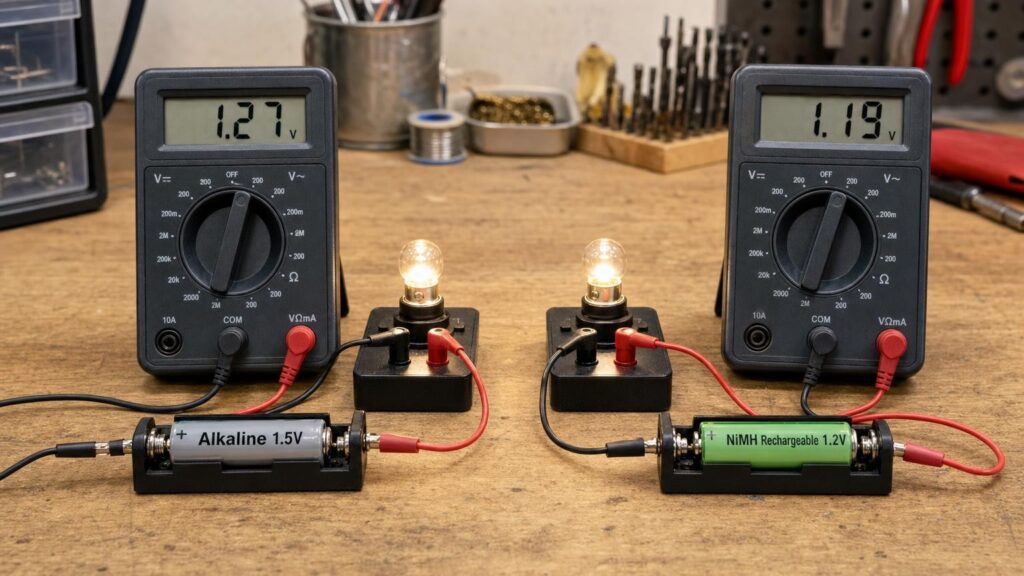
A rechargeable nickel-metal hydride (NiMH) AA battery is usually labelled 1.2 volts, while a disposable alkaline AA is labelled 1.5 volts. That difference can make the rechargeable cell look like a weaker substitute, but the numbers are nominal voltage ratings rather than a complete measure of performance.
Voltage changes as a battery is charged and discharged, and the pattern depends on its chemistry. A device’s current demand, low-battery threshold and number of cells can all be more important than the label. Understanding these factors makes it easier to decide whether NiMH batteries are a good match for a particular device.
Nominal voltage versus the voltage a device actually receives
Nominal voltage is a convenient reference value associated with a battery chemistry. It is not a promise that the cell will deliver exactly that voltage throughout its useful charge.
A freshly charged NiMH cell begins above its 1.2V nominal rating. Its voltage then settles to a relatively stable level for much of the discharge cycle before dropping more sharply near empty. This comparatively flat discharge curve is one reason a 1.2V NiMH battery can work well in equipment commonly powered by AA cells.
An alkaline AA also varies from its 1.5V label. It may begin above that nominal figure when fresh, but its voltage generally declines more steadily as it is used. Consequently, a partly discharged alkaline battery may be supplying a voltage similar to, or lower than, that of a charged NiMH cell.
The two label values therefore cannot be treated as fixed outputs. A device receives a changing voltage that is influenced by the battery chemistry, remaining charge, current draw, temperature and internal resistance.
Why current demand can matter more than the label
When a device draws current, battery voltage can fall temporarily under the load. This effect is called voltage sag. How pronounced it is depends partly on the cell’s internal resistance and the amount of current being requested.
NiMH cells can often sustain demanding loads effectively. In devices such as motorised toys, camera flashes and frequently used torches, their relatively steady loaded voltage may be more useful than the higher initial no-load voltage of an alkaline cell. An alkaline battery can show a respectable voltage when measured without a substantial load yet fall more noticeably while powering a demanding device.
This does not mean NiMH is automatically the best choice for every application. Low-drain equipment such as a basic wall clock or remote control may operate for long periods on disposable alkaline batteries. In those uses, rechargeability may be less valuable if the batteries are replaced only rarely, while charge retention during long idle periods becomes especially important.
Think about the job the cell performs, not simply which label has the larger number. Devices that draw short, powerful bursts or run motors and bright lamps present different requirements from equipment sipping a small current over many months.
When the lower voltage causes compatibility problems
Many AA-powered products can use NiMH cells successfully, but compatibility is not universal. Some electronics are designed around the discharge behaviour of alkaline batteries and may respond poorly to the lower, flatter operating voltage of NiMH.
Strict low-battery thresholds
A device may stop operating when its supply falls below a predetermined voltage. If that threshold is relatively high, it can interpret a healthy NiMH battery as partly depleted or unsuitable. Possible symptoms include an early low-battery warning, reduced performance or refusal to start.
Misleading battery indicators
A battery-level display calibrated for the gradually declining voltage of alkaline cells may not estimate NiMH charge accurately. It might show less than full soon after installation, remain at one level for a long time or drop quickly near the end. This does not necessarily indicate a defective battery; the gauge may simply be using the wrong voltage profile.
Several cells connected in series
Devices often use two, three or four cells in series, adding their voltages together. The nominal difference between 1.2V and 1.5V is then multiplied across the battery pack. Equipment with a narrow acceptable input range may be more sensitive to that combined difference.
Other products regulate their internal voltage and tolerate a wider input range. Because the design is not obvious from the battery compartment, checking the manual or manufacturer’s guidance is preferable when reliable operation matters. This is particularly important for specialised, safety-related or costly equipment.
Capacity ratings: what the mAh number does and does not tell you
Rechargeable AA packaging commonly displays capacity in milliamp-hours (mAh). This measures how much electric charge a battery can deliver under stated test conditions. It does not directly state voltage, instantaneous power or guaranteed runtime in every device.
Runtime depends on the device’s current demand, its cut-off voltage, the battery’s discharge characteristics and environmental conditions. Two cells with the same mAh rating may therefore produce different practical results if their voltage under load or ability to retain charge differs.
Capacity comparisons are most meaningful between batteries of the same physical size and chemistry. A mAh figure alone is not suitable for comparing batteries with different nominal voltages, because the amount of stored energy also depends on voltage.
The highest advertised capacity is not always the most practical choice. A cell optimised for maximum initial capacity may lose charge faster while sitting unused, or it may offer a different balance of cycle life and storage performance. The better option is the one whose characteristics match the device’s usage pattern.
Low-self-discharge versus maximum-capacity NiMH cells
All rechargeable batteries gradually lose some stored charge while idle. This is known as self-discharge. Low-self-discharge NiMH cells are designed to retain their charge better during storage than traditional high-capacity NiMH designs, although actual retention varies with the battery, age, storage conditions and temperature.
This creates a useful shopping distinction:
- Low-self-discharge cells are generally well suited to devices used intermittently, such as remote controls, emergency torches and occasional accessories. They are also convenient when batteries are charged in advance and kept ready.
- Higher-capacity cells may suit equipment used intensively soon after charging, such as frequently operated toys or photographic accessories. Their extra rated capacity can be useful when idle storage is not the main concern.
The distinction is not absolute, and products can balance these qualities differently. Nevertheless, it helps explain why choosing purely by the largest mAh number may disappoint. A battery that begins with a little less capacity but remains charged in a drawer can be more dependable for occasional use.
Choosing NiMH batteries by the way the device is used
A practical decision can be made by considering five questions:
- How much current does the device draw? NiMH is often appealing for high-drain or frequently used equipment because it can sustain load well and be recharged repeatedly.
- How often is the device used? Regular use makes rechargeable batteries easier to justify. For equipment that sits idle, low-self-discharge performance deserves greater attention.
- Is the device sensitive to voltage? Early warnings, weak output or failure to start with known-charged NiMH cells can indicate a high cut-off threshold or another compatibility issue.
- How many cells does it require? The more cells connected in series, the greater the difference between the nominal pack voltages of alkaline and NiMH batteries.
- How important is dependable readiness? For equipment that must work immediately after long storage, follow the manufacturer’s battery advice and consider both shelf readiness and maintenance requirements.
It can be sensible to test a set of NiMH cells in an ordinary device before committing to several sets, provided the device permits their use. If its instructions specify a particular chemistry or warn against rechargeable cells, follow that guidance.
How NiMH chargers know when charging is complete
A suitable charger must replenish the cell without continuing a high charging current after it is full. NiMH charging is more complex than stopping at a simple fixed voltage, so chargers may use several signals and safeguards.
During charging, cell voltage rises. Near full charge, it reaches a peak and can then show a small change. Many chargers look for this behaviour to terminate or reduce charging. More capable designs may also monitor temperature, the rate of temperature change or elapsed charging time. Backup time and temperature limits can provide additional protection if the primary signal is unclear.
Detecting a full cell can become harder at very low charging currents because the voltage change near full charge is less distinct. A charger should therefore be designed so that its termination method suits its charging rate rather than relying on an improvised timer.
Independent charging channels are another useful feature. They allow the charger to assess each cell separately. Chargers that treat two cells as a pair may stop based on their combined behaviour, even if one cell reaches full charge before the other. Individual channels are particularly helpful when cells have developed small differences in capacity or remaining charge.
Charger compatibility and habits that protect performance
Use a charger explicitly intended for NiMH batteries and the relevant cell size. Battery chemistries require different charging methods. A charger designed for alkaline rechargeables, lithium-ion cells or another system should not be assumed suitable merely because a battery appears to fit.
Good ownership habits also make performance more predictable:
- Keep cells that power a multi-cell device together as a set, especially when they are similar in age, capacity and usage history.
- Do not mix battery chemistries, such as alkaline and NiMH, in the same device.
- Avoid mixing fully charged cells with depleted ones. The weakest cell can limit the entire set.
- Keep battery and charger contacts clean and dry, following the equipment instructions.
- Remove batteries from devices that will be stored for extended periods, particularly where the manufacturer recommends doing so.
- Stop using cells that are damaged, leaking, unusually hot or otherwise abnormal, and follow local guidance for safe disposal or recycling.
- Recycle spent rechargeable batteries through an appropriate collection scheme rather than placing them in general waste where local rules prohibit it.
A quality charger is part of the buying decision, not an afterthought. Clear status indicators, independent channels and appropriate charge-termination controls can make a rechargeable system easier to manage and reduce guesswork.
Judge the battery-device pairing, not 1.2V in isolation
A 1.2V NiMH AA battery is not simply a weaker version of a 1.5V alkaline cell. The ratings describe different chemistries with different discharge curves. NiMH voltage remains comparatively steady through much of a charge and can hold up effectively under demanding loads, while alkaline batteries start at a higher voltage that generally declines more continuously.
The lower nominal voltage matters most when equipment has a strict cut-off threshold, an alkaline-calibrated battery gauge or several cells connected in series. Capacity, self-discharge, usage frequency and charger design also affect whether a rechargeable set will be convenient.
Rather than choosing by voltage or the largest mAh figure alone, match the battery to the device and the way it is used. For uncertain or critical applications, the device manufacturer’s guidance should be the deciding reference.
Continue exploring on Frowse
Discover More Frowse Insights
- Pressurised and Traditional Espresso Baskets Do Different Jobs
- What “Solid Top” Really Means on an Acoustic Guitar
- Why Identical-Looking Concealed Cabinet Hinges May Not Be Interchangeable
- Where Ink Goes When an Inkjet Printer Is Not Printing Pages
- Why a Wireless Charger’s Wattage Is Not Its Charging Speed