





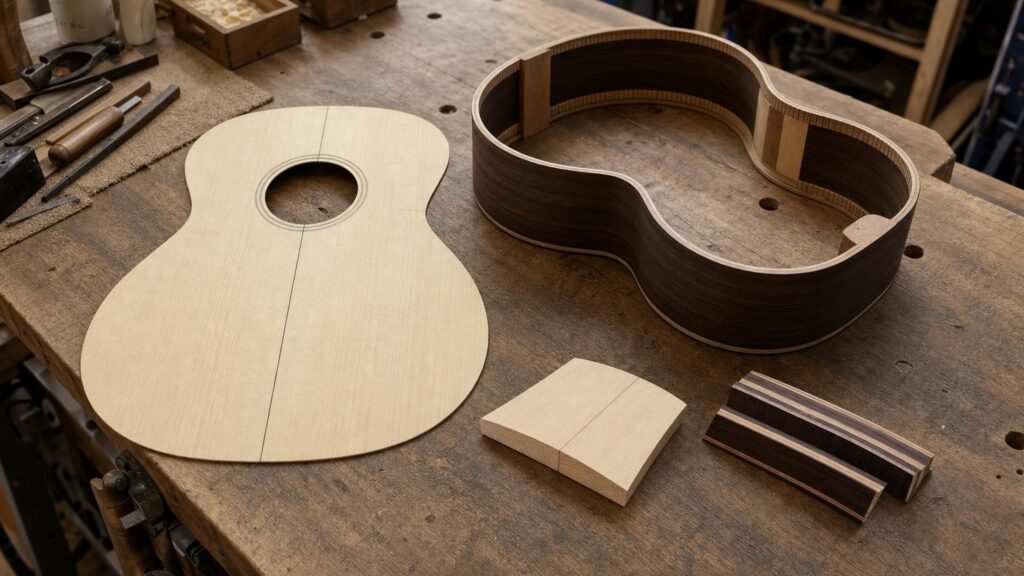
“Solid top” is one of the most prominent phrases used to describe an acoustic guitar, but it is also easy to misunderstand. It identifies how the soundboard is made, not necessarily how the rest of the body is constructed. It also says nothing definite about the guitar’s bracing, setup, workmanship or suitability for a particular player.
Understanding the term can help you compare guitars more sensibly. A solid top may offer desirable acoustic characteristics, but the label should be considered alongside the instrument’s complete construction, current sound, playing feel and likely working environment.
“Solid top” describes one part of the guitar, not the whole instrument
The top is the large front surface of an acoustic guitar’s body. It supports the bridge, contains the soundhole on most conventional designs and acts as the primary soundboard. A “solid-top” guitar has a top made from wood that is solid through its thickness rather than assembled from multiple bonded layers.
Solid does not necessarily mean that the entire top is cut from one uninterrupted slab. Many soundboards are formed from two pieces of solid wood joined along the centre line. Each piece is still solid through its thickness.
The back and sides of a solid-top guitar may be laminated. This combination is common because it places solid wood in the acoustically important soundboard while using more stable and economical materials elsewhere. Product descriptions should therefore be read literally:
- Solid top refers only to the soundboard unless other parts are specifically identified.
- Solid spruce top names both the top construction and the stated wood species.
- Solid top and solid back does not automatically mean that the sides are solid.
- All-solid normally indicates solid wood for the top, back and sides.
Wording such as “spruce guitar” or “mahogany body” can be less informative. It may describe appearance, a surface layer or a broad material specification without clearly identifying which sections are solid.
Solid wood, laminate and veneer: what the terms actually mean
Solid wood is natural timber throughout its thickness. Its grain structure continues through the material, although the visible pattern can differ between the inner and outer faces.
Laminate is made by bonding multiple thin layers together. The layers may use the same wood or different materials, and their grain directions may differ. This layered construction can increase dimensional stability and make efficient use of decorative woods.
A veneer is a thin surface layer of wood. It can be applied over a laminated or otherwise layered core to provide the visible grain and colour of a particular species. Veneer is not automatically a sign of poor construction. It is simply a surface treatment and does not make the underlying panel solid wood.
Appearance alone is an unreliable guide. A laminate can carry a convincing natural-wood veneer, while finishes, binding and internal components may hide the edge of the material. Even visible grain around the soundhole can be difficult to interpret without experience. Clear manufacturer specifications are usually more useful than trying to identify construction from photographs.
Terminology is not always presented consistently, particularly in abbreviated marketplace listings. If a description names a wood but does not say “solid”, it is safer not to assume solid construction. Look for separate specifications for the top, back and sides.
Why the soundboard matters more than its share of the guitar
Plucked strings do not move enough air on their own to produce the familiar volume of an acoustic guitar. Their energy travels through the saddle and bridge into the top. The top vibrates over a much larger area, moving air both outside and inside the body.
This makes the soundboard especially influential. Its stiffness, mass, thickness and ability to respond to changing string energy affect projection, attack, sustain and dynamic behaviour. A top must be light enough to respond but strong enough to withstand continuous string tension.
Solid wood can offer a useful balance of stiffness and low mass when it is selected and worked appropriately. That potential helps explain why solid tops are valued. However, the word “solid” does not reveal the quality of the timber, how it was dried, how thick it is or how effectively the complete structure has been designed.
The top is also not the sole source of a guitar’s voice. Body size and shape, scale length, bridge, bracing, back and sides, internal air volume, strings and setup all contribute. Two solid-top guitars can consequently sound and feel very different.
Bracing and build quality can outweigh the label
The underside of an acoustic guitar top is reinforced by braces. These resist string tension while controlling how different areas of the soundboard vibrate. Bracing patterns, dimensions and shaping vary between designs, and small construction choices can substantially affect the balance between strength and responsiveness.
A heavily built solid top may be durable but comparatively reluctant to vibrate. A lighter structure may feel more responsive, but it still needs enough strength for long-term stability. Bridge weight, glue joints, top thickness and the consistency of assembly matter as well.
For this reason, “solid” should be treated as a material fact rather than a certificate of tonal quality. A well-designed laminate-top guitar can be more balanced, comfortable or musically satisfying than a poorly executed solid-top model. Build consistency and setup are particularly important when comparing instruments at similar prices.
How the back and sides contribute
The back and sides create the body enclosure and interact with the air moving inside it. Compared with the soundboard, the sides generally have a more structural role, while the back may combine structural, reflective and vibrational functions depending on the design.
Solid back and sides can contribute their own resonant character, but their effect cannot be isolated neatly from the rest of the instrument. Laminated back and sides are often stiffer and more dimensionally stable. They can provide a robust body structure while allowing the solid top to do much of the active acoustic work.
This makes a solid top with laminated back and sides a practical middle ground. It can provide some of the responsiveness associated with a solid soundboard without the cost and climate sensitivity of an all-solid body. An all-solid guitar may offer additional acoustic possibilities, but those possibilities depend on skilled design and construction rather than the materials alone.
Tone at purchase and the possibility of tonal development
Solid tops are often associated with greater responsiveness, harmonic complexity and a wider dynamic range. In practical terms, a responsive guitar may react clearly to both a light touch and stronger playing rather than compressing everything into a similar volume and character.
These are tendencies, not guarantees. Wood species, individual pieces of timber and complete guitar designs vary. A laminate top may produce a direct, consistent sound that suits accompaniment, recording or casual use, while a solid top may not suit a player’s preferred style simply because its tonal balance is different.
Solid tops are also said to develop tonally as they age and are played. Changes in wood, finish and structure may affect an instrument over time, but the scale and desirability of any change are variable. It is difficult to separate ageing from changes in strings, setup, humidity and the player’s own technique.
Do not buy a guitar you dislike today on the assumption that it will transform later. Tonal development is better regarded as a possible long-term characteristic, not a remedy for poor balance, uncomfortable action or an unsuitable neck.
Durability, humidity and everyday ownership
Wood absorbs and releases moisture as surrounding conditions change. Solid panels can therefore expand and contract across the grain. Excessively dry conditions may contribute to shrinkage, cracking, sharp fret ends, altered action or changes in the top’s shape. Excess moisture can encourage swelling, a higher action and structural distortion.
Laminate is generally more dimensionally stable because its bonded layers resist movement in any one direction. That does not make a laminated guitar immune to heat, moisture, impact or poor storage, but it can make the body more tolerant of changing environments.
Think about how the guitar will live. Regular travel, seasonal heating, air conditioning, storage near external walls or long periods in a vehicle can expose it to significant changes. A solid-top guitar benefits from sensible storage, gradual temperature adjustment and appropriate humidity management where conditions are persistently dry or damp.
The aim is a stable environment rather than constant intervention. A protective case can slow rapid changes, while a reliable humidity reading is more useful than guessing. Any humidifying product should be used according to its instructions because excessive moisture can also cause problems.
Repairability, longevity and value
A solid top can crack along the grain, and an experienced repairer may be able to close and reinforce the damage if it is addressed appropriately. Loose braces, bridge lifting and structural distortion can occur with either solid or laminated construction and vary greatly in seriousness.
Damage to laminate can behave differently. A strong layered panel may resist some cracking, but separation between layers can be complicated to repair, especially if moisture has spread through a wide area. Decorative veneer damage may also be difficult to disguise even when the underlying structure remains sound.
Repairability depends on the location and extent of damage, access to the affected area, finish type and the instrument’s construction. It is unwise to assume that every solid guitar is easy to restore or that every laminate guitar is disposable.
Solid wood generally adds material-selection and manufacturing demands, so solid-top and all-solid instruments often cost more. Yet value depends on use. A resilient laminate guitar that is played frequently may offer better value than a more delicate instrument that its owner is reluctant to take anywhere. Equally, a carefully made solid-top guitar may justify its cost for a player who values touch sensitivity and acoustic nuance.
How to judge a “solid top” guitar before buying
Start with the exact specification rather than the headline. Confirm which parts are solid and which are laminated, and ask for clarification when the wording only names a species. Then consider the guitar as a complete instrument:
- Intended use: Decide whether it will stay in a controlled home environment, travel regularly, be used on stage or serve as a general practice instrument.
- Sound: Listen for an even response, useful volume and a tonal balance that suits your playing rather than trying to hear whether the top is “solid”.
- Playing feel: Check neck shape, string height, body size and overall comfort. A construction upgrade does not compensate for a poor physical fit.
- Setup: High or uneven action can obscure an otherwise good instrument. Establish whether an issue is adjustable or a sign of structural movement.
- Build consistency: Inspect joints, bridge seating, finish, fretwork and the top for obvious distortion. When possible, compare more than one example.
- Ownership demands: Be realistic about climate control, storage and maintenance.
If buying online, prioritise precise material descriptions, clear photographs and a practical returns process. Avoid treating prestige wording as a substitute for complete specifications.
Choose the construction that suits how the guitar will live
A solid-top acoustic guitar can be an appealing choice for players who value responsiveness and are prepared to provide reasonable environmental care. A laminate-top instrument may be preferable when resilience, consistency and straightforward ownership matter more. Solid tops with laminated back and sides occupy a useful middle position, while all-solid construction is most worthwhile when its sound, feel and ownership requirements genuinely suit the buyer.
The best choice is not the guitar with the most impressive material label. It is the one that sounds good now, feels comfortable, is built consistently and fits the conditions in which it will actually be played and stored.
Continue exploring on Frowse
Discover More Frowse Insights
- Digital Piano Actions Explained: Weighted Keys, Hammers and Sensors
- Bicycle Tyre Sizes Explained: The Numbers That Determine Rim Fit
- Why Garden Hoses Lose Flow and Why Their Connectors Do Not Always Fit
- Why Scissors Stop Cutting Even When the Blades Still Feel Sharp
- Why Matt, Eggshell, Satin and Gloss Paint Labels Are Not Universal