





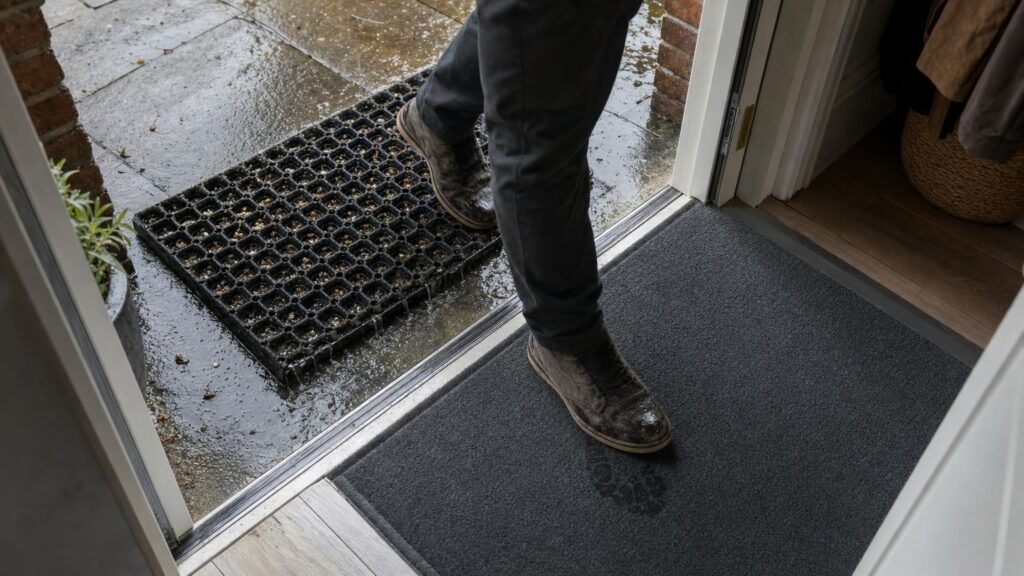
A doormat may be expected to remove grit, soak up rain and cope with standing water, but these are three different jobs. Coarse surfaces tend to scrape effectively, dense textile piles can absorb moisture, and open or channelled constructions help water escape. A mat designed around one task may be much less capable at another.
Choosing well therefore starts with the entrance rather than the material name. Consider what people bring in on their footwear, how exposed the doorway is, where water can go and how much clearance the door provides. These factors reveal why apparently similar mats can behave very differently in everyday use.
Why one doormat cannot do every job
The first task is scraping: loosening grit, dried mud and other debris from the tread of a shoe. This usually requires stiff fibres, raised ridges or a textured surface that resists the movement of the sole.
The second is absorbing: taking moisture from wet footwear and holding it until the mat dries. Soft, dense piles generally provide more contact with the sole and more space in which moisture can be retained.
The third is draining: moving rainwater or melted snow away from the standing surface. Holes, channels and open constructions can help, but only if the water has somewhere to go beneath or around the mat.
These functions can conflict. A thick absorbent mat may become saturated outdoors, while an open rubber mat can drain freely but take up very little moisture. A stiff scraper may remove large particles yet leave a film of water on smooth soles. In demanding entrances, two mats with different roles can be more effective than expecting one construction to handle everything.
Scraping, absorbing and draining: the mechanisms explained
How scraping works
Scraping depends on contact and resistance. Bristles, coarse fibres or moulded projections reach across the sole and disturb material caught in its tread. A firmer texture usually dislodges coarse debris more readily, although it may make less contact with flat or lightly treaded footwear.
Surface texture alone does not guarantee useful scraping. Widely spaced ridges may leave parts of a sole untouched, while fibres that flatten underfoot can lose their initial bite. The mat must also remain reasonably stable; one that moves with each step provides less resistance.
How absorption works
An absorbent mat uses fibres and the spaces between them to take up and retain moisture. Pile density, depth and fibre form all affect how much of the shoe contacts the surface. Fine, dense piles can also collect smaller particles that a coarse scraper misses.
Absorption is temporary storage, not disposal. Once the pile is saturated, it cannot continue taking up water effectively and may transfer dampness back to footwear. Drying conditions and cleaning routines are therefore part of performance rather than merely aftercare.
How drainage works
A draining mat gives water a route through or away from its walking surface. Perforations, an open grid, grooves or raised sections may all contribute. However, drainage holes positioned over a flat, non-draining floor can simply move water underneath the mat, where it remains trapped.
Effective drainage depends on the whole setting: the mat’s design, the slope and permeability of the surface below it, and whether dirt or leaves are blocking the openings. Raised edges can contain some water, but they can also create shallow reservoirs if there is no outlet.
How coir handles dry dirt and damp conditions
Coir is made from coarse coconut fibres, and its naturally stiff texture makes it particularly suited to scraping dry soil, sand and dried mud. A dense coir surface offers many points of contact, while a deeper pile can hold loosened particles below the top until the mat is shaken or cleaned.
Some fibre shedding is characteristic of coir, especially when it is new or exposed to vigorous foot traffic. Over time, repeated compression can flatten the pile and reduce its ability to reach into footwear tread. Dirt held deep in the fibres may also make the surface feel less effective.
Coir can handle the damp brought in on shoes, but prolonged exposure to rain is a different challenge. Persistent wetting can make drying slow and may affect the fibres, backing or overall shape, depending on the construction. A sheltered porch or covered threshold is generally a more suitable setting than a position exposed continuously to heavy weather.
Backing deserves attention. Coir may be sold with different base constructions, and the fibre on top does not reveal how the entire mat will react to moisture. Care instructions and stated placement guidance should take priority over assumptions based on appearance.
Rubber: grip, scraping and water management
Rubber is not absorbent in the way a textile pile is, but it tolerates contact with water and can be moulded into useful scraping and drainage patterns. Ridges, knobs and flexible projections can disturb mud and grit, while an open grid allows debris and water to fall below the standing surface.
Different rubber constructions behave differently. A largely solid mat may protect the floor immediately beneath it, but recessed patterns can collect water and dirt. An open mat drains through its holes, yet the water then reaches the surface below. If that surface is level and impermeable, moisture may remain underneath.
Rubber mats can feel secure because their weight and surface friction resist movement, but no material should be assumed to be universally non-slip. Dust, grease, water, floor finish, temperature and mat design can all alter grip. The mat should lie flat, and its underside and the floor beneath it need periodic cleaning.
For exposed entrances, rubber can be practical where the priority is scraping and water resistance rather than moisture absorption. Mud that accumulates in channels or openings still has to be removed, otherwise the texture and drainage routes become less effective.
Polypropylene: construction matters as much as fibre
Polypropylene appears in many forms, including stiff bristles, looped surfaces and relatively soft low-pile mats. As a result, the fibre name alone says little about how a particular mat will perform.
Bristled polypropylene constructions can scrape grit and coarse dirt, especially when their fibres are firm and well spaced. Looped or ribbed surfaces can collect particles between raised sections. A dense, low pile may offer broader contact with damp soles, although it should not automatically be treated as a highly absorbent textile.
Backing also changes the result. A moulded base may add structure and help contain moisture, whereas an open or perforated design prioritises drainage. The bond between pile and backing, the stiffness of the finished mat and the height of its edges influence how easily it can be shaken, brushed or rinsed.
Polypropylene is often chosen for settings where easy cleaning and resistance to routine dampness matter. Even so, suitability for fully exposed outdoor use depends on the complete construction and the manufacturer’s guidance, not the face fibre alone.
Microfibre and the trade-off behind high absorbency
Microfibre mats use numerous fine fibres to create a large contact area. A dense pile can take moisture and fine dirt from footwear effectively, making this construction useful inside an entrance or in another protected position after coarse dirt has already been removed.
The trade-off is that retained water must eventually evaporate or be removed through washing and drying. A saturated microfibre mat becomes less capable of accepting more moisture and may stay damp in a poorly ventilated entrance. A deep pile can also hold grit, which may be difficult to see from the surface.
Many textile mats are designed to be washable, but washing compatibility, temperature limits and drying methods vary. The care label should be checked rather than assuming that every microfibre mat can be machine washed or tumble dried. The mat should be returned to service only when sufficiently dry.
Because of its absorbent character, microfibre is generally better suited to indoor or well-protected use than to an uncovered doorstep. Combining an external scraper with an internal microfibre mat separates coarse dirt removal from final moisture capture.
Pile, backing and edges: the specifications that change real-world use
Pile height affects both capacity and clearance. A deeper pile can hold more debris or moisture, but it may obstruct a low-swinging door and can take longer to clean and dry. A thin mat is easier to fit beneath many doors, although it has less depth in which to store dirt.
Pile density determines how closely the surface contacts footwear. Dense pile can be effective for moisture and fine particles, while open, stiff textures may be better for larger debris. Excessively soft pile may compress quickly; very coarse pile may miss smoother areas of the sole.
Backing affects rigidity, moisture containment and movement. A water-resistant backing can reduce immediate transfer to the floor, but it may also trap moisture beneath the mat if water enters around the edges. Backing grip varies with floor material and condition, so compatibility should not be assumed.
Edges influence both containment and accessibility. Bevelled or low-profile edges can reduce the abruptness of the transition onto the mat. Raised borders may contain dirt and small amounts of water but can hinder drainage. Any mat that curls, buckles or fails to lie flat needs attention because its usable surface and stability have changed.
Match the mat to the doorway, weather and floor
A practical choice begins with placement. Use the following checks before comparing colours or decorative patterns:
- Assess exposure: An uncovered entrance needs a construction that can tolerate frequent wetting and either drain or be emptied easily. A sheltered entrance gives coir and textile surfaces more protection.
- Identify the main contaminant: Coarse grit and dried mud call for scraping. Persistent rain calls for water management. Fine dirt and damp soles favour a denser absorbent surface.
- Inspect the ground below: Open mats work best where water can escape. On sealed hard flooring, drainage through a mat may merely conceal trapped water. Absorbent substrates can also be affected by prolonged dampness.
- Measure the full space: Check width, depth, threshold shape and the arc of the door. Include the mat’s backing and border when considering its total height.
- Consider the route indoors: Where weather brings both mud and water, an outdoor scraper followed by an indoor absorber divides the work effectively.
Floor type matters indoors as well. Smooth tile, sealed wood, laminate and textured stone interact differently with a backing. Moisture, cleaning residue and fine dust can reduce friction, so the floor and underside should be kept clean and dry as appropriate. If a product supplies floor-compatibility guidance, follow it.
Cleaning and drying determine how long performance lasts
A mat cannot keep collecting material indefinitely. Embedded grit fills the spaces intended to receive more dirt, flattened fibres lose scraping contact, and blocked openings stop water from draining. Regular care restores capacity and makes deterioration easier to spot.
Loose dirt can often be removed by shaking, brushing or vacuuming where the construction permits. Rubber and some synthetic mats may be suitable for rinsing, but trapped mud should be cleared from both the top and underside. Coir usually benefits from dry debris removal and protection from unnecessary soaking. Washable textile mats require the specified wash and drying method.
Drying fully is particularly important for absorbent piles. Leaving a wet mat flat on a moisture-sensitive floor can keep both surfaces damp. Periodically lifting the mat also provides an opportunity to clean underneath, check drainage routes and inspect for curling, cracking, pile loss or backing deterioration.
Choose by the problem at the entrance
Start by deciding whether the dominant problem is grit, mud or water. Then assess how exposed the doorway is and whether water can drain away. Measure the available area and door clearance before choosing a pile height or border style.
Finally, consider upkeep. A construction that performs well only when brushed, rinsed or laundered regularly must fit the maintenance you are prepared to provide. Coir, rubber, polypropylene and microfibre each offer useful qualities, but their behaviour depends on structure, backing, placement and care. The best choice is the mat whose compromises suit the actual entrance – not simply the material with the most appealing label.
Continue exploring on Frowse
Discover More Frowse Insights
- Why Tennis Balls Come in Pressurised Cans – and What Changes After Opening
- Suction, Airflow and Floorheads: What Really Determines Vacuum Cleaning Performance
- Inside an Air Mattress: How Its Construction Affects Support, Stability and Ownership
- Why Scissors Stop Cutting Even When the Blades Still Feel Sharp
- Why More Ceiling-Fan Blades Do Not Automatically Mean More Airflow