





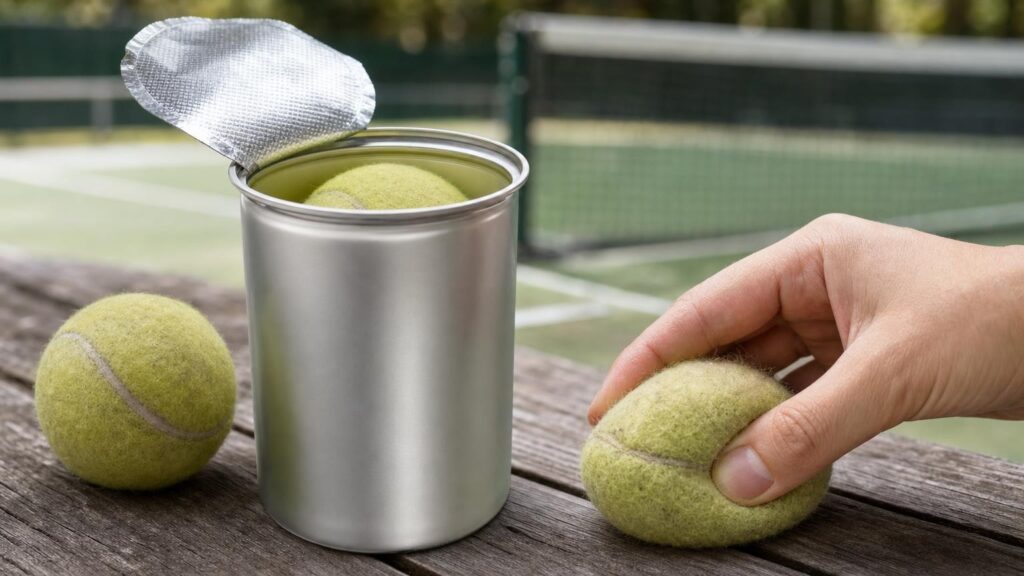
The hiss when a new can of tennis balls is opened is more than packaging theatre. It reveals an important part of how pressurised tennis balls are stored. Each ball has a hollow rubber core containing gas at a higher pressure than the surrounding atmosphere. The can is also pressurised, reducing the rate at which gas escapes from the balls before they are used.
Once the seal is broken, the balls begin interacting with normal atmospheric pressure. Their internal pressure, rubber shell and felt covering then change at different rates. Understanding those changes helps explain why a freshly opened ball can feel lively and predictable, while an older one may feel soft, slow, unusually quick through the air or simply inconsistent.
Why a New Can of Tennis Balls Is Sealed Under Pressure
A pressurised tennis ball consists of a hollow rubber core covered with felt. Gas inside the core pushes outwards, while the rubber resists stretching. When the ball strikes the court or a racket, it compresses and then springs back towards its original shape. Internal pressure contributes to that rebound.
Rubber is not a perfect gas barrier. Gas molecules can gradually pass through it, even when there are no visible holes. If pressurised balls were stored for long periods in ordinary unpressurised packaging, the difference between the pressure inside each ball and the surrounding air would encourage this gradual diffusion.
A sealed, pressurised can creates an environment closer to the pressure inside the balls. This reduces the pressure difference across the rubber wall and helps preserve the intended playing characteristics during storage. It does not make the ball permanently airtight, but it delays significant pressure loss until the can is opened.
The metal or plastic lid fitted after opening is useful for keeping the balls together and protecting them from loose dirt. However, it does not recreate the original pressurised environment. The original seal has been broken, and simply replacing the lid will not stop diffusion through the rubber.
How Rubber, Internal Pressure and Felt Work Together
A tennis ball’s behaviour cannot be judged by bounce alone. Three main elements work together, and each affects play differently.
The rubber core
The core supplies structure and elasticity. It deforms during impact, stores some of the impact energy and returns towards its original shape. The formulation and thickness of the rubber influence how firm the ball feels and how readily it deforms.
Rubber also changes through repeated impacts and environmental exposure. A ball that has been struck many times can behave differently from one that has spent the same number of days sitting unused, even if both have lost a similar amount of pressure.
Internal gas pressure
Internal pressure supports the rubber shell and contributes to rebound and responsiveness. As pressure falls, a ball generally becomes easier to compress and may rebound less energetically. Players may describe it as soft, flat or dead.
That perceived softness also affects racket response. A lower-pressure ball can spend and deform differently during contact, changing launch, control and the amount of effort needed to produce depth. These effects may become noticeable before a ball appears visibly damaged.
The felt covering
Felt affects grip between the ball, court and strings. It therefore influences spin, launch and how the ball reacts after bouncing. It also creates aerodynamic drag as the ball travels through the air.
Fresh felt can stand up from the surface and produce substantial air resistance. With use, it may fluff, become compressed, collect fine material or wear away. Heavy fluffing can increase drag, while smoother or badly worn felt can reduce it. The result is that an ageing ball is not automatically slower in every sense: it might rebound less yet travel differently through the air because its felt has also changed.
What Starts Changing When the Can Is Opened
Opening the can exposes the balls to normal atmospheric pressure. Gas then gradually diffuses through the rubber because the pressure is higher inside the core than outside it. This process occurs even if the balls remain unused.
Several separate forms of ageing begin or accelerate after opening:
- Pressure loss: Gas gradually passes through the rubber, reducing internal pressure.
- Felt wear: Contact with rackets, courts, baskets and ball-machine mechanisms can flatten, fluff or remove fibres.
- Dirt and moisture pickup: Felt can retain clay, dust, grit and water, changing mass, grip and airflow.
- Rubber fatigue: Repeated compression can alter how the core deforms and recovers.
- Local damage: Cuts, exposed seams or uneven felt loss can make flight and bounce less consistent.
Pressure loss is not the same as surface wear. A clean-looking ball may have softened after sitting in an opened can, while a relatively fresh ball can become heavily worn during an intensive session. This is why neither appearance nor calendar age alone provides a complete measure of condition.
How Ageing Changes Play on Court
As pressure, rubber and felt change, the ball may produce a lower rebound or a less predictable one. It can also feel less responsive off the racket, requiring a larger swing to achieve the same apparent depth. If balls within the same set have aged unevenly, their differences may matter more than their overall age.
Felt condition complicates the picture. A fluffed ball can experience more air resistance and lose speed more rapidly during flight. A smoother ball may move through the air more readily but offer a different sense of grip at contact. Dirt or moisture can further alter its feel and trajectory.
Temperature can create temporary changes too. Gas pressure falls when a ball becomes colder and rises when it becomes warmer, so a cold ball may feel less lively until it returns to a moderate playing temperature. This is different from long-term gas diffusion. Warming an old ball may temporarily change its response, but it does not rebuild worn felt or permanently replace gas that has escaped.
Useful life therefore depends on both elapsed time and amount and type of play. Competitive players seeking uniform response may replace balls sooner than casual players who are comfortable with greater variation. A ball can also leave match use while remaining serviceable for drills or informal hitting.
Pressurised and Pressureless Balls Are Different Trade-offs
Pressureless balls are not simply pressurised balls without a sealed can. Their construction relies more heavily on the rubber shell itself for rebound, often using thicker or firmer rubber rather than high internal pressure as the main source of liveliness.
Because they do not depend on maintaining the same pressure difference, pressureless balls retain functional bounce in a different way. This can make them practical for repeated practice, coaching baskets and ball machines, where opening new cans frequently may be inconvenient.
The trade-off is feel. Pressureless balls may initially feel firmer or heavier at impact, depending on their construction. Their playing behaviour can also evolve as the rubber softens and the felt wears. They are not immune to ageing: abrasion, moisture, dirt, cracking and material fatigue still matter.
Neither type is universally better. Fresh pressurised balls are often chosen when players value a familiar, responsive feel and close consistency within a newly opened set. Pressureless balls can suit repeated drills where durability and storage convenience matter more than reproducing the exact sensation of fresh pressurised balls.
Why Court Surface and Felt Type Matter
Court surfaces expose felt to different stresses. Abrasive hard courts can wear fibres aggressively. Clay and similar loose surfaces can load the felt with fine particles, affecting colour, visibility, grip and airflow. Softer surfaces may be less abrasive but still change how the felt interacts with the ground.
Labels such as regular-duty, extra-duty and surface-specific generally indicate that the felt has been selected with particular court conditions in mind. The exact terminology and construction can vary by manufacturer, so these descriptions should be read as intended-use guidance rather than universal technical standards.
A more durable felt is not automatically the best choice for every court. Felt designed to resist abrasion on a hard surface may behave differently on a softer or particle-covered court. Shoppers should consider where most of their play takes place, how quickly ordinary felt becomes damaged there and whether local clubs or competitions specify a particular type.
Visibility matters as well. A ball that becomes heavily coated in surface material may be harder to track even while it still bounces adequately. For practical use, felt condition can therefore determine replacement before pressure loss does.
Altitude Balls and the Effect of Air Density
At higher elevations, atmospheric pressure and air density are lower. A standard pressurised ball can behave more energetically because the pressure difference between its interior and the surrounding air is greater. Reduced aerodynamic drag can also allow it to travel faster or farther than players expect.
Altitude balls are intended to moderate these effects through differences in construction or pressure. They should not be treated as premium versions of standard balls. Their purpose is to produce more suitable behaviour under particular environmental conditions.
Choose according to the elevation where the balls will actually be used. An altitude version used near sea level may feel less lively than intended, while a standard ball taken to a substantially higher location may feel unusually quick. If a venue provides ball guidance, that is more useful than choosing by label alone.
Storage, Reuse and the Limits of Pressure-Saving Accessories
Unopened cans are best kept in stable, moderate conditions, away from prolonged heat, direct sunlight and unnecessary temperature swings. Extreme heat can raise internal pressure and accelerate material ageing. Cold conditions can temporarily reduce pressure and bounce, but refrigeration is not a reliable way to restore or indefinitely preserve opened balls.
Cold storage can also introduce practical issues such as condensation when balls return to a warmer environment. Moisture in the felt may change grip, weight and flight until it dries. Heating a flat ball is no solution either: any increase in liveliness is temporary, and excessive heat can harm rubber, felt or packaging.
Pressure-maintaining containers aim to reduce the pressure difference that drives gas loss. Repressurising devices may expose balls to elevated external pressure over time. Their results depend on the container, seal, ball condition and method of use, so they should not be assumed to return every ball to factory-fresh performance.
Most importantly, pressure accessories address only one part of ageing. They cannot replace missing felt, remove embedded grit, undo rubber fatigue or repair a damaged seam. A repressurised but badly worn ball may bounce more strongly while still flying or gripping inconsistently.
Choosing by Use, Not Just by Freshness
The most useful choice starts with the job the ball must perform:
- Match play or consistency-focused sessions: Fresh pressurised balls provide a predictable starting point and make it easier to keep the set uniform.
- Regular coaching and repeated drills: Pressureless balls may offer convenient reuse, provided their firmer feel suits the players and exercise.
- Ball machines: Consistency across a large batch matters. Mixing balls with very different pressure, felt wear or construction can produce uneven feeds.
- Casual practice: Previously opened pressurised balls may remain useful if their bounce, felt and consistency are adequate for the activity.
- Surface-specific use: Select felt intended for the main court environment rather than assuming the most durable-sounding label is always preferable.
- Higher-elevation play: Consider altitude versions when conditions call for them, rather than viewing them as an upgrade for ordinary elevations.
There is no single fixed replacement interval that suits every player and setting. Judge balls as a set: compare their rebound, firmness, felt condition and flight, and watch for uneven behaviour. Freshness matters, but so do construction, court surface, altitude, storage and the standard of consistency the session requires. The pressurised can preserves a carefully balanced starting condition; what happens afterwards depends on both time and use.
Continue exploring on Frowse
Discover More Frowse Insights
- Inside Flat-Pack Furniture: How Boards, Edges and Fasteners Affect Durability
- Porcelain, Stoneware and Earthenware: What the Names Really Mean
- Why a Wireless Charger’s Wattage Is Not Its Charging Speed
- Why Paper Weight Alone Cannot Tell You How Printer Paper Will Perform
- AGM, EFB and Flooded Car Batteries: Why the Right Size Is Not Enough