





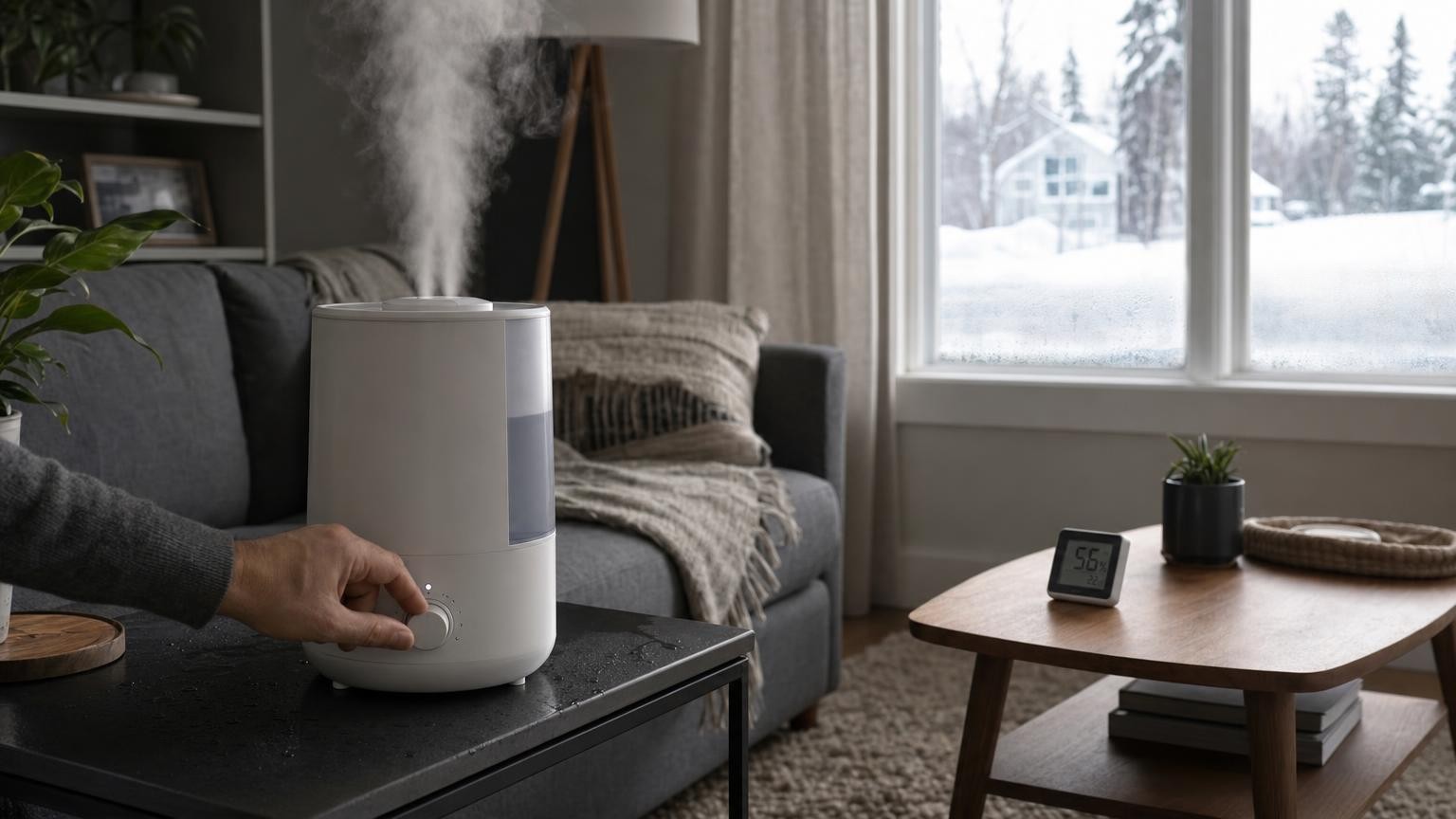
A Canadian winter can make indoor air feel uncomfortably dry. Cold outdoor air holds less moisture, and heating that air indoors can reduce its relative humidity further. A humidifier can add moisture, but the largest or most powerful model is not automatically the best choice. Too much humidity may lead to condensation on windows and other cold surfaces, potentially contributing to dampness and damage.
The right humidifier depends on the space, the building, local water quality and how much cleaning and refilling you are prepared to do. Comparing those factors before focusing on extra features can help you find a practical fit for winter use.
Why Canadian Winter Changes the Humidifier Decision
Indoor humidity needs can vary throughout the season. A setting that works on a relatively mild day may create condensation when the temperature drops sharply and windows or exterior walls become colder. Older windows, limited insulation and air leakage can also affect how much moisture a home can tolerate.
This makes adjustable output and regular monitoring more useful than relying on one fixed winter setting. Watch windows, exterior-wall corners and other cold surfaces. If condensation appears, reduce the output, increase ventilation where appropriate and investigate whether moisture is collecting elsewhere.
Consider the building as well as personal comfort. A tightly sealed newer room may retain added moisture more effectively than a draughty space. Kitchens, bathrooms, drying laundry and normal household activity also release moisture, so the humidifier is only one part of the indoor environment.
Start With the Space You Actually Need to Humidify
Begin by deciding whether you want to humidify one closed room, an open living area or much of the home. Portable tabletop models are generally intended for local or single-room use. Larger console units can serve a broader area, while whole-home systems are connected to a building’s heating or ventilation equipment and involve different installation and maintenance considerations.
Floor area is useful, but it does not tell the whole story. Also consider:
- Ceiling height: A room with high or vaulted ceilings contains more air than a standard-height room with the same floor area.
- Open doorways: Moisture can disperse into halls and adjoining rooms, making conditions harder to control.
- Insulation and air leakage: Draughty rooms may lose humidified air quickly, while tightly sealed spaces may retain it.
- Heating patterns: Strong airflow from a vent or baseboard heating can influence moisture distribution and placement.
- Room use: A bedroom used overnight presents different requirements from a large living area occupied intermittently.
Treat manufacturer coverage figures as comparison aids rather than guarantees. Test the unit in the intended room with a humidity meter and observe how often it runs, whether humidity changes meaningfully and whether condensation develops. Trying to humidify an entire open-plan home with a small bedroom model is likely to result in constant operation and frequent refilling.
Compare Evaporative, Ultrasonic and Warm-Mist Designs
Evaporative humidifiers
An evaporative model draws water through a wick or filter and uses a fan to move air across it. As water evaporates, moisture enters the room without a visible plume. Evaporation naturally slows as the surrounding air becomes more humid, although monitoring is still necessary.
The fan creates audible airflow, and the wick usually needs cleaning or replacement. Mineral deposits can shorten filter life, particularly with hard water. On the other hand, minerals are more likely to remain in the filter or reservoir than to be dispersed as white dust around the room.
Ultrasonic humidifiers
Ultrasonic models use a vibrating element to produce a fine mist. They are often quieter than fan-driven designs, although they may still produce bubbling, dripping or electronic sounds. Many offer cool mist, and some models provide additional mist-temperature options.
The main water-quality consideration is mineral dispersion. When mineral-rich tap water is turned into mist, deposits can settle as white dust on nearby surfaces. Distilled or appropriately demineralized water can reduce this issue, while some units accept mineral-control cartridges. Those solutions add either ongoing cost or the inconvenience of obtaining treated water.
Warm-mist humidifiers
Warm-mist units heat water to create vapour. They do not necessarily need a fan, but boiling or heating sounds may still be noticeable. Because they heat water, they generally use more electricity than comparable cool-mist technologies.
Hot water, steam and heated surfaces require particular caution in homes with children or pets. Placement stability and strict adherence to the manufacturer’s safety instructions are essential. A warm mist may feel appealing in winter, but it does not remove the need to control overall room humidity.
Match Tank Capacity and Output to Daily Use
Tank volume, moisture output and advertised runtime describe different things. A large tank can reduce refill frequency, but it does not guarantee that a unit can humidify a large room. Output indicates how quickly water can be added to the air, while runtime depends on tank size, output setting and operating conditions.
Runtime claims are often based on a particular setting. A model may run much less time when used at maximum output. Conversely, automatic control may extend the time between refills by pausing or reducing output after reaching the selected humidity.
Think through the refill routine before buying. Check whether the tank fits beneath your tap, has a wide opening and can stand securely while being filled. Water is heavy, so a large tank may be awkward to carry even if it is convenient to refill less often. A comfortable handle and a route from sink to room without tipping the tank can matter more than a small difference in stated capacity.
A suitable unit should make useful progress in the intended space without needing maximum output continuously. Constant operation can increase noise, water use and maintenance while suggesting that the humidifier is undersized or that the room loses moisture rapidly.
Choose Controls That Prevent Guesswork
A built-in humidistat allows a humidifier to adjust or stop output around a chosen level. It is helpful, but its reading may be influenced by moisture immediately around the machine. A separate humidity meter positioned elsewhere in the room can provide a useful comparison.
Adjustable output is valuable because outdoor temperature and indoor conditions change. Automatic modes can simplify operation, while manual settings provide more direct control. Timers may suit a predictable routine, but they do not respond to humidity unless paired with a sensor. Low-water shutoff is an important convenience that stops operation when the reservoir is empty.
Do not assume that one target is appropriate throughout winter. Review conditions after major weather changes, when more people are in the home or when other moisture-producing activities increase. Condensation is a practical warning to lower output, even if the control panel says the selected level has not been reached.
Account for Canadian Tap Water and Mineral Buildup
Water hardness varies by location and source. Mineral-rich water can leave scale in reservoirs, on heating elements and around ultrasonic transducers. In ultrasonic units, it can also contribute to airborne white dust.
Check the manufacturer’s water guidance before choosing a model. Distilled or demineralized water may reduce deposits, but regularly buying and carrying it raises the operating cost. Demineralization cartridges also require replacement and may not remove every maintenance task. Evaporative filters contain much of the mineral residue, but they become a recurring expense and may need more frequent attention with hard water.
If you already see heavy scale in a kettle or on plumbing fixtures, make mineral management part of the purchase decision. A design that works well with your normal water and cleaning routine may be more practical than a quieter or more stylish option that demands treated water every day.
Inspect the Design for Cleaning, Refilling and Placement
Any humidifier that stores water needs regular cleaning according to its instructions. Residue and films can develop in neglected tanks and water channels, so easy access is not merely a cosmetic detail.
Look for wide tank openings, smooth internal surfaces and removable components that can be reached without special tools. Inspect the path from the tank to the base: narrow channels, fixed covers and deep corners can make thorough cleaning difficult. Check whether small parts are easy to lose and whether the tank sits securely after refilling.
Placement affects both performance and risk. Use a stable, water-resistant surface and protect surrounding materials as directed by the manufacturer. Keep mist away from walls, curtains, wood furnishings, electronics and other moisture-sensitive objects. Avoid positioning the unit where a heating vent or fan immediately carries mist onto a cold surface. Cords should not create a trip or pulling hazard, especially around children and pets.
Plan for Noise, Light and Overnight Operation
Bedroom use makes minor operating details more noticeable. Evaporative units produce fan noise, while ultrasonic models may make faint buzzing, bubbling or dripping sounds. Warm-mist models can create heating and boiling sounds. Noise also changes with output: a low fan setting may be quiet but add moisture more slowly.
Check what a sleep mode actually does. It might dim the display, reduce fan speed, change output or combine several functions. If indicator lights are distracting, confirm that they can be switched off rather than merely dimmed. Also consider whether button tones, empty-tank alerts or automatic restarts could interrupt sleep.
There can be a trade-off between quiet operation and other priorities. A nearly silent ultrasonic model may require more careful water treatment, while a filtered evaporative unit may make more fan noise but reduce mineral dust. Decide which compromise best fits the room.
Calculate the Full Ownership Trade-Off
The purchase price is only one part of humidifier ownership. Depending on the design, ongoing costs may include replacement wicks, filters, mineral cartridges, distilled water, cleaning materials and electricity. There is also the time required for refilling, descaling, drying and replacing parts.
Before choosing, use this final checklist:
- Room fit: Is the unit intended for a closed bedroom, an open living space or a larger home system?
- Technology: Are you comfortable with fan noise, mineral dust, recurring filters or heated water?
- Water quality: Will your tap water create scale or require treatment?
- Daily handling: Can you fill, lift and position the tank comfortably?
- Cleaning: Are all water-contact areas accessible enough for regular care?
- Controls: Can output respond to changing conditions, and will you monitor humidity separately if needed?
- Household safety: Is the unit stable and appropriate for its location around children, pets, cords and moisture-sensitive objects?
- Overnight use: Are its sounds, lights and alerts suitable for the intended room?
The most suitable humidifier for a Canadian winter is not simply the one with the biggest tank or longest claimed runtime. It is the model that can manage the intended room, work with your water, respond to changing weather and remain easy enough to clean that routine maintenance is realistic.
Continue exploring on Frowse
Discover More Frowse Insights
- AGM, EFB and Flooded Car Batteries: Why the Right Size Is Not Enough
- How Self-Watering Planters Move Water from Reservoir to Soil
- Why Replacement Toilet Seats So Often Fit Poorly
- What Changes Inside a Quartz Clock When the Second Hand Sweeps Instead of Ticks
- Why a Washing Machine’s Kilogram Capacity Is Not the Size of Every Load