





A quartz clock with a sweeping second hand can look calmer and sound less intrusive than one that advances with a distinct tick every second. The difference, however, is not simply cosmetic. Both types can use quartz regulation, but they convert their timing signals into hand movement in different ways.
Those internal differences affect how often the motor is energised, how the gears move and how much torque is available for the hands. They can also influence perceived noise and battery life. Understanding these trade-offs helps you choose a clock that suits its room and intended use rather than assuming that one style of movement is always better.
Why a sweeping second hand is more than a visual difference
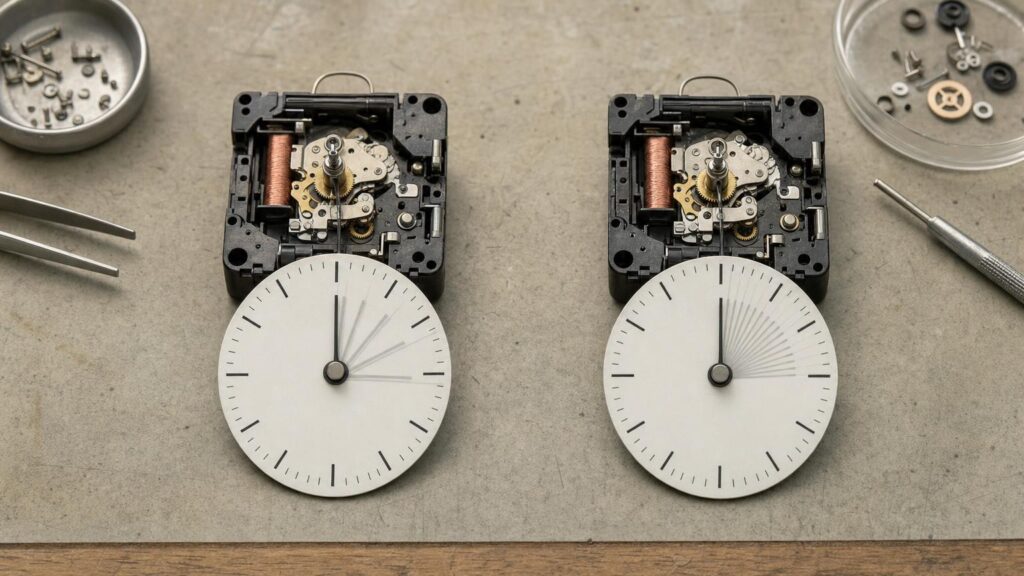
In a conventional ticking quartz clock, the second hand normally jumps from one second marker to the next. Each jump is produced by a controlled electrical pulse and a corresponding mechanical step inside the movement. That once-per-second action often creates the familiar tick.
A sweep movement divides the visible journey into much smaller increments. The second hand is advanced more frequently, making the steps difficult to distinguish at ordinary viewing distances. The result appears smoother and may avoid the prominent once-per-second sound of a standard movement.
This changes several parts of the design equation. A sweep clock needs a control system and motor arrangement intended for repeated movement. Its gears must transfer those frequent steps cleanly, while the battery must supply energy often enough to maintain motion. The design must also provide sufficient force to overcome friction and move the fitted hands reliably.
The quartz timebase stays broadly the same
Ticking and sweeping quartz clocks usually share the same basic timekeeping principle. A quartz crystal forms part of an electronic oscillator. When electrically excited, the crystal vibrates at a stable frequency. An electronic circuit divides that high-frequency signal into lower-frequency timing signals that can control the clock movement.
This quartz timebase determines when the movement should act. It is separate from the visible style of the second hand. A clock can therefore display time through large one-second jumps or many smaller movements while still being regulated by quartz.
For shoppers, the important point is that a sweeping hand does not inherently indicate a more accurate clock. Accuracy also depends on the design and stability of the oscillator, electronic components, manufacturing tolerances and operating conditions. Sweep describes how motion is displayed, not a separate standard of timekeeping.
The same distinction applies in reverse. A clock that ticks once per second is not necessarily less accurate simply because its movement is visually less fluid. Hand motion, sound and timekeeping accuracy are related to different aspects of the mechanism.
From one step per second to many smaller movements
A standard quartz movement commonly stores the divided timing signal until it is time to advance the motor by one step. The motor turns through a controlled amount, and the gear train converts this movement into a one-second advance of the second hand. The minute and hour hands move so slowly that their progress usually appears continuous even though they are driven through the same gear system.
In a sweep movement, the electronics command the motor more frequently. Each motor action produces a smaller visible change at the second hand. Rather than making one large jump each second, the hand covers the same distance through a sequence of closely spaced steps.
What looks like continuous motion is therefore usually not mechanically continuous. It is a rapid series of discrete movements. How smooth it appears can depend on the number and size of those movements, viewing distance, hand length and the precision of the gears. A long second hand can make small irregularities more noticeable because its tip travels farther for any given angular movement.
How the motor and control circuit change
The movement’s control circuit decides when to send electrical pulses to an electromagnetic coil. The resulting magnetic field acts on a small rotor, which turns in controlled increments. This rotor is the input to the clock’s gear train.
With a basic ticking movement, the circuit and motor can be optimised around one primary action per second. A sweep design needs a pulse pattern that creates more frequent rotor movement. The coil, rotor, electronic driver and mechanical components must work together at that higher operating rate.
This is why a ticking clock cannot generally be turned into a proper sweep clock merely by muffling it or removing a sound-producing part. The audible tick is normally a consequence of the motor and gears advancing, not a separate alert generated for each second. Changing the motion requires a movement designed to produce the different sequence of steps.
The force delivered by each action also matters. The motor must overcome resistance in the gear train, bearings and hand assembly. If the available torque is too low, the hand may hesitate, lose time under load or stop at a difficult position. More force is not automatically preferable, however, because movement design involves balancing torque with energy use, size and noise.
What the gear train contributes
The motor does not directly rotate all three hands at their final speeds. A series of gears reduces and distributes the rotor’s motion so that the second, minute and hour hands complete their rotations over the correct periods.
Gear design has a strong influence on how refined the movement seems. Tooth shape, alignment, shaft support and the clearances between components affect how consistently force is transferred. Some clearance is necessary to prevent binding, but excess clearance can produce backlash – small amounts of free movement between engaging teeth. This may make the second hand appear less settled or cause minor changes in sound.
Frequent motor steps can reduce the prominence of an individual tick, but they also create repeated interactions throughout the gear train. Depending on the movement and clock case, these may be heard as a faint hum, rustle or rapid mechanical pulse rather than a once-per-second click.
Hand fitting is equally important. Hands that are bent, loosely mounted or touching one another add resistance and can make an otherwise suitable movement seem weak or noisy. The second hand should clear the minute hand, while all hands should clear the dial, markers and front cover throughout a full rotation.
Sweep does not automatically mean silent
Descriptions such as silent, non-ticking and sweep are useful indicators, but they do not necessarily mean that a clock will be inaudible. A non-ticking movement may eliminate the obvious once-per-second sound while still producing low-level motor or gear noise.
The clock’s case can also amplify vibration. A large, light or hollow housing may act as a resonating surface, while the wall and mounting method can affect how vibration is transmitted. Perceived loudness will depend on room acoustics, background noise and distance from the listener.
This distinction matters most in quiet spaces. In a kitchen or living area, subtle movement noise may disappear beneath ordinary activity. In a bedroom, reading room or study at night, the same sound can be more noticeable. If quiet operation is a priority, treat “non-ticking” as evidence that the prominent one-second tick is absent rather than as a guarantee of complete silence.
The trade-off between smooth motion and battery life
A sweep motor is activated more frequently than a conventional once-per-second design, so it can require more energy. Yet there is no universal battery-life penalty that applies to every sweep clock. Electronic efficiency, pulse strength, coil design, friction and hand load all affect consumption.
The hands are particularly relevant. Long or heavy hands have greater rotational demands than short, light ones. Poor alignment, rubbing or an overtightened fitting can increase resistance further. A movement working near its load limit may use energy less effectively and be more vulnerable as battery voltage declines.
Conversely, a well-matched and efficient sweep movement may provide practical battery life despite its frequent drive pulses. A ticking movement is not guaranteed to run longer if it is driving unsuitable hands or suffering from mechanical drag.
When comparing clocks, avoid assuming identical running time from the same battery format. Battery type tells you about physical compatibility and nominal electrical characteristics, but not the complete energy demand of the movement. Follow the manufacturer’s battery guidance and use a fresh, suitable cell rather than mixing battery assumptions across different clocks.
When high-torque movements are necessary
Torque is the turning force available to move the hands. Larger clocks often use longer hands, and their extra length increases the load placed on the movement. Decorative metal hands or unusually broad hands can also demand more force than lightweight alternatives.
A high-torque movement is designed to handle a greater hand load. It can be useful for oversized wall clocks, large dial diameters or replacement projects involving substantial hands. It is not automatically a quality upgrade for a small clock. Additional torque may be unnecessary, and design choices made to provide it can affect power consumption, movement dimensions and sound.
Sweep motion and high torque are separate characteristics. A movement may offer one, both or neither. If you need a large clock with smooth hand motion, check that the movement is intended to combine frequent stepping with the required hand capacity. Do not infer load capability from the word “sweep” alone.
For replacement movements, compatibility involves more than torque. Shaft length and diameter, hand attachment style, dial thickness and available space behind the face must all be suitable. The movement must also accommodate the actual length and weight of the hands, not just the clock’s overall case size.
Choosing by room, clock size and ownership priorities
The best movement style depends on where the clock will be used and what you value most.
- For bedrooms and quiet studies: A sweep or non-ticking movement can remove the pronounced once-per-second tick. Remember that faint motor, gear or case noise may remain.
- For kitchens and busy living spaces: The practical difference in sound may be less important. Dial readability, suitable size and easy battery access may deserve equal or greater attention.
- For oversized clocks: Confirm that the movement is designed for the supplied hand length and weight. High torque can matter more than whether the second hand ticks or sweeps.
- For battery-conscious ownership: A simple ticking movement may have an advantage in some designs, but actual running time depends on the complete mechanism and load. Look for grounded manufacturer information rather than relying only on movement labels.
- For visual preference: Sweep motion can create a calmer, more fluid appearance, while discrete ticking makes each elapsed second obvious. Neither presentation is inherently more accurate.
Once installed, make sure the clock is mounted securely and sits in its intended orientation. Check that the hands are parallel to the dial and to one another, with no contact at any point in their rotation. Signs of rubbing include intermittent stopping, visible hesitation, scraping sounds or time loss that appears after the hands reach a particular position.
Ultimately, a sweeping quartz clock changes the way timed electrical signals are converted into mechanical movement. More frequent motor steps, a suitably designed control circuit and a well-matched gear train create the smooth appearance. Those benefits come with design considerations involving noise, energy use and available torque. Choose according to the room, hand size and priorities that matter to you, rather than treating sweep motion as a shortcut for judging overall clock quality.
Continue exploring on Frowse
Discover More Frowse Insights
- Why a Tripod’s Load Rating Does Not Tell You How Steady It Will Be
- Why Noise-Cancelling Headphones Work Better on Some Sounds Than Others
- Why Matt, Eggshell, Satin and Gloss Paint Labels Are Not Universal
- Why Thread Count Cannot Tell You How a Bed Sheet Will Feel
- What Makes a Paintbrush Hold Paint, Cut Cleanly and Keep Its Shape?