




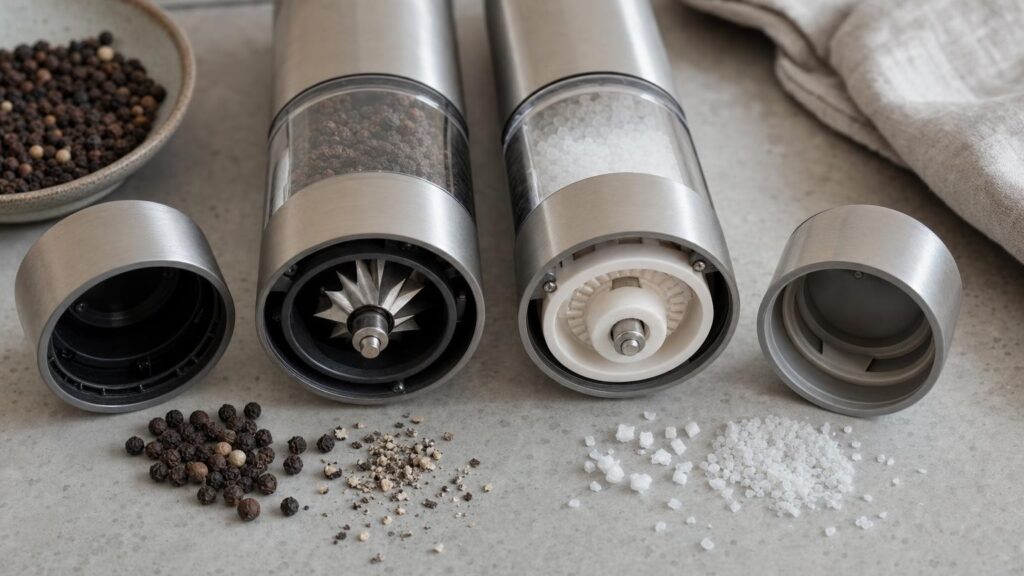
Salt and pepper mills often look like a matching pair, but the ingredients inside them present very different engineering problems. A pepper mechanism must grip, crack and shear tough, irregular peppercorns. A salt mechanism mainly has to crush brittle crystals while resisting the corrosive conditions that salt and moisture can create.
These differences affect far more than the choice between steel and ceramic. Burr shape, adjustment design, shaft support and manufacturing tolerances all influence how consistently a mill feeds and grinds its contents. Understanding those details makes it easier to assess a mill on its working parts rather than its appearance or an impressive-sounding number of settings.
Why one grinding mechanism does not suit both seasonings
A mill works by drawing pieces of seasoning into a narrowing space between a fixed and a moving grinding surface. As the handle or body turns, the mechanism grips the contents and reduces them to smaller particles.
Peppercorns do not simply shatter at the first point of contact. Their outer shells and layered interiors can compress, split and tear. They also vary naturally in size and shape. A good pepper mechanism therefore needs an assertive initial bite, followed by a controlled path that continues to crack and shear the pieces.
Salt crystals are more readily fractured under pressure. Instead of cutting through a plant structure, the mechanism crushes a mineral crystal along its weak points. The central challenge is not only producing the desired particle size but also choosing components that can tolerate long-term contact with salt.
A mechanism designed as a compromise may grind both ingredients, but that does not mean it handles either one especially well. It might fail to pull peppercorns in reliably, produce excessive salt dust or use metal parts that are vulnerable to corrosion. Purpose-specific internals are therefore more meaningful than identical external styling.
What happens when peppercorns and salt crystals meet a grinder
Whole peppercorns are relatively large, rounded and irregular. When the first teeth cannot get a firm purchase, the peppercorns may roll or bounce above the mechanism. This can make a mill feel as though it is turning without producing much pepper. Deep feed grooves and prominent cracking teeth help move peppercorns towards the finer grinding surfaces.
Oils and fragments from pepper can also build up around a mechanism. Very damp peppercorns, unsuitable soft spices or a mixture containing sticky ingredients may feed poorly and leave residue. The mechanism needs enough clearance to admit whole peppercorns without allowing them to pass through largely unbroken.
Dry salt crystals tend to fracture more abruptly. Their size and shape depend on the type of salt, and very large or uneven crystals may not enter a compact mechanism easily. Fine salt, meanwhile, may pass through too quickly or offer little benefit when put into a mill.
Moisture is a particularly important consideration with salt. Salt can attract and retain moisture from humid surroundings, encouraging clumping and increasing the risk of corrosion where susceptible metals are present. A mill that works well with dry crystals may begin to jam if its contents become damp or if compacted salt accumulates around the burrs.
Burr geometry: cracking pepper versus crushing salt
The word burr refers to the working surfaces that reduce the seasoning. Their geometry includes the height and angle of the teeth, the depth of the grooves and the way the gap narrows through the grinding path.
Pepper needs a staged bite
A pepper burr commonly benefits from distinct zones. Coarser teeth first catch and split whole peppercorns, while smaller teeth or cutting edges reduce the fragments further. This staged action helps prevent rounded peppercorns from skidding above the opening.
If the entry teeth are too shallow, the mill may need repeated turns before pepper begins to flow. If the internal path is poorly controlled, larger fragments can escape alongside powder. A useful pepper design balances aggressive feeding with enough control to deliver a reasonably even chosen texture.
Salt needs controlled crushing
Salt mechanisms can use a crushing action that places crystals under concentrated pressure. The geometry should admit the intended crystal size and break it progressively rather than merely pulverising the surface. An excessively tight or abrupt path may create more fine dust, while a wide, poorly regulated gap can release unexpectedly large pieces.
There is no single burr pattern that is automatically best for every mill. Geometry has to work with the mechanism’s diameter, rotation, adjustment range and intended contents. Two mills described as ceramic, for example, can perform differently because their tooth shapes and support structures are not the same.
Steel and ceramic mechanisms have different strengths
Hardened steel is widely associated with pepper mechanisms because it can form defined teeth and edges capable of biting into tough peppercorns. A well-made steel burr can combine sharp geometry with the toughness needed to withstand repeated loading.
However, steel is not one uniform material. Corrosion resistance, hardness and wear behaviour depend on the alloy, treatment and finish. A label that says only “steel mechanism” provides limited information. Susceptible steel should not be assumed suitable for salt simply because it performs well with pepper.
Ceramic is useful in salt mills because it is not affected by salt in the same way as corrosion-prone metal. It can provide hard crushing surfaces and is also used in some mechanisms intended for pepper or other dry seasonings. Its value around salt is primarily about material compatibility as well as wear resistance, not a universal claim that ceramic always grinds better.
Ceramic is hard but less tolerant than tough metal of certain impacts or severe misalignment. Poorly supported ceramic components can chip or fracture if subjected to loads they were not designed to handle. Steel can eventually dull or corrode, while ceramic quality, tooth definition and mounting can vary. The better question is therefore not simply “steel or ceramic?” but “Is this material well designed and supported for the intended ingredient?”
How grind adjustment systems work – and why settings drift
A mill changes grind size by altering the spacing between its grinding surfaces. A wider gap generally permits larger particles to leave, while a narrower gap retains pieces for further reduction. The usefulness of this adjustment depends on how accurately the mechanism moves and whether it remains in position during grinding.
Traditional top-nut systems often use the nut that holds the handle to adjust tension along the central shaft. Tightening or loosening it changes the burr spacing. This arrangement is straightforward, but the setting may be disturbed when the top is removed for refilling. A loose nut can also move gradually as the mill is used.
Base-mounted controls place a dial or selector near the mechanism. These can separate adjustment from refilling and may include marked or indexed positions. Markings are helpful for returning to a preferred setting, but they do not guarantee meaningful differences between every position. The internal movement and stability still determine the actual result.
Settings can drift because of vibration, loose fasteners, worn threads or insufficient friction in the control. Poor manufacturing tolerances may allow parts to move without the adjuster visibly changing. At the finest setting, burrs that touch or bind can make turning difficult and accelerate wear. At a very coarse setting, inadequate support may allow the moving burr to wobble rather than maintaining a consistent gap.
Shaft stability, alignment and the quality of the grind
The central shaft transfers movement from the handle or turning body to the burr. Guides, bushes or other supports keep that shaft centred. A rigid body and a secure handle connection help the assembly remain aligned under load.
When the shaft wobbles, the burr gap changes during each rotation. One side may become tight while the opposite side opens. The result can be a mixture of powder and large fragments even when the adjustment appears fixed. It can also cause intermittent resistance, scraping or a rhythm in which the mill alternates between grinding and spinning freely.
Alignment matters at every grind size, but its effects are particularly noticeable at fine settings because the intended gap is already small. Tightening an unstable mechanism does not necessarily make it more precise; it may simply force misaligned surfaces together.
Shoppers can look for a handle or turning section with little unnecessary play, a shaft supported at more than one point and an adjustment control that moves deliberately. A heavy exterior does not itself guarantee stability. Structural rigidity and accurate internal support matter more than decorative weight.
Diagnosing uneven grinding, jamming and poor output
Weak output is not always evidence of a failed burr. Before replacing a mill, it helps to identify whether the problem comes from the ingredients, the adjustment or the structure.
- The mill turns but little comes out: Peppercorns may be bridging above the feed opening, or oversized salt crystals may not fit the mechanism. Overfilling can also restrict movement inside some mills.
- The grind contains powder and large pieces: The shaft or burr may be wobbling, the setting may be too coarse for controlled reduction, or worn teeth may no longer process pieces consistently.
- The handle becomes unusually hard to turn: The setting may be too fine, a large fragment may be trapped, or damp contents may have compacted around the burrs.
- The chosen setting will not stay in place: Check for a loose top nut, an adjuster that lacks positive engagement or wear in the threads and retaining parts.
- Salt output declines over time: Look for clumping, compacted deposits or signs that unsuitable metal components have corroded.
- Grinding feels rough only at one point in each turn: This can suggest misalignment, a bent shaft, debris in the mechanism or damage to a tooth.
Cleaning and maintenance should follow the maker’s instructions because mechanisms and body materials differ. In general, introducing water to a mill not designed for washing can worsen clumping or corrosion. It is also unwise to use salt in a pepper mill unless the manufacturer specifically identifies the mechanism as suitable for it.
Choosing a matched pair without assuming the mills are identical
A visually matched set can still contain two different, purpose-built mechanisms. That is usually more relevant than whether both mills have the same dimensions or finish. When comparing a pair, check that the salt and pepper mechanisms are specified separately rather than described with vague shared wording.
Useful buying checks include:
- Intended contents: Confirm that each mill is explicitly designed for salt, pepper or both.
- Mechanism material: Look for salt-compatible internal components and a pepper burr capable of gripping and cracking peppercorns.
- Burr geometry: Defined feed teeth are valuable for pepper, while a controlled crushing path suits salt crystals.
- Adjustment security: The control should move intentionally, remain in place and avoid relying on a loose handle fastener.
- Shaft support: Minimal wobble and a rigid connection help maintain an even burr gap.
- Refilling design: Refilling should not repeatedly disturb the grind setting or leave adjustment parts easy to lose.
- Suitable crystal size: Check any guidance on coarse salt, as very large crystals may not suit every mechanism.
The number of advertised grind settings should be treated as secondary information. Several stable, useful settings can be more practical than a long scale of positions that are difficult to distinguish or that move during use.
The durable choice starts with the right mechanism
Salt and pepper mills perform related jobs, but they do not process equivalent materials. Pepper needs to be caught, cracked and sheared; salt needs to be crushed by components able to tolerate its environment. That distinction shapes the most appropriate burr geometry and often influences whether steel or ceramic is the better fit.
Adjustment accuracy and shaft alignment then determine whether those grinding surfaces can do their work consistently. A stable, ingredient-appropriate mechanism is more important than matching looks, decorative weight or a large number of settings. Choosing each mill for its contents gives a matched pair the best chance of delivering reliable output and lasting service.
Continue exploring on Frowse
Explore products on Amazon
Looking for products related to this guide? to enter your own search term.
Discover More Frowse Insights
- Inside a Duvet: How Fill and Construction Determine Warmth
- How Small Bluetooth Speakers Produce More Bass Than Their Size Suggests
- What Pouch Thickness, Roller Design and Temperature Change in a Laminator
- Why Sticky Notes Can Be Repositioned – and Why Some Refuse to Stay Flat
- Why Solar Garden Lights Fade Before Dawn