




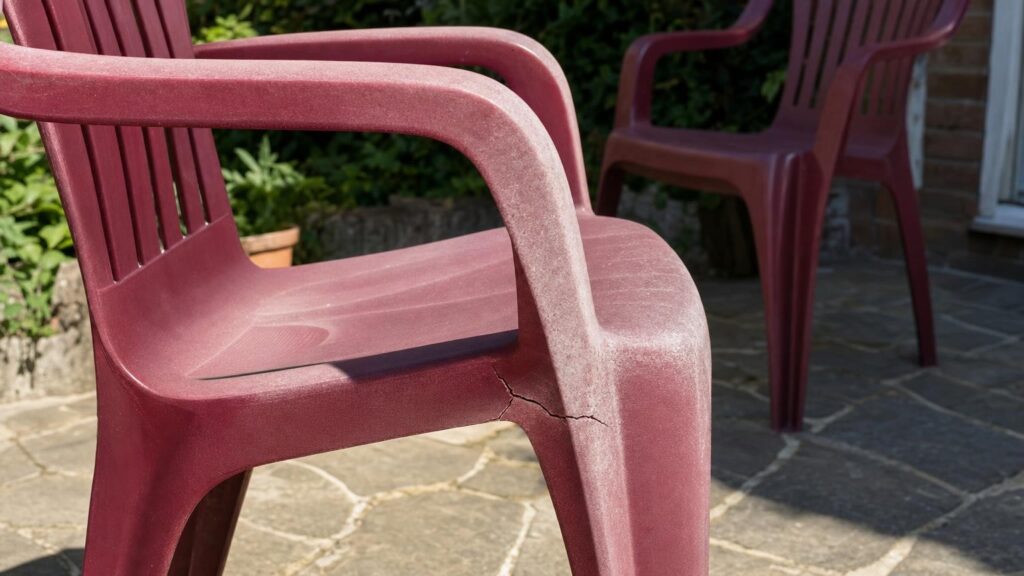
Plastic outdoor furniture can change in several visibly different ways as it ages. Its colour may fade, the surface may develop a pale powdery film, or a once-flexible component may become stiff and crack. Although these effects can occur together, they are not interchangeable signs of poor quality. Each points to a different combination of material formulation, construction and exposure.
Understanding the differences helps when comparing new furniture and inspecting an older set. Fading may be mainly an appearance issue, while cracking around a load-bearing joint can indicate that an item is reaching the end of its useful life. Cleaning can remove grime and some loose surface material, but it cannot rebuild degraded plastic.
The material starts with the resin
“Plastic” covers a broad family of materials. Common outdoor furniture resins include polypropylene, polyethylene and rigid polyvinyl chloride, usually known as PVC. Each has characteristic behaviour, but the resin name alone does not determine durability.
Polypropylene is widely used for moulded chairs and other rigid furniture parts. It can combine low weight with useful stiffness and may flex under load rather than feeling completely rigid. Polyethylene is found in several forms and is often used where toughness, flexibility or hollow moulded construction is useful. Rigid PVC is naturally firmer and is used in some frames, profiles and components, but its performance depends heavily on its additives.
A finished formulation may contain pigments, fillers, stabilisers, impact modifiers and processing aids. Recycled content can also vary in composition and processing history. These factors influence colour retention, flexibility and resistance to weathering, so two products made from the same nominal resin can age differently.
Construction matters as well. A well-formulated resin cannot compensate indefinitely for an excessively thin load point, a sharp internal corner or a poorly supported joint. Conversely, thoughtful geometry can reduce stress and help a relatively light item perform effectively.
Why colour fades in sunlight
Sunlight contains ultraviolet radiation that can alter both colourants and the polymer close to the surface. Some pigments are more resistant to light than others. Dyes and certain bright colours may show change more readily, while suitable inorganic pigments can be more stable. The result still depends on the complete formulation rather than colour alone.
Fading is not the same as dirt, mineral deposits or staining. Grime often collects unevenly around textured areas, feet and drainage points and may be removable with washing. Genuine fading tends to follow exposure: upward-facing surfaces, arm tops and the side facing the strongest sunlight may become lighter before shaded areas.
Colour that runs throughout the plastic generally makes scratches less conspicuous than a thin applied finish because newly exposed material is a similar colour. It does not guarantee that the colour will never change. The surface layer can still fade or oxidise. Painted or coated plastic can retain a particular appearance for a time, but chips and adhesion failure may reveal a visibly different substrate.
Colour choice also affects perception. A small shift may be obvious on a strong, uniform shade but less noticeable on a mottled, pale or textured finish. That is an appearance consideration, not proof that one colour is structurally stronger.
UV stabilisers help, but do not make plastic weatherproof
Outdoor plastic formulations may use several types of protective additive. UV absorbers reduce the amount of damaging radiation reaching the polymer. Light stabilisers interrupt some of the chemical reactions triggered by exposure, while antioxidants help limit degradation caused by oxidation during processing and use.
These additives slow ageing rather than stopping it permanently. Their effectiveness depends on the type and concentration used, how evenly they are dispersed, whether they suit the resin and how severe the exposure becomes. Heat and oxygen can work alongside ultraviolet radiation, while stabilisers may gradually be consumed, migrate or become less effective.
A broad claim such as “UV-resistant” therefore needs context. It may indicate that the material has been formulated for outdoor exposure, but it does not reveal how long the original colour and mechanical properties will last in a particular garden or climate. Useful product information may mention the resin, outdoor suitability, care requirements and storage advice, but shoppers should be wary of treating a single label as a lifetime guarantee.
Chalking is a surface change, not automatically structural failure
Chalking appears as a pale, dusty or powdery surface. As the polymer at the outermost layer breaks down, pigment and filler particles can become less securely bound and rub away. Dark furniture can make this effect especially visible.
Not every powdery deposit is degraded plastic. Dried hard-water marks, salt, dust, pollen, cleaner residue and airborne pollution can create similar films. A gentle wash in a small area can help distinguish removable contamination from a recurring surface change. If colour continues to transfer to a cloth after ordinary dirt has been removed, deterioration of the surface is more likely.
Light chalking can be predominantly cosmetic while the thicker material beneath remains serviceable. It becomes more concerning when accompanied by fine cracks, roughness, loss of flexibility or weakening around stressed areas. Chalking shows that weathering has occurred, but appearance alone cannot establish how much structural strength remains.
How plastic becomes brittle
Many plastics rely on long molecular chains for toughness and flexibility. Ultraviolet radiation, heat and oxygen can damage those chains over time. As degradation progresses, a component may flex less, feel unusually hard or develop cracks under loads it previously tolerated.
Additive loss or depletion can contribute. Some formulations use impact modifiers or other ingredients to achieve the required behaviour, and ageing can change that balance. Cold weather may temporarily reduce impact resistance in some plastics, while repeated heating and cooling makes components expand and contract. These cycles can worsen existing weaknesses.
Damage rarely develops evenly. Stress concentrates around screw holes, joints, moulded corners, slots, feet and transitions between thick and thin sections. A small crack at a high-load point can matter more than widespread cosmetic fading on a broad panel. Loads applied at an angle, dragging furniture over rough ground and rocking a chair on two legs can add stresses beyond ordinary use.
Brittleness can also reveal itself through a change in sound or feel, but such clues are subjective. Visible cracking, splitting, distorted joints or an obvious loss of normal flexibility provide stronger reasons to stop using and replace the affected item.
Moulding, wall thickness and design influence ageing
The manufacturing method helps determine a product’s shape and internal structure. Injection moulding forces molten plastic into a shaped tool and is suited to detailed components, ribs and integrated joints. Poorly balanced geometry can leave residual stresses or weak transitions, while well-designed ribbing can add stiffness without making every section solid.
Blow moulding creates hollow forms by expanding hot plastic inside a mould. It can produce broad, lightweight panels, but seams, corners and local wall thickness deserve attention. Rotational moulding also creates hollow products, often as large continuous forms. Wall consistency, moulded openings and supported load areas remain important.
No moulding method is automatically best for every furniture type. Shoppers can instead look for practical design features:
- Load-bearing points that appear broad and well supported rather than thin or sharply notched.
- Ribs or curves that stiffen seats, backs and tabletops without creating awkward dirt traps.
- Smooth transitions between thick and thin areas.
- Drainage that prevents water from remaining in recesses or hollow sections.
- Fasteners and joints positioned so that normal movement does not repeatedly prise at the surrounding plastic.
- An even finish without obvious warping, deep sink marks, open seams or unfinished sharp edges.
Heavier does not always mean better, but very thin sections at stressed points leave less material to tolerate wear, impact and gradual surface degradation.
Exposure is more than sunshine
Sunlight is a major source of weathering, but outdoor furniture faces several interacting conditions. High surface temperatures can accelerate chemical reactions and make parts expand. Frost and cold can reduce flexibility temporarily, while moisture entering a crack or joint can make existing damage more troublesome through repeated wet and dry or freeze and thaw cycles.
Salt air, pollution, tree sap, bird droppings and accumulated soil can mark surfaces and complicate cleaning. Organic debris can hold moisture against the material. Strong sunlight after contamination may also make stains more difficult to remove.
Exposure can vary across one furniture set. A chair beside a wall may remain shaded while another receives direct afternoon sun. Tabletops and armrests face the sky, whereas undersides are sheltered. Covers can reduce sunlight and dirt exposure, but poorly ventilated covers may trap condensation. Storage under shelter can help, provided furniture is clean and dry before being put away.
Local conditions therefore matter when interpreting durability language. Furniture left outdoors throughout the year in an exposed setting faces a different ageing pattern from the same item stored during harsh weather.
What cleaning and restoration can – and cannot – fix
Begin with the least aggressive method: remove loose debris, then use lukewarm water, a mild detergent and a soft cloth or brush. Rinse away cleaner residue and allow the item to dry. Follow the manufacturer’s care instructions when available and test any unfamiliar cleaner on a hidden area first.
Harsh solvents can soften, stain or craze some plastics. Abrasive pads may remove the degraded surface but leave scratches that hold dirt and appear uneven. Excessive pressure from pressure washers can damage textured finishes, force water into joints or enlarge existing cracks. Household chemicals should not be mixed, and specialist restoration products should only be used when they are identified as suitable for the particular material.
Cleaning can remove grime, deposits, sap and loose chalk. A compatible surface dressing may temporarily deepen colour or alter gloss, but it does not restore lost pigment throughout the weathered layer or rebuild damaged polymer chains. Painting may refresh appearance if the plastic can be prepared and coated successfully, yet it adds a finish that may later chip or peel.
Cracks, severe embrittlement, distorted load points and weakened joints are structural problems, not cleaning problems. Cosmetic treatment can hide warning signs without restoring strength.
How to assess furniture before buying and during ownership
When comparing plastic outdoor furniture, use material claims as one part of the decision rather than the whole decision. Where information is available, identify the resin and check whether the item is intended for sustained outdoor use. Look for meaningful care and storage guidance rather than relying only on vague phrases about all-weather performance.
Examine how the product carries weight. Consider seat supports, leg junctions, hinges, fastener holes and the transition between broad panels and narrow members. Consistent moulding, sensible drainage and reinforced load areas are more informative than decorative thickness in places that carry little stress.
Also match the product to the intended environment. If shade or indoor storage is unavailable, colour change and surface weathering may matter more. If furniture must be moved often, weight, grip points and resistance to knocks deserve attention. A buyer who is willing to clean and store furniture seasonally may make a different trade-off from someone who needs it to remain outside.
During ownership, inspect furniture after storage and periodically through the season. Pay particular attention to:
- Fine cracks spreading from screws, corners or joints.
- Legs or supports that have become distorted.
- Connections that loosen repeatedly.
- A marked change in flexibility compared with matching pieces.
- Chalking accompanied by flaking, splitting or a rough, weakened surface.
Fading alone may not prevent continued use. By contrast, cracks and changed behaviour at load-bearing points warrant a cautious response. Furniture showing significant structural deterioration should be retired rather than made to look sound with a cosmetic coating.
Plastic outdoor furniture ages through a combination of chemistry, design and exposure. Resin choice and stabilisers influence the starting point, while pigments affect how colour change appears. Moulding quality and load-bearing geometry determine where stresses gather, and the local environment controls how quickly different surfaces weather. Recognising fading, chalking and brittleness as distinct effects makes it easier to choose realistically, maintain gently and know when restoration has reached its limits.
Continue exploring on Frowse
Explore products on Amazon
Looking for products related to this guide? to enter your own search term.
Discover More Frowse Insights
- Tempered Glass, PET, TPU and Liquid Adhesive Screen Protectors Explained
- Speed Class, UHS and V-Rating: How to Read an SD Card
- Airflow, Airspeed and Nozzle Shape: How to Judge a Leaf Blower’s Real Capability
- Why Vacuum-Sealer Bags Are Textured – and Why Smooth Bags Often Do Not Work
- Why Some Induction Pans Heat Evenly – and Others Only Pass the Magnet Test