




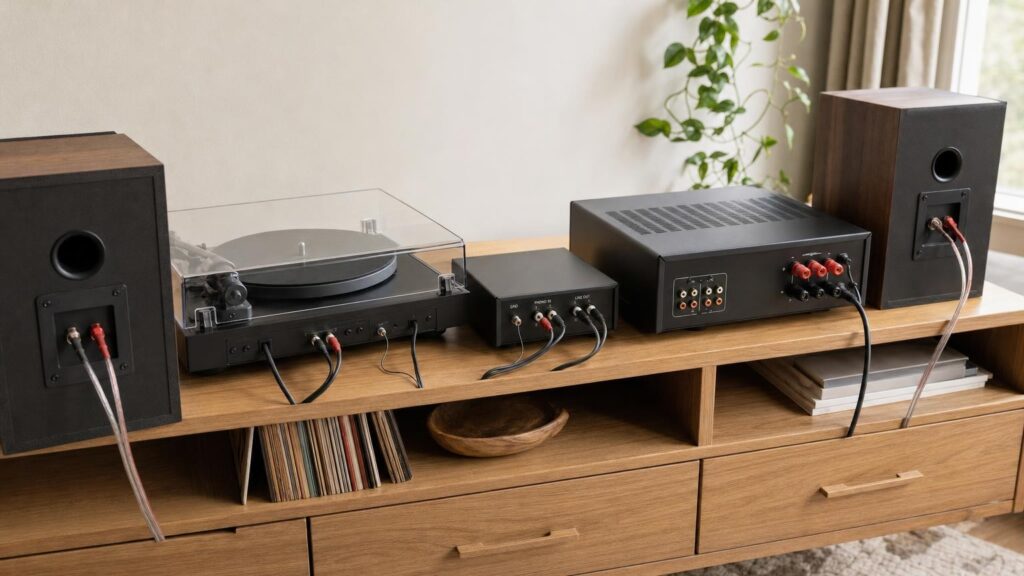
A turntable and a pair of speakers may appear easy to connect: find matching sockets, add a cable and play a record. In practice, the connectors are only part of the story. A turntable cartridge produces a specialised signal that usually needs both correction and amplification before speakers can reproduce it properly.
If the signal chain is incomplete or incorrectly matched, the result may be extremely quiet, thin, distorted or affected by hum. Understanding four things before buying – signal level, phono equalisation, speaker amplification and cartridge compatibility – makes it much easier to assemble a system that works as intended.
Phono level and line level are not interchangeable
Most familiar audio sources, such as media players, streamers and many computers, deliver a line-level signal. Inputs labelled AUX, LINE, CD or similar are designed to receive this kind of signal.
A conventional turntable cartridge is different. Its stylus follows the record groove, and the cartridge converts that movement into a small electrical signal. This raw phono-level output is considerably weaker than a typical line-level signal. It is also recorded with a deliberate tonal balance that must be corrected during playback.
For that reason, connecting a turntable’s raw phono output directly to a standard AUX input will not normally work properly. There may be some sound, but it is likely to be very quiet and lacking in bass. Increasing the speaker or amplifier volume does not solve the underlying mismatch and may make unwanted noise more obvious.
Connector shape does not determine signal type. RCA plugs can carry either phono-level or line-level audio, while some equipment uses other connector formats. Two sockets that physically accept the same cable are not necessarily electrically compatible.
What a phono preamp actually does
A phono preamp, also called a phono stage, performs two essential jobs.
- It adds gain. The phono stage raises the cartridge’s small output to approximately the level expected by an ordinary line input.
- It applies playback equalisation. Records are made using a standardised frequency curve that reduces low frequencies and increases high frequencies during production. The phono stage applies the complementary RIAA playback equalisation, restoring a balanced sound.
Without a phono stage, the output is not merely quieter than expected. Its frequency balance is also wrong, which is why a raw cartridge connected to an AUX input can sound noticeably thin or bright.
The opposite mistake is to process the signal twice. If a turntable’s built-in phono preamp is active and its line-level output is connected to another PHONO input, the second phono stage adds unnecessary gain and applies equalisation again. The result can be excessively loud, bass-heavy, muffled or distorted.
A working system therefore needs one suitable phono stage in the signal path – not zero and usually not two.
Where the phono stage can be located
The phono stage does not have to be a separate box. It may be built into one of several components, so shoppers should identify where this function will be performed before choosing cables or inputs.
Inside the turntable
Some turntables include a built-in phono preamp. Their output can usually feed a normal line input on an amplifier, receiver or pair of powered speakers. Models with a PHONO/LINE switch commonly use PHONO for the unprocessed cartridge signal and LINE for the output after the internal preamp.
The labels and operating instructions matter. Switch naming and socket arrangements can vary, and the switch should not be changed merely according to the shape of the connector.
Inside an amplifier or receiver
An integrated amplifier or receiver may have an input specifically labelled PHONO. This input includes a phono stage, although shoppers should still check which cartridge type it supports. A turntable supplying raw phono output connects here. A turntable already set to LINE should instead use a line-level input such as AUX.
In an external phono preamp
A separate phono preamp sits between the turntable and a line-level input. This is useful when neither the turntable nor the amplifier or speakers provides a suitable phono stage. It can also offer more cartridge-matching options, depending on its design.
The basic path is turntable phono output, external phono preamp, then a line input on the next component. The external unit should not normally feed another PHONO input.
Inside powered speakers
Some powered speakers include a dedicated PHONO input, while many provide only line-level or digital inputs. A socket accepting RCA plugs is not automatically a phono input. If it is labelled AUX, LINE or analogue input, a raw cartridge signal will usually need a phono preamp first.
Powered and passive speakers need different system chains
A phono preamp prepares the source signal, but it does not normally provide the power needed to drive passive loudspeakers. This distinction explains why adding a phono stage does not always complete the system.
Powered or active speakers contain their own speaker amplification. They generally accept line-level audio, although a model with a dedicated PHONO input may also accept a compatible turntable signal directly. Volume control may be built into the speakers or provided by another component.
Passive speakers do not contain a power amplifier. They require an integrated amplifier, receiver or separate preamplifier and power amplifier arrangement. A turntable or phono preamp cannot usually drive passive speakers on its own.
Common valid signal chains include:
- Turntable with an active built-in phono stage, then powered speakers with a line input.
- Turntable with raw phono output, then an external phono preamp, then powered speakers.
- Turntable with raw phono output, then an amplifier’s compatible PHONO input, then passive speakers.
- Turntable set to LINE, then an amplifier’s line input, then passive speakers.
- Turntable with raw phono output, then powered speakers with a compatible PHONO input.
Each chain needs a way to control listening volume. Powered speakers often provide this themselves, while a passive system usually relies on the integrated amplifier or receiver. An external phono preamp may have no user-adjustable volume control because its job is signal preparation rather than everyday level control.
MM and MC cartridges: matching matters
Moving-magnet and moving-coil cartridges both generate phono-level signals, but they do not necessarily have the same output or electrical requirements.
Moving-magnet cartridges, commonly abbreviated to MM, generally have a higher output than moving-coil designs and are supported by many standard phono inputs. Moving-coil cartridges, or MC cartridges, often produce a lower output and may require additional gain as well as different electrical loading.
This means a socket labelled PHONO is not automatically suitable for every cartridge. A phono stage intended only for MM use may produce very low output or excessive noise with a low-output MC cartridge. Some phono stages support both types through a switch or settings, while others are designed for one type only. There are also cartridge designs whose requirements do not fit a simple assumption based on the MM or MC name alone.
Before buying, identify the cartridge fitted to the turntable and consult the specifications for both the cartridge and phono stage. If the turntable has an internal preamp, check whether it is intended for the installed cartridge. If a future cartridge change is likely, consider whether the phono stage offers the necessary compatibility rather than assuming it will adapt automatically.
Grounding, hum and quiet operation
Many turntables with a phono-level output have a separate ground lead. This usually connects to the ground terminal beside the PHONO input on an amplifier or external phono preamp. Its purpose is to establish the intended grounding arrangement and reduce hum.
Some turntables do not use a separate ground wire because grounding is handled through their cables or internal design. A missing separate lead is therefore not necessarily evidence that something is incomplete. The correct arrangement is the one specified for the equipment.
A steady low-frequency hum that changes when the tonearm or cables are touched may suggest a grounding or connection problem, but not every unwanted sound has the same cause. Loose plugs, damaged or poorly routed cables, nearby power equipment and excessive phono gain can also increase noise. Digital interference or mechanical vibration may have different symptoms again.
When diagnosing hum, turn the system off before checking connections. Confirm that the ground lead, where required, is securely attached to the appropriate terminal. Keep delicate phono cables reasonably separated from mains adaptors and power leads, and avoid adding improvised grounding connections without guidance from the equipment manufacturer.
Check inputs, outputs and controls before buying
A useful compatibility check begins with functions rather than plug shapes. Work through the signal path in order:
- Cartridge: Is it MM, MC or another design, and what kind of phono stage does it require?
- Turntable output: Is the output raw phono level, line level or switchable between the two?
- Phono stage: Is one built into the turntable, amplifier or powered speakers, or is an external unit needed?
- Speaker type: Are the speakers powered, or do passive speakers need a separate power amplifier?
- Available input: Is the intended socket a true PHONO input or an ordinary line input?
- Volume control: Which component will provide convenient listening-level adjustment?
- Connections: Are the required audio cables, speaker cables and any ground lead supported at both ends?
Also check whether a built-in phono preamp can be switched off if an external one will be used. A PHONO/LINE control can add flexibility, but only when its setting is understood. If a component offers several analogue sockets, verify their labels and purpose rather than assuming all of them accept the same signal.
Common connection mistakes and how to diagnose them
The sound is extremely quiet and thin
The most likely cause is a raw phono signal entering a line-level input. Check whether the turntable has a built-in preamp and whether it is set to LINE. Otherwise, use a compatible PHONO input or add an external phono preamp.
The sound is very loud, bass-heavy or distorted
A line-level turntable output may be feeding a PHONO input, creating double amplification and double equalisation. Set a switchable turntable to PHONO for that input, or move its LINE output to an AUX or other line input.
There is no sound from passive speakers
Check for a power amplifier in the chain. A phono preamp raises and equalises the cartridge signal, but it does not normally power passive speakers. Also confirm the amplifier’s selected source, speaker connections and volume setting.
An MC cartridge is too quiet or noisy
The phono stage may be set for MM or may not support that MC cartridge’s output and loading needs. Confirm the cartridge model and use the appropriate phono-stage mode or a suitable separate solution.
There is persistent hum
Check the intended grounding arrangement, cable seating and cable routing. If the hum appeared after adding a phono stage or changing gain settings, recheck the entire path for duplicated stages, unsuitable gain or an unconnected ground lead.
Build the signal chain in the right order
A dependable record-playing system follows a clear functional sequence: the cartridge reads the groove, a suitable phono stage adds gain and RIAA equalisation, a volume and amplification stage brings the signal to a usable listening level, and the speakers convert it into sound.
Some products combine several of these functions, which can make a system look simpler. The underlying requirements remain the same. Before buying, identify which component performs each job and whether its signal type, cartridge support and controls match the next component. Matching connectors are convenient, but matching functions are what make the system work properly.
Continue exploring on Frowse
Discover More Frowse Insights
- Phillips, Pozidriv and JIS: Why Cross-Head Drivers Are Not Interchangeable
- Why Thicker String-Trimmer Line Is Not Always Better
- Why Noise-Cancelling Headphones Work Better on Some Sounds Than Others
- Why a Blackout Roller Blind Can Still Leave a Room Bright
- Why Thread Count Cannot Tell You How a Bed Sheet Will Feel