




Look beyond the material on the box
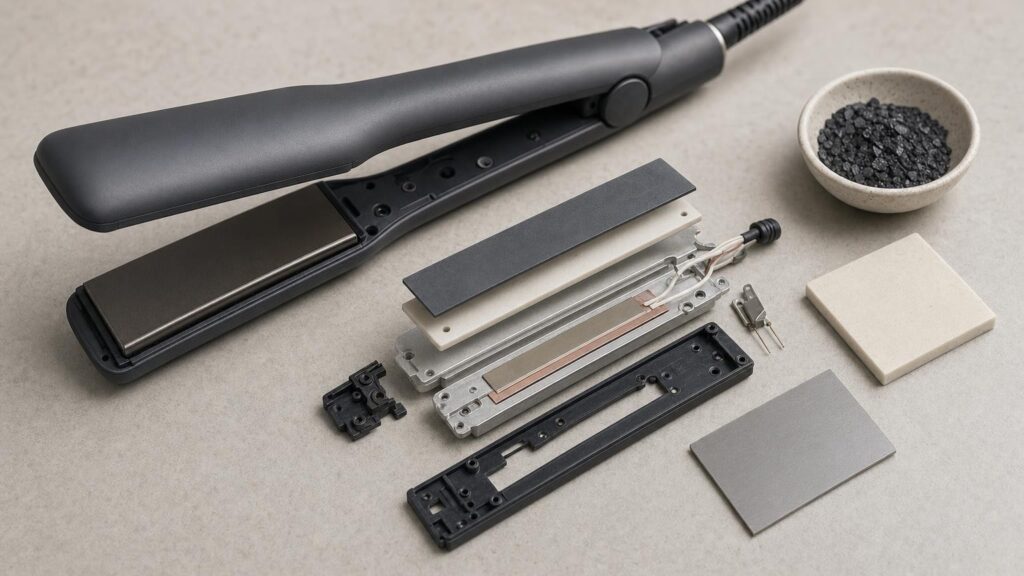
Ceramic, titanium and tourmaline are among the most prominent labels used to describe hair straighteners. They can sound like three clearly defined plate technologies, each with predictable performance. In reality, these words may refer to different parts of the product: the main plate body, a thin surface coating or an additive mixed into another material.
The material name therefore cannot tell you, by itself, how evenly a straightener heats, how closely it maintains the selected temperature or how smoothly it moves through hair. Those qualities depend on the complete system, including the heaters, sensors, control electronics, plate mass, mounting and hinge design.
Understanding what each label does – and does not – reveal makes it easier to compare straighteners without assuming that one fashionable material is automatically superior.
Plate substrate, coating and additive: three different things
A straightener plate can be thought of as a layered construction. The substrate is the underlying structural material. It gives the plate its shape and contributes to its weight, strength and thermal behaviour. Metal is commonly used because it can be formed precisely and can transfer heat from an internal heater to the plate surface.
A coating is a thinner surface layer applied over that substrate. It may be used to alter surface smoothness, wear characteristics or heat distribution. A ceramic-labelled plate, for example, may be a metal plate with a ceramic-based coating rather than a solid ceramic component.
An additive is incorporated into a coating or surface formulation. Tourmaline is commonly presented in this way. It does not usually describe the main structural plate or the heating system.
This distinction matters because similar wording can cover significantly different constructions. Phrases such as “ceramic technology”, “titanium plates” or “tourmaline ceramic” do not always explain the thickness, composition or durability of the relevant layer. If the product specification does not say whether a material is solid, plated, coated or blended into another layer, avoid filling in the gap with assumptions.
Ceramic: even heating versus coating durability
Ceramic materials are electrical insulators, although their ability to conduct and spread heat varies with their precise composition. In straighteners, ceramic or ceramic-based surfaces are generally intended to help distribute heat and provide a smooth contact face. The finished result still depends on what sits underneath the surface and where the heating elements are positioned.
A predominantly ceramic plate and a ceramic-coated metal plate are not the same construction. A coated metal plate may warm rapidly because the metal substrate transfers heat efficiently, while the ceramic-based outer layer modifies the surface. A thicker ceramic construction can provide more thermal buffering, but may take longer to respond to control adjustments. These are general material tendencies rather than guarantees of product performance.
Durability is another consideration. Ceramic materials can be brittle, while thin coatings may gradually scratch, chip or wear through. Wear can be accelerated by impacts, abrasive cleaning or residue left to build up on the plates. A damaged surface may no longer glide or distribute contact in the way it did when new, even if the heater continues to work.
Titanium: fast heat transfer with less thermal buffering
A titanium label does not necessarily mean that each plate is a solid slab of titanium. Titanium may form a surface layer, be combined with another metal or appear as one part of a more complex plate assembly. The underlying structure remains important.
Titanium-based plate systems are often designed for rapid thermal response. A thin metallic surface and relatively low-mass plate assembly can transfer energy to the contact surface quickly and react promptly when the heater switches on. That can be useful when working at a steady pace, but quick transfer is not automatically the same as even or accurate heating.
Where the plate has less thermal buffering, heater control becomes particularly important. Sensor location, switching logic and heater placement must work together to avoid large fluctuations or local hot areas. Technique matters too: slow movement, very small sections or repeated passes increase the time hair remains in contact with the hot surface. The material name does not compensate for an unsuitable temperature setting or inconsistent handling.
Tourmaline: a surface treatment, not a heating system
Tourmaline is a mineral used in finely ground form as an additive in some ceramic and other surface coatings. A “tourmaline” straightener is therefore usually still based on another plate and heater architecture. The term says little about the quantity of tourmaline present or the way it has been incorporated.
Marketing commonly associates tourmaline surfaces with ion generation, reduced static or smoother-looking hair. Tourmaline can exhibit electrical effects under certain conditions, but a label alone does not establish how significant any effect will be during normal use. Hair condition, humidity, products and brushing can also affect static and surface behaviour.
Most importantly, tourmaline does not reveal the number of heaters, the accuracy of the controls, the evenness of plate temperature or the durability of the coating. Treat it as one surface characteristic rather than a complete performance specification.
The hidden system behind consistent plate temperature
The temperature displayed on a straightener is normally a control setting or target. It is not necessarily a measurement of every point on the plate surface. Three separate questions are worth considering:
- Accuracy: how close is the measured plate temperature to the selected setting?
- Uniformity: is the temperature similar at the centre, edges and ends of each plate?
- Stability: how much does the temperature rise and fall as the straightener is used?
Heater number and placement influence uniformity. A short heater located near the centre may create a different thermal pattern from a heater extending along most of the plate. The plate material and mass then determine how readily that energy spreads and how much heat the assembly stores.
Sensor position also matters. A sensor close to the heater may respond quickly to changes there without perfectly representing the outer surface. One placed farther away may measure a more representative area but react more slowly. Control electronics use that reading to decide when to supply power, and the quality of this logic affects both recovery and overshoot.
Detailed information is not always published, so shoppers may be unable to compare these systems directly. Adjustable temperature controls and credible explanations of heater or sensor design can be more informative than a material label alone, but specifications should not be treated as proof of performance unless supported by reliable measurement.
Recovery time matters more than warm-up headlines
Initial heat-up time describes how long the straightener takes to reach its ready state after being switched on. Recovery time describes how it responds after cooler hair repeatedly removes energy from the plates. These are related but different measures.
As a section passes between the plates, their surface temperature can fall. The heater then adds energy to restore the target. If recovery is slow, later sections may encounter a cooler surface. If the control system responds too aggressively, the temperature may temporarily rise beyond the intended level. Plate mass can moderate these changes, while a responsive heater and well-tuned controls can replenish heat efficiently.
Working pace and section size affect the demand placed on the system. Large, dense sections absorb more energy and may prevent full contact with all the hair. Very rapid repeated passes give the plates less time to recover. A quick warm-up is convenient, but it does not demonstrate consistent temperature throughout a complete styling session.
Floating plates, pressure and full-length contact
Floating plates are mounted so that they can tilt or move slightly under pressure. This allows them to adapt to the angle of a hair section and can help maintain contact along more of the plate length. The aim is not simply to press harder, but to achieve useful contact without relying on a perfectly parallel hand position.
The term does not guarantee good alignment. Plate edges can still sit unevenly, the hinge may apply pressure inconsistently, or a gap may remain at one end. Excessive movement can also make the straightener feel less precise. Poor edge finishing or misalignment may contribute to snagging regardless of the plate coating.
When examining a straightener, look at how the plates meet with light, normal pressure. They should close predictably rather than requiring a forceful grip. Greater pressure does not necessarily improve straightening and can add unnecessary tension as the tool moves through the hair.
Plate width changes control, coverage and access
Plate width has a direct effect on handling, yet it is often overshadowed by material terminology. Narrow plates provide access close to the roots and make it easier to work on fringes, short sections and detailed areas. Their smaller body can also be easier to rotate when creating bends or curls, although the shape of the outer casing matters.
Standard-width plates offer a balance between access and coverage for varied everyday use. Wide plates cover more hair in one pass and may be convenient for long or dense hair, provided the section is thin enough for even contact. Taking a section as wide as the plate but too thick to sit between the surfaces defeats much of the benefit.
Wider models are generally bulkier around the roots and may be harder to manoeuvre on short hair. They can also occupy more luggage space and may feel heavier during a long session. Rather than choosing the greatest possible coverage, match width to the areas you need to reach, the styles you create and the size of sections you can control comfortably.
A specification-led way to choose
Start by establishing what the advertised material actually describes. Is it the plate substrate, a surface coating or an additive? If the wording is vague, regard it as incomplete information rather than evidence of a particular construction.
Then compare the features that affect day-to-day control:
- Temperature adjustment: look for settings that suit your intended use rather than focusing only on the highest available figure.
- Heating information: consider any clear description of heater layout, sensors and control, while recognising that claims do not replace independent measurement.
- Plate condition and alignment: check for smooth edges, even closing and a predictable floating action where fitted.
- Plate width: balance coverage against root access, detail work and portability.
- Handling: consider overall weight, grip shape, control placement, hinge resistance and cable movement.
- Care requirements: follow the cleaning instructions and avoid abrasive methods that could damage a coating.
Ceramic, titanium and tourmaline each describe potentially useful material choices, but none is a universal sign of quality. The better buying decision comes from considering the complete thermal and mechanical design, then matching its controls, plate size and handling to how you actually plan to use the straightener.
Continue exploring on Frowse
Discover More Frowse Insights
- Why Replacement Toilet Seats So Often Fit Poorly
- Why Noise-Cancelling Headphones Work Better on Some Sounds Than Others
- Why Tennis Balls Come in Pressurised Cans – and What Changes After Opening
- How to Read Bicycle Gearing Beyond the Number of Speeds
- Why a Power Bank Delivers Less Capacity Than Its Label Suggests