




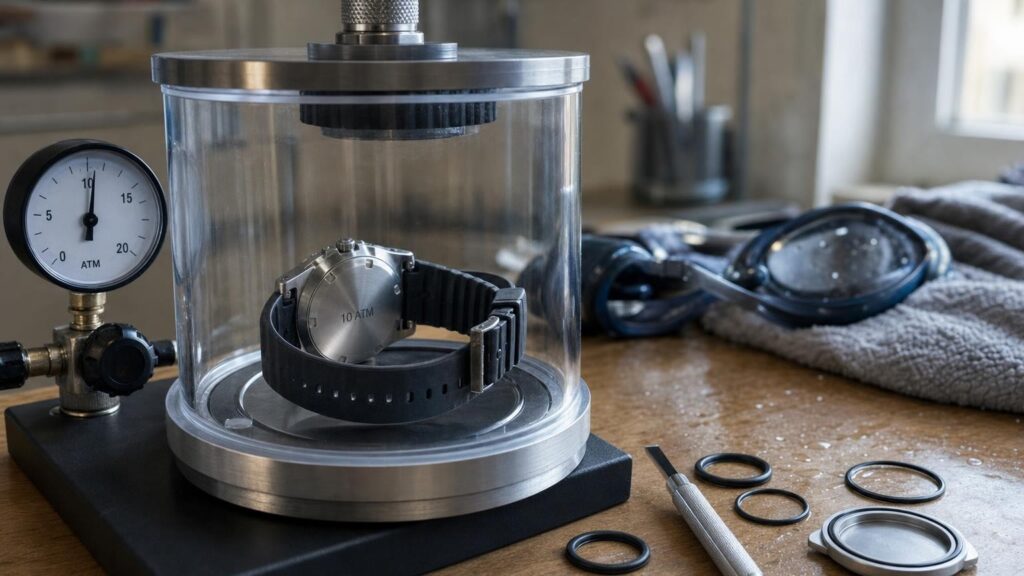
A water-resistance marking can look reassuringly simple: 3 ATM, 5 bar, 100 metres or another compact figure on the dial or caseback. Yet that figure is not a promise that the watch can be used for every activity associated with the stated depth. It describes performance under specified test conditions.
Real-world suitability also depends on the watch’s design, the manufacturer’s instructions and the present condition of its seals. Understanding those limits helps shoppers compare watches more intelligently – and helps owners preserve the resistance their watch was designed to provide.
What ATM, bar and metre markings mean
ATM and bar are units used to express pressure. One atmosphere and one bar are close in value, although they are not exactly identical. Watch markings often pair pressure ratings with conventional metre equivalents, such as 3 ATM with 30 metres or 10 ATM with 100 metres.
The metre figure is easily misunderstood. It does not necessarily mean the wearer can take the watch to that literal depth. Instead, it commonly represents the pressure associated with a water column under controlled testing. The watch is subjected to a specified pressure, usually without someone wearing it and without all the movement, temperature variation and impacts that occur during actual use.
Two watches with apparently similar markings may also have different intended uses. Their construction, controls, testing method and manufacturer guidance can differ. A metre figure should therefore be treated as part of the specification rather than as stand-alone permission to swim, snorkel or dive.
Static laboratory pressure versus real-world wear
Water-resistance assessments are conducted under controlled conditions. Depending on the relevant design and test process, a watch or representative sample may be exposed to air or water pressure while stationary. The test can establish whether the case resists leakage at the specified pressure under those conditions.
Daily wear is less predictable. A watch may encounter moving water, abrupt immersion, knocks against hard surfaces, changing pressure and accidental contact with a crown or pusher. These factors are not neatly represented by a single number on the caseback.
It is sometimes claimed that ordinary swimming movements create pressure equivalent to a particular extra depth. Such simple comparisons are not a dependable way to interpret a rating. Water striking a watch, the speed and angle of movement, and the design and condition of the case all vary. The more useful question is whether the manufacturer explicitly approves the watch for the intended activity.
Read the rating alongside the manufacturer’s usage guidance
Generic water-resistance charts can offer a rough orientation, but they should not override the instructions supplied for a specific watch. Manufacturers may describe what their ratings mean in terms of everyday situations such as rain, splashes, hand washing, swimming or diving.
Before buying, look for clear answers to practical questions:
- Is the watch intended only for incidental splashes, or is swimming expressly permitted?
- Does the guidance distinguish between surface swimming and underwater diving?
- Are the crown and pushers allowed to be operated in water?
- Does the maker identify any temperature, hot-water or steam restrictions?
- Is periodic pressure testing recommended, particularly after the case has been opened?
Terminology and test standards can vary between ordinary watches, sports watches and watches designed specifically for diving. A dedicated diving model may incorporate features and testing requirements that cannot be inferred from a similar-looking pressure figure on a general-purpose watch. Compare the complete usage guidance, not just the largest number in the specification.
How the case keeps water out
A watch case relies on several interfaces to keep moisture away from the movement. These can include the seal around the crystal, the caseback seal, the crown assembly and seals around any pushers. Gaskets made from resilient materials are compressed between components to close the small paths through which water could otherwise enter.
Crystal and caseback seals
The crystal must be fitted and sealed correctly where it meets the case. The caseback also needs an appropriate gasket and even closure. Threaded, screwed or press-fit casebacks use different construction methods, but none remains resistant merely because it looks substantial. The condition and positioning of the seal are crucial.
Push-pull and screw-down crowns
A push-pull crown is pressed into its normal position after setting the time. Its water resistance depends on seals within the crown and case tube. A screw-down crown is threaded into place, helping hold the crown securely against its sealing surfaces and reducing the chance that it will be left partly extended.
A screw-down crown can support good sealing discipline, but it does not determine the watch’s overall rating by itself. The crystal, caseback, crown tube, pushers and gaskets still form one system. Conversely, the absence of a screw-down crown does not automatically tell you that a watch has no useful water resistance. The declared rating and maker guidance remain decisive.
Pushers and additional controls
Chronograph pushers, correctors, rotating controls and other case openings create additional sealing points. Their presence is not necessarily a weakness when properly designed, but each component must be sealed and maintained. A watch with more controls may also give the wearer more opportunities to operate one accidentally.
Controls, straps and other easily confused limitations
As a general ownership rule, do not pull, turn or press a crown or pusher underwater unless the manufacturer expressly says that operation is permitted. Moving a control may temporarily alter the contact between its seals and surrounding components. A screw-down crown should normally be fully secured before the watch is exposed to water, without forcing or cross-threading it.
The case rating should also be separated from the water tolerance of the strap and decorative elements. A watch case might resist water while a leather strap stains, stiffens or deteriorates after soaking. Some fabrics retain moisture, while adhesives, coatings, stitching and decorative inserts may have their own limitations.
When choosing a watch for frequent wet use, check both halves of the specification: whether the case is approved for the activity and whether the fitted strap is suitable for repeated exposure. A replaceable strap can make a capable watch more practical, but changing it does not alter the case’s water-resistance rating.
Why water resistance changes with age and use
Water resistance is not necessarily permanent. Gaskets are compressed whenever the watch is assembled and can gradually lose elasticity. They may dry, distort or accumulate dirt. Repeated operation of the crown and pushers can wear sealing surfaces, while grit around a crown can interfere with closure.
Impacts may affect the crystal, caseback, crown tube or case geometry even when there is no obvious crack. Corrosion and contamination can also damage the surfaces against which a gasket must seal. The result is that a watch’s original rating describes its intended performance in the relevant tested condition, not the guaranteed condition of every example years later.
This distinction matters particularly with pre-owned watches. An engraving on the caseback cannot reveal whether the watch has been opened, whether the correct gasket was installed or whether it has subsequently passed a suitable pressure test. Service records and a current professional assessment can be more informative than appearance alone.
Temperature changes, hot water and condensation
Rapid temperature changes can place stress on a watch because the case, crystal and sealing materials may respond differently as they warm or cool. Temperature shifts can also encourage moisture already present inside the case to condense on a cooler surface.
Hot water, steam and soaps introduce additional considerations. Heat may be unfriendly to some gasket materials, while soaps and cleaning products can affect seals, finishes or strap components. A rating associated with pressure resistance should not automatically be read as approval for showers, saunas, hot tubs or similarly warm and steamy environments.
Droplets on the outside of a cool crystal can simply be ordinary surface condensation and can be wiped away. Mist, haze or droplets beneath the crystal are different: they suggest moisture may be inside the case. If internal condensation appears, avoid operating the controls and arrange prompt professional assessment. Waiting for the visible mist to disappear does not establish that the interior is dry or undamaged.
Servicing, battery changes and pressure testing
Opening a watch interrupts the sealing system. A battery replacement, movement service or repair may require removal of the caseback and its gasket. Crowns, pushers and crystals may also be disturbed during more extensive work.
Restoring water resistance involves more than closing the case again. The relevant gaskets need to be inspected, correctly seated and replaced when necessary. Suitable lubrication may be used where appropriate, and the caseback must be closed correctly. A pressure test suited to the watch can then check the assembled case for leakage.
There is no single service interval that fits every watch and pattern of use. Frequent immersion, harsh conditions, heavy crown use or an important upcoming trip may justify more attention than occasional exposure to rain. When buying, consider whether suitable servicing and pressure testing are readily available, especially if reliable water resistance is central to how you plan to use the watch.
A practical pre-purchase and ownership checklist
- Start with the activity. Decide whether you need protection from occasional splashes, regular swimming or a watch intended for diving.
- Check explicit manufacturer guidance. Do not translate the metre figure into an activity without confirming what the maker permits.
- Inspect the control design. Understand how the crown closes, whether there are pushers and whether any control can be operated underwater.
- Consider the whole watch. Check whether the strap, adhesives, finishes and decorative materials tolerate the same conditions as the case.
- Plan for maintenance. Ask what should happen after battery changes, servicing or other work that opens the case.
- Assess pre-owned examples individually. An original rating does not prove the current condition of the seals. Seek service information or current pressure testing where water exposure matters.
- Watch for warning signs. Damage around the crown, crystal or caseback and condensation beneath the crystal warrant professional attention.
A water-resistance rating is valuable when read correctly. It describes tested pressure performance, while the manufacturer’s instructions explain how that performance should translate into use. Match those instructions to your activities, account for the strap and controls, and remember that seals require care. Water resistance is best treated as a maintained property of the complete watch – not a permanent promise printed on its case.