




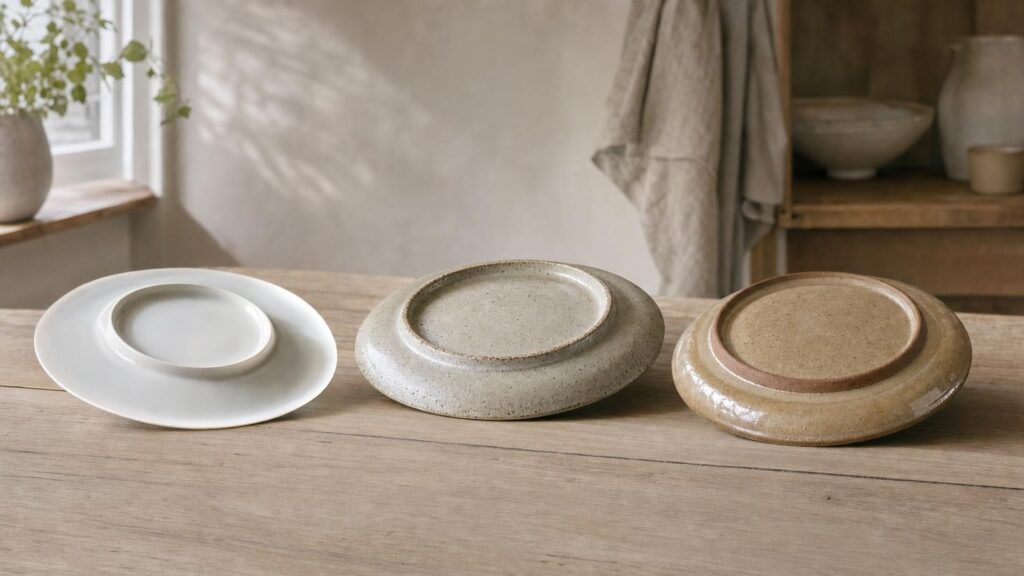
Porcelain, stoneware and earthenware are familiar dinnerware labels, but they do not form a simple ladder from basic to superior. Each name describes a general type of ceramic body produced through a particular combination of clay, minerals, forming methods and firing conditions. These differences can affect porosity, colour, thickness, weight and appearance, yet the material name alone cannot tell you how a plate, bowl or mug will perform in daily use.
Design and manufacturing decisions matter just as much. A thick porcelain plate may be heavier than a slim stoneware one, while a well-shaped earthenware bowl may be easier to handle than either. Rim profile, glaze, decoration, foot rings and care instructions all influence the ownership experience. Understanding the three material categories helps you interpret product descriptions without mistaking them for automatic quality grades.
What separates porcelain, stoneware and earthenware?
All three materials begin with clay mixed with other mineral ingredients. The precise recipes vary, as do the ways pieces are formed, dried, glazed and fired. During firing, heat permanently changes the ceramic body. Some components fuse into a denser, glass-like structure through a process called vitrification.
A highly vitrified body generally absorbs less water and can provide considerable strength relative to its thickness. A less vitrified body remains more porous and depends more on its glaze to provide a smooth, low-absorption surface. Firing temperature is only part of the explanation. The composition must suit the intended firing range, and careful control during forming, drying, glazing, firing and cooling also affects the result.
The boundaries between ceramic categories are not perfectly fixed. Manufacturers and regions may use terminology somewhat differently, and related terms such as china, fine china, fully vitrified and semi-vitrified can overlap with the main labels. The finished construction and stated care requirements are therefore more informative than a material name considered in isolation.
Porcelain: dense, refined and sometimes translucent
Porcelain is typically made from a refined, pale-firing ceramic mixture and fired to create a highly vitrified body. It is usually white or off-white beneath the glaze, although coloured finishes and decoration may conceal the underlying body.
One of porcelain’s distinctive possibilities is translucency. When made sufficiently thin, it may allow some light to pass through, giving cups and plates a delicate visual quality. Translucency is not guaranteed, however. Porcelain can also be formed into thicker, more substantial shapes that are intended to feel solid rather than fine.
The dense body normally has very low water absorption. Porcelain can often be made relatively thin while retaining useful strength, which is why it is associated with fine rims and light profiles. Hardness should not be confused with immunity to damage. A thin edge can chip when it strikes a tap, worktop or another dish, and a hard impact can crack any ceramic material.
Porcelain may suit shoppers who value lightness, a pale body, a slim profile or a more formal appearance. Actual dimensions and item weight remain important. A wide porcelain plate with a pronounced rim may occupy more cupboard and dishwasher space than a narrower stoneware plate, despite being thinner.
Stoneware: substantial, varied and practical
Stoneware is generally fired to produce a dense, vitrified or semi-vitrified body. It is often associated with thicker walls, earthy body colours and a substantial feel, but these are tendencies rather than defining rules. Stoneware may be pale, grey, buff, brown or another shade, and it can carry glossy, matt, textured or deliberately varied glazes.
Thicker stoneware may retain heat longer than a thinner piece of similar size, which can be useful when serving food. The same mass adds weight to a place setting, cupboard stack or dishwasher rack. Anyone who uses high shelves, prefers easy lifting or finds heavy dishes awkward should compare stated item weights instead of assuming every stoneware piece will feel the same.
There can be considerable variation within the category. One stoneware design may be slim and closely vitrified, while another may have chunky walls, visible clay and an intentionally irregular glaze. Neither construction is inherently better. A lighter, consistently shaped design may stack more compactly, while a weightier piece may provide the tactile character another shopper prefers.
Earthenware: more porous and reliant on glaze
Earthenware is generally fired at lower temperatures than porcelain and most stoneware, leaving its body less vitrified and more porous. Glaze consequently has an important role in creating the finished surface used for eating, drinking and cleaning.
The body may be cream, buff, red or terracotta in colour. Earthenware can support vivid decoration, traditional shapes and warmer, more rustic-looking finishes. Its porosity is a construction characteristic rather than evidence of poor workmanship. A well-made glazed earthenware piece can be entirely suitable for its stated purpose when handled according to the maker’s instructions.
Damage to the glaze or body deserves attention. A chip may expose a porous area that can absorb moisture. Cracks and extensive crazing may also make a piece more difficult to keep clean. Crazing appears as a network of fine lines in the glaze and may result from differences in how the body and glaze respond to stress or temperature changes. Some decorative finishes imitate a crackled appearance intentionally, so the product description and care information provide useful context.
Do not assume that an intact decorative surface makes earthenware suitable for every appliance or cleaning method. Compatibility depends on the complete item, including its glaze and decoration, rather than on the body category alone.
How the three materials compare in real use
The ceramic name suggests certain tendencies, but practical performance comes from the complete design:
- Weight and thickness: Porcelain is often made in thin, light forms, while stoneware and earthenware are frequently thicker. Exceptions are common, making stated dimensions and weights more reliable than category assumptions.
- Porosity: Porcelain is normally highly vitrified and has very low water absorption. Stoneware may be semi-vitrified or highly vitrified. Earthenware usually remains more porous beneath its glaze.
- Translucency: Thin porcelain may transmit some light. Stoneware and earthenware are normally opaque.
- Chipping: Every ceramic body can chip. Fine porcelain edges may be vulnerable to direct impacts, while a heavy stoneware piece can strike another dish with considerable force. Rounded or reinforced rims may be more forgiving than very fine edges, although manufacturing quality and handling still matter.
- Scratching and marking: Surface behaviour often depends more on the glaze than the body. Some apparent scratches are deposits left by metal cutlery rather than cuts into the glaze. Matt or pale finishes may make these marks easier to notice.
- Thermal shock: Abrupt temperature changes can stress any ceramic. A dense or vitrified body is not automatically thermal-shock resistant. Moving a cold dish into intense heat or placing a hot piece on a cold, wet surface may cause cracking.
Shape has its own practical effects. Deep foot rings can influence stacking and dishwasher placement. Broad rims use extra cupboard space, while irregular edges may prevent close nesting. Flat plates offer a larger uninterrupted eating area, whereas raised edges can make foods with sauces easier to contain.
Glaze, decoration and finish change the experience
The ceramic body and its surface coating are separate parts of the construction. Glaze is a glass-like layer fused to the body during firing. It can provide colour, gloss, texture and a surface that is easier to clean.
Glossy glaze usually feels smooth and may wipe clean readily, although dark glossy colours can make fingerprints and water spots more visible. Matt glaze creates a softer appearance but may show cutlery deposits or staining more readily, depending on its texture and formulation. Pronounced texture can also affect how utensils feel as they move across the surface.
Reactive glazes are formulated to develop variation during firing. Differences in colour, speckling, pooling and edge tone may be intentional. Shoppers who want closely matching pieces should take note of descriptions such as reactive, hand-finished or individually varied.
Unglazed foot rings and exposed clay details can add visual contrast, but they may feel rough against tables or adjacent dishes. Check the underside when possible and place pieces down carefully rather than sliding them across delicate surfaces.
Decoration can determine care requirements. Metallic rims, lustres and applied motifs may need different treatment from undecorated glazed ware. Microwave, oven and dishwasher compatibility should never be inferred from the ceramic body. Follow the instructions for the complete decorated item.
Reading product descriptions without overinterpreting them
Some dinnerware terms provide useful construction clues, while others mainly describe appearance or positioning:
- Fine china: This generally indicates a refined ceramic tableware body, but it is not a complete technical specification. Check the stated material, dimensions and care instructions.
- Bone china: This is a type of china traditionally formulated with bone ash. It is associated with a pale body and possible translucency, but thickness, weight and durability still depend on the individual design.
- Vitrified: This describes a body made dense and low in absorption through firing. It does not guarantee resistance to impacts, scratches or abrupt temperature changes.
- Semi-vitrified: This suggests that the body is only partly vitrified and may absorb more moisture than a fully vitrified body. The glaze and intended use remain relevant.
- Reactive glaze: This indicates that visible variation between pieces may be part of the intended finish.
- Hand-finished: This may refer to one production or decorative step. It does not necessarily mean the whole item was formed and decorated by hand.
- Chip-resistant: This should be treated as a relative performance description, not a promise that chipping cannot occur.
Useful specifications include individual dimensions, weight, body material, finish, included piece sizes and appliance-care instructions. Descriptive words such as premium, artisan or luxury reveal little by themselves about absorption, handling, stacking or maintenance.
Choosing for your routine and caring for it well
For frequent meals, consider comfortable weight, cupboard fit, dishwasher placement and the shape of each piece alongside its appearance. Smooth foot rings and consistent profiles can help when dishes are stacked closely. If low weight is a priority, compare the stated weight of individual plates and bowls rather than relying on the material label.
For formal settings, a slim profile, translucency or detailed decoration may be appealing. Such features may call for gentler handling even when the underlying ceramic body is strong. For a relaxed or rustic table, varied stoneware or decorated earthenware can provide the desired character, but irregular forms may require more storage space.
Whatever the material, avoid sudden temperature changes unless the maker explicitly approves the intended use. Microwave suitability does not necessarily mean oven suitability, and dishwasher approval does not mean pieces should be allowed to knock together during a cycle. Load ceramics so that rims, handles and decorated edges remain separated.
Inspect dinnerware periodically for chips, cracks and changes in the glaze. Stop using a piece when damage produces sharp edges, makes cleaning difficult or conflicts with the manufacturer’s guidance. With crazed or chipped earthenware, watch for staining or signs that moisture has reached the exposed body.
Choose the construction, not a hierarchy
Porcelain, stoneware and earthenware describe different approaches to ceramic composition and firing, not automatic levels of quality. Porcelain is commonly dense, pale and capable of a fine profile. Stoneware is often substantial and may be vitrified or semi-vitrified. Earthenware is usually more porous and glaze-dependent, with visual warmth and strong decorative potential.
The most suitable choice combines body type with practical details such as weight, thickness, rim shape, foot finish, glaze texture, decoration and care requirements. Compare those features with the way you lift, stack, wash, store and heat your dishes. That is more useful than choosing by the ceramic name alone.
Continue exploring on Frowse
Discover More Frowse Insights
- Why Identical-Looking Concealed Cabinet Hinges May Not Be Interchangeable
- What Makes Suitcase Wheels Smooth, Stable and Repairable?
- Where Ink Goes When an Inkjet Printer Is Not Printing Pages
- Why More Ceiling-Fan Blades Do Not Automatically Mean More Airflow
- What Makes a Paintbrush Hold Paint, Cut Cleanly and Keep Its Shape?