




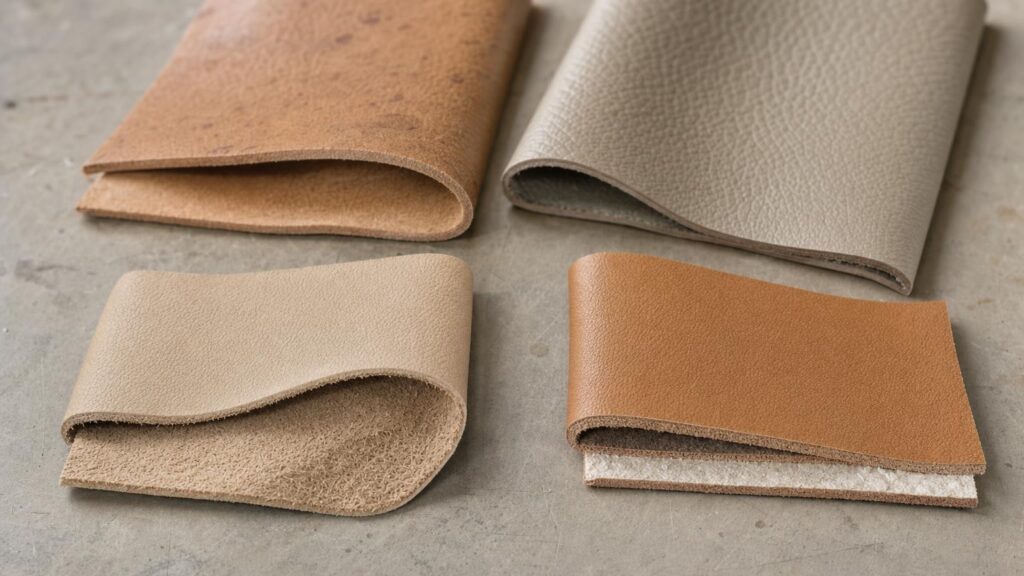
A leather upholstery label can sound definitive, but it rarely tells the whole story. Terms such as full-grain, top-grain, split and bonded leather mainly describe the material beneath the visible surface. They do not necessarily reveal how much that surface has been sanded, coloured, embossed or protected.
Those finishing choices can have a greater effect on how a sofa or chair looks, feels, cleans and ages than the prestige of the headline term. To assess leather upholstery properly, shoppers need to ask two questions: what is the underlying material, and what has been done to its surface?
How a hide becomes upholstery leather
Animal hide is not uniform from top to bottom. Its outer section contains the dense grain structure and the original skin surface. Beneath it are looser, more fibrous layers. A hide may be split horizontally during processing, separating the grain-bearing upper section from one or more lower sections.
The upper section can become full-grain or another form of top-grain leather, depending on how its surface is treated. The lower section becomes split leather. Although both originate from hide, they do not have the same fibre structure or natural surface.
Tanning stabilises the material, after which manufacturers may apply dyes, pigments, oils, waxes, embossed patterns and protective coatings. These processes are not minor details. They help determine colour consistency, stain sensitivity, cleanability, texture and the way wear becomes visible.
Thickness alone is not a reliable guide to category or quality. Leather can be adjusted for a particular use, and a substantial-looking surface may include coatings or backing materials. Equally, a thinner upholstery leather is not automatically inferior if it has been selected and engineered appropriately.
Full-grain and top-grain are related, not simple quality grades
What full-grain means
Full-grain leather retains its natural grain surface rather than having that surface mechanically removed. It may display pores, wrinkles, scars and variations in grain or colour. These features can make each upholstered panel look slightly different.
Because the original grain remains, full-grain leather is often associated with natural character and the potential to develop a patina. However, the label does not guarantee that the leather is uncoated, exceptionally soft or suitable for every household. Full-grain leather can still be coloured and finished in different ways.
A lightly protected surface may reward careful ownership with gradual tonal change and character. The same surface may also show spills, body oils, scratches or fading more readily than a heavily pigmented alternative. That trade-off can be attractive to one buyer and frustrating to another.
Why top-grain is a broader description
Top-grain generally refers to leather made from the upper, grain-bearing part of the hide. In commercial descriptions, however, the term can cover surfaces treated in quite different ways. Some top-grain leather retains much of its natural appearance, while some is buffed to reduce blemishes and then given a new, embossed texture.
Buffing and correction are not automatically signs of unsuitable upholstery. They can produce a more consistent surface and allow pigment and protective finishes to adhere evenly. The practical question is how extensively the surface has been altered and whether the resulting finish matches the buyer’s expectations.
Full-grain should therefore not be treated as the automatic winner in a universal ranking. A protected, corrected top-grain leather may be easier to live with in a busy family room, while a less corrected full-grain option may suit someone who values variation and evolving patina above uniformity.
Split leather, suede-like surfaces and coated splits
Split leather is made from a lower layer of the hide after the grain-bearing section has been separated. It has a more fibrous structure and does not retain the hide’s original outer grain surface. In an unfinished form, it can have a suede-like appearance.
For upholstery, a split may be finished with pigments, an embossed pattern or a more substantial surface coating. This can create a smooth face resembling grain leather. The visible texture may therefore be manufactured rather than the animal’s original grain.
This distinction matters because shoppers are interacting with both the leather substrate and the applied surface. Flexing, abrasion and ageing depend on how those components work together. A photograph showing a convincing grain pattern cannot establish whether the material underneath is grain leather, coated split leather or another construction.
Split leather can be used selectively on furniture, including areas that receive less direct contact. Its presence is not something to infer from appearance alone. The specification should identify where it is used and how it is finished.
Bonded leather is a composite construction
Bonded leather is not a continuous layer cut from a hide. It is a composite made using leather fibres or fragments combined with binders, backing materials and a manufactured surface. The precise formulation and layer structure can vary.
This makes it fundamentally different from full-grain, top-grain and split leather, all of which begin as continuous hide layers. Although bonded material contains leather, its behaviour is governed by the complete composite system rather than by leather content in isolation.
A percentage of leather content, where provided, does not by itself explain how the upholstery will flex, resist abrasion or age. The binder, backing, surface film, furniture design and conditions of use all matter. Shoppers should be cautious about treating a higher-sounding leather percentage as a complete performance measure.
Bonded constructions can offer a uniform appearance and may help achieve a particular price point. Their ageing pattern, however, should not be assumed to resemble the patina of a lightly finished hide. If the manufactured face wears or separates, the change may present as deterioration of a surface layer rather than gradual variation within natural grain.
Corrected grain, pigmentation and protective coatings
Grain category and finish type describe different things. A label might identify the hide layer while saying little about the visible finish. Understanding the following treatments makes specifications more useful.
- Correction: The natural surface is sanded or buffed to reduce visible marks and create a more even base.
- Embossing: A texture is pressed into the surface. It may imitate natural grain or create a decorative pattern.
- Pigmentation: Opaque colour is applied over the leather, improving colour consistency and helping conceal natural variation.
- Protective topcoating: A clear or coloured finishing layer helps protect the surface from handling, spills and abrasion.
- Transparent or semi-transparent colouring: More of the leather’s natural variation remains visible, although sensitivity to use may also be more apparent.
These treatments involve trade-offs rather than a simple progression from good to bad. Pigmented and protected leather can be practical where consistent colour and straightforward cleaning matter. A lighter finish can preserve a more natural hand and appearance but may demand quicker attention to spills and greater acceptance of marks.
Heavier coatings can also reduce some of the tactile and visual qualities associated with natural leather. Instead of developing colour variation within the grain, a coated surface may eventually show wear in the finish itself. Buyers expecting a traditional patina should establish what kind of finish they are actually getting.
What the finish means in everyday ownership
Furniture is exposed to repeated flexing, friction, skin oils, food, drink, sunlight and cleaning products. How visibly it responds depends heavily on the finish.
A more absorbent, lightly protected leather may darken when it encounters liquid or oil. Scratches can stand out initially, although some marks may become part of a broader patina. Variation is part of the appeal, but owners need to be comfortable with the furniture changing rather than remaining showroom-perfect.
A pigmented, protected finish generally creates a stronger barrier between daily life and the hide. Spills may be easier to remove promptly, and the colour is likely to look more uniform. Yet scratches or abrasion that break through the coating can contrast with the surrounding area. Over time, frequently used seats, piping and arm fronts may reveal finish wear.
Sunlight can affect colour and materials, so positioning remains relevant regardless of the leather category. Heat and very dry conditions can also be unhelpful. Care products should match the manufacturer’s instructions because a cleaner or conditioner intended for one finish may be inappropriate for another. More product is not necessarily better, particularly on coated upholstery.
How to read an upholstery specification critically
Online listings often condense complex upholstery into a short phrase. Use the following checks before drawing conclusions:
- Identify the substrate. Look for full-grain, top-grain, corrected-grain, split or bonded construction rather than relying solely on the word “leather”.
- Find the finish description. Terms such as pigmented, protected, coated, waxed, embossed or corrected reveal how the visible surface was created.
- Check every upholstered area. Seats and armrests may use a different material from outer backs, side panels or other non-contact sections.
- Clarify “leather match”. This commonly signals a combination of materials rather than one upholstery type throughout. The listing should explain which material appears where.
- Treat “genuine leather” as incomplete. It indicates real leather content in ordinary usage but does not specify the hide layer, level of correction, finish or overall construction.
- Do not classify by smell or texture. Fragrance, softness and grain pattern can be influenced by processing, embossing and coatings.
- Read the care instructions. They can provide clues about finish sensitivity and indicate the maintenance the maker expects.
- Ask how variation is presented. Natural markings may be desirable characteristics in one range but largely concealed in another.
If the description remains ambiguous, useful questions include: Is the seating surface continuous grain leather or split leather? Is it corrected and embossed? Is the colour pigmented? Which areas use alternative materials? What routine cleaning is recommended?
Choose according to priorities, not prestige
The right upholstery depends on the kind of ownership experience wanted. Someone who values natural markings, a tactile surface and gradual patina may accept colour variation and more attentive care. Someone managing frequent spills or seeking a consistent appearance may prefer a more protected, pigmented finish.
Budget matters, but material names should not be used as shortcuts for value. A prestigious label does not compensate for a finish that conflicts with household needs. Conversely, correction or pigmentation does not automatically make leather undesirable. These processes may deliver exactly the uniformity and practicality a buyer wants.
Consider how marks should age. Should light scratches and tonal changes merge into an evolving surface, or should the furniture retain an even colour for as long as possible? Is occasional visible variation welcome, or will it look like a defect? Honest answers are more useful than choosing the category with the strongest marketing reputation.
Finally, upholstery is only one part of a sofa or chair. Seams, panel placement, cushion support and frame construction also affect comfort and service life. Excellent leather cannot correct weak underlying furniture construction, while a suitable, well-finished cover can perform poorly if it is badly sewn or placed under excessive stress.
Ask what the leather is and what has been done to it
Full-grain, top-grain, split and bonded leather are meaningful terms, but none provides a complete buying decision on its own. They describe an underlying layer or construction. Correction, colour systems, embossing and protective coatings then shape much of what the owner sees and experiences.
Read upholstery information in two stages: identify the substrate, then identify the finish. Compare that combination with the appearance, maintenance commitment and ageing pattern you are prepared to accept. This approach is more dependable than ranking every leather by a single prestige label.
Continue exploring on Frowse
Discover More Frowse Insights
- Why a Desk Lamp’s Lumen Rating Does Not Reveal How Well It Lights a Work Surface
- End Grain, Edge Grain and Face Grain Cutting Boards Explained
- Digital Piano Actions Explained: Weighted Keys, Hammers and Sensors
- How Fabric Softener Affects Absorbency, Static and Fabric Feel
- Why a Wireless Charger’s Wattage Is Not Its Charging Speed