




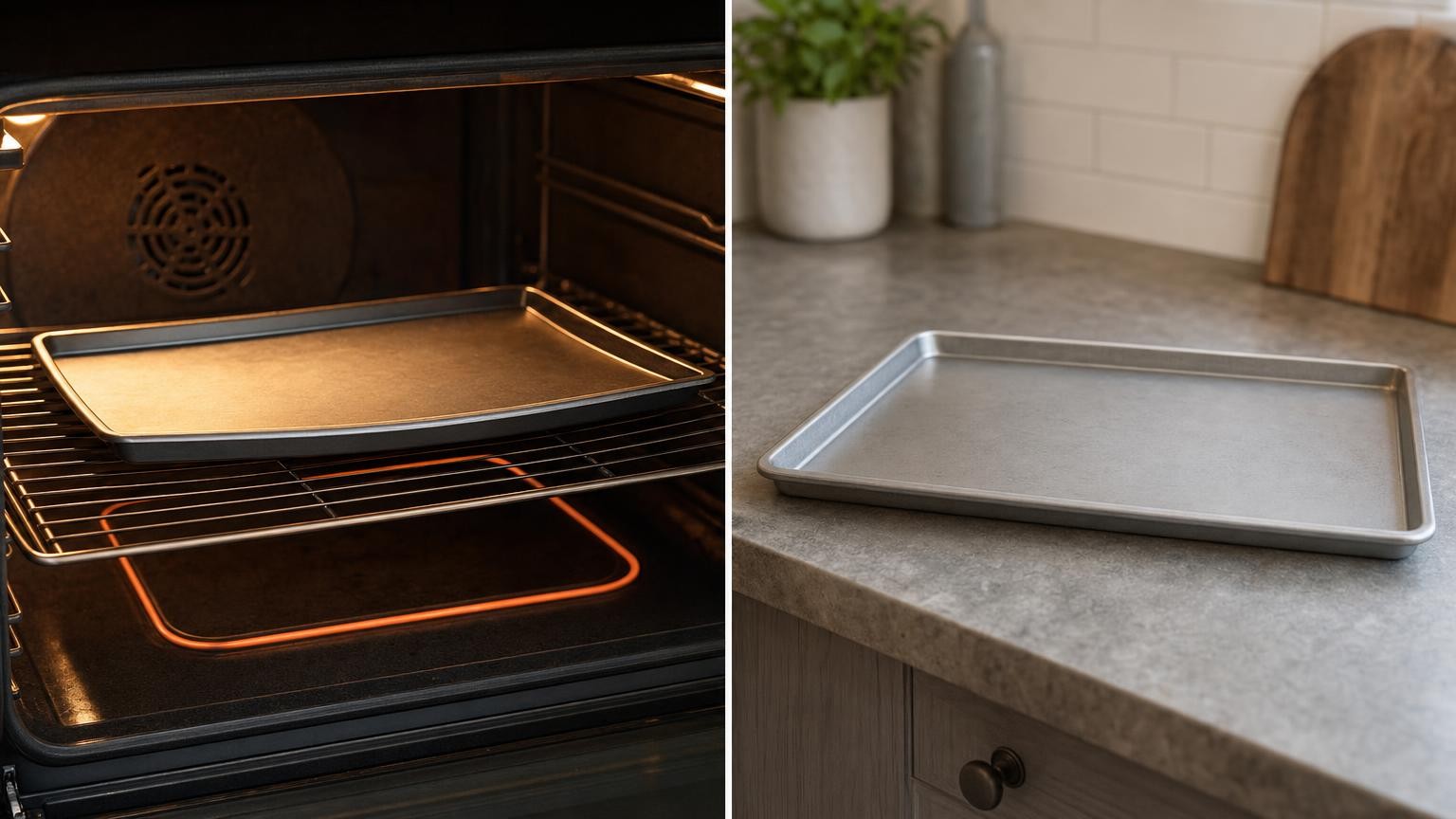
A baking tray can look perfectly flat when it enters the oven, then suddenly bow, twist or make a sharp popping sound as it heats. In some cases, it settles back into shape during cooking or once it cools. In others, a raised corner or curved base remains.
This movement is usually caused by uneven thermal expansion. Different parts of the tray heat and expand at different rates, creating stress within the metal. Whether that stress produces a temporary flex or a lasting bend depends on the tray’s material, thickness, size and construction, as well as how it is heated and cooled. Understanding these factors makes it easier to distinguish ordinary thermal movement from permanent deformation and to choose a tray suited to the way you cook.
Why a Baking Tray Can Suddenly Twist in the Oven
Metal expands when heated and contracts when cooled. A baking tray would change dimensions relatively evenly if every part of it reached the same temperature at the same time. Real cooking conditions are less uniform. The base may receive strong heat from below while the raised edges remain cooler. Food may cover one side, and oven racks may support some areas more firmly than others.
These temperature differences mean one part of the tray tries to expand before another. Because the sections are joined together, they cannot move independently. Stress builds until the broad, flat base bows or twists to accommodate the difference. The movement can be gradual, but it may also happen abruptly, producing the familiar metallic pop.
A dramatic change during heating does not automatically mean the tray is ruined. It may simply have flexed temporarily as temperatures changed. The more useful test is what happens after the heat becomes more even and, ultimately, after the tray has cooled on a suitable surface.
The Mechanics of Uneven Heating and Thermal Expansion
A tray’s base, corners, walls and rims do not necessarily respond to heat in the same way. The broad centre is often relatively flexible, while formed corners and rolled edges are stiffer. As the base expands, the rigid perimeter can restrain it. The resulting compressive stress may push the centre upwards or downwards.
Preheating can make the effect more noticeable. An empty tray placed in a hot oven heats quickly, but not always uniformly. Conversely, putting chilled dough, frozen food or a cold baking dish onto part of a hot tray can cool one area while the surrounding metal remains hot. A heavily loaded section may also warm more slowly than an exposed section.
Oven hot spots and concentrated radiant heat can add to the imbalance. A tray positioned close to a heating element may experience a stronger temperature gradient than one heated more gently. Abrupt temperature changes, such as moving hot metal onto a cold or wet surface, can reverse the pattern quickly as one region contracts before another.
None of these conditions guarantees warping. The outcome depends on how much stress develops and how effectively the tray’s structure resists or distributes it.
Temporary Warping Versus Permanent Deformation
Metal can flex within an elastic range. When the stress is removed, it returns broadly to its previous shape. This helps explain why a tray may bow during preheating, flatten as its temperature equalises, or recover after cooling.
Permanent deformation occurs when stress pushes the metal beyond its elastic limit. The tray then retains some of its altered shape. Repeated heating cycles can also make an existing weakness more noticeable, particularly if the tray is thin, already dented or repeatedly subjected to strong temperature differences.
Shoppers can use a simple practical distinction:
- Temporary movement: the tray changes shape while heating but returns close to flat when temperatures equalise or after it cools.
- Permanent deformation: the tray remains bowed, twisted or unstable on a flat surface after it has cooled fully.
- Functional deformation: the change is large enough to affect cooking, cause oil to collect in one area or make the tray sit insecurely.
A slight residual curve may not prevent a tray from working, especially for dry foods or lined baking. However, a rocking tray or one that sends hot fat towards a corner can be inconvenient and may no longer suit liquid-rich roasting.
How Alloy and Metal Construction Affect Behaviour
Aluminium and steel are common choices, but neither material is automatically warp-proof. Their behaviour depends on alloy, thickness, forming and reinforcement as well as the basic metal.
Aluminium
Aluminium conducts heat readily, so it can respond quickly to oven temperature changes and distribute heat effectively across the surface. It is also relatively light. Those qualities are useful for baking, but a thin aluminium sheet can be flexible. Aluminium also expands noticeably as it heats, so adequate gauge and edge construction matter on larger trays.
A substantial aluminium tray can be much more rigid than a thin one. The material label alone therefore says little about whether a particular tray will stay flat.
Steel
Steel is generally stiffer than aluminium at a comparable thickness and is often used where rigidity is important. It conducts heat less readily, however, so temperature differences can persist across the tray depending on its construction and oven conditions. Steel is also denser, which can make a robust tray heavier to lift and store.
Some steel trays rely on a protective or non-stick surface because the underlying metal may need protection from moisture. Care requirements depend on the particular finish, so the manufacturer’s instructions remain important.
Layered and formed constructions
Some trays use more than one layer, a textured base, pressed channels or other formed details. These can alter stiffness and heat distribution, but the presence of an extra feature is not proof of superior performance. Its location, depth and integration with the rest of the tray all matter.
Why Gauge, Tray Size and Shape Matter Together
Gauge describes metal thickness, although gauge numbering is not always presented consistently across materials and markets. Where an actual thickness or product weight is stated, it may be easier to compare trays of similar dimensions.
Thicker metal generally resists bending better than thinner metal, but size changes the calculation. A large base has a longer unsupported span and more opportunity to bow. A small tray made from moderately thick metal may therefore feel more rigid than a much larger tray of the same thickness.
Shape also contributes. Deep walls, formed corners and bends in the metal add stiffness, while a broad, shallow, uninterrupted sheet is easier to flex. This is why two trays made from the same material can behave differently.
Greater thickness and reinforcement bring trade-offs. A heavier tray can feel stable and cope well with substantial loads, but it takes more effort to lift with one hand, may respond more slowly to temperature changes and occupies more storage space. A lighter tray is easier to handle and can heat quickly, yet may be more susceptible to movement. The right balance depends on the intended task rather than maximum weight alone.
Rims, Rolled Edges and Reinforcement
A raised rim does more than contain crumbs or cooking juices. Bending the metal at the perimeter creates a stronger section that helps the tray resist flexing. Folded or rolled edges can increase this effect, and some designs enclose a reinforcing rod within the rim.
Reinforcement is especially relevant on large trays because the perimeter helps control a wider central span. Pressed ribs or channels in the base can also increase rigidity by turning a flat sheet into a more structured shape. However, pronounced surface features may affect how flat items sit or how easily the tray can be scraped and cleaned.
Rolled edges can add strength without making the entire base very thick, but they also add bulk. Depending on how an edge is sealed and cared for, joints or enclosed areas may require attention during washing and drying. A reinforced rim is useful, but shoppers should consider the complete design rather than treating the phrase as a guarantee against all movement.
What Coatings and Surface Finishes Do and Do Not Change
Surface finish and structural strength are separate buying considerations. Bare aluminium, anodised surfaces, non-stick coatings and darker finishes can differ in food release, cleaning, browning and care requirements. They do not, by themselves, determine whether a tray will warp.
The underlying metal, its thickness, the tray’s dimensions and the stiffness of its rim remain the main structural factors. A coated tray can still be thin and flexible, while an uncoated tray can be heavy and rigid.
Colour and finish may also change how a surface absorbs radiant heat, which can influence browning. That is a cooking-performance issue rather than direct proof of warp resistance. Shoppers should avoid using terms such as non-stick, anodised or heavy-duty as substitutes for construction details.
Repeated severe flexing can be undesirable for an applied coating because the surface layer must move with the metal beneath it. Avoid metal utensils or cleaning methods that conflict with the care guidance, and inspect a coated tray if it has become sharply creased or damaged.
Everyday Use That Can Encourage Warping
Normal oven use always involves temperature change, so perfect control is neither possible nor necessary. A few habits can nevertheless reduce extreme thermal stress:
- Avoid placing a very hot tray directly onto a cold, wet or highly conductive surface. Use a stable, heat-resistant support.
- Do not run cold water over a tray immediately after it leaves the oven. Allow it to cool before washing.
- Distribute food reasonably evenly where the recipe permits, rather than concentrating a heavy frozen load in one corner.
- Make sure the tray is supported appropriately by the oven rack and is not balanced on too few contact points.
- Use the tray within the temperature and cooking guidance provided for it, particularly when it has a coating.
- Avoid forcing a large tray into an oven cavity where its rim presses against the sides, as expansion needs some clearance.
These steps cannot eliminate every pop or flex. They simply reduce abrupt differences between sections of the metal.
How to Assess a Tray Before Buying
Start with the jobs the tray needs to perform. Biscuits and occasional reheating place different demands on a tray from high-heat roasting, large batches or frequent oven use.
When details are available, compare:
- Material and construction: look beyond a simple aluminium or steel label and note whether the tray is formed, layered or reinforced.
- Thickness or weight: compare products of similar size. A total weight is less informative when dimensions differ greatly, but it can still indicate how substantial a like-for-like design may be.
- Dimensions: check both oven fit and usable cooking area. Larger trays need more structural support.
- Rim design: raised, folded or reinforced rims can improve stiffness and contain liquids, although they add weight and bulk.
- Base design: ribs or pressed patterns may add rigidity, while a smooth base may be simpler to line and clean.
- Temperature suitability: confirm that the tray and any coating are intended for the temperatures and cooking methods you use.
- Handling: consider whether a loaded tray will be comfortable to lift, turn and remove from the oven.
Marketing descriptions such as professional or heavy-duty are difficult to compare without supporting dimensions or construction information. Concrete details are more useful.
Choosing the Right Level of Rigidity
For occasional baking at moderate temperatures, a lighter tray may offer a practical balance of price, quick heating and easy storage. For large batches, substantial roasting loads or frequent temperature cycling, a thicker base and strongly formed rim are more valuable. If flatness is particularly important, a smaller unsupported span, reinforced perimeter and substantial construction deserve priority.
No single material, coating or feature guarantees that a baking tray will never move. Temporary bowing can be a normal response to uneven heating and may disappear as temperatures equalise. Lasting distortion is more likely when thermal stress exceeds what the metal and design can recover from.
The most reliable buying approach is to consider material, gauge, dimensions, shape and reinforcement together. That provides a clearer picture of likely rigidity than any finish or marketing term on its own – and helps match the tray’s weight and strength to the cooking it will actually do.
Continue exploring on Frowse
Discover More Frowse Insights
- Why Lower Microwave Power Usually Means Switching Full Power On and Off
- Why Identical-Looking USB-C Cables Can Perform Completely Different Jobs
- Why Stainless-Steel Cutlery Can Still Rust, Stain and Bend
- Why Mattress Firmness and Foam Density Are Not the Same Thing
- Why One Glue Cannot Bond Every Household Material