




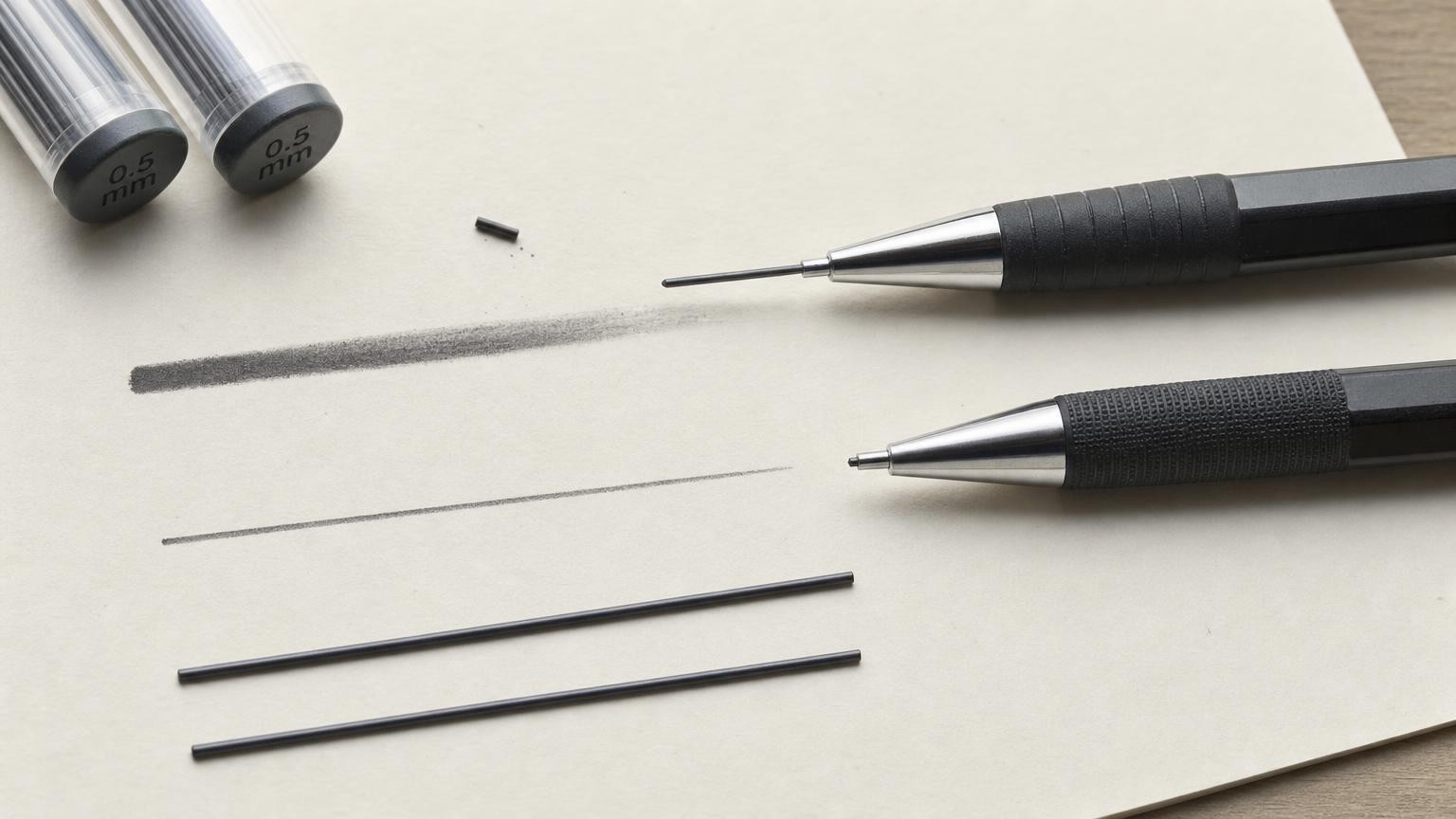
A diameter marking such as 0.5 mm or 0.7 mm is the first compatibility check when buying mechanical pencil refills, but it does not describe the whole writing system. Two packs carrying the same diameter can differ noticeably in darkness, smoothness, point retention, smudging and resistance to snapping. They may also feed differently through the same pencil.
These differences arise because performance depends on several interacting factors: the lead’s formulation and hardness, its dimensional consistency, and the design and condition of the pencil’s internal mechanism. Understanding those factors makes it easier to choose suitable refills and diagnose problems without immediately replacing the pencil or blaming the lead.
What mechanical pencil lead is made from
Despite its familiar name, pencil lead does not contain metallic lead. Mechanical pencil refills are generally graphite-based composite materials. Graphite provides the visible mark, while binders and other formulation components help create a thin, coherent rod that can survive handling and writing.
The balance of those ingredients influences several qualities at once. A formulation may prioritise a dark, smooth mark, while another may place greater emphasis on rigidity, point retention or clean handling. Changing the proportions and processing can affect:
- Darkness: how much material is deposited on the paper and how strongly it reflects light.
- Smoothness: whether the lead glides readily or produces more noticeable feedback.
- Friction: how much resistance the writer feels across different paper surfaces.
- Strength: how well the refill tolerates bending, impact and writing pressure.
- Erasability: how deeply material is worked into the paper and how readily it can be lifted.
- Smudge behaviour: how easily loose graphite transfers after a mark is made.
These characteristics involve trade-offs rather than a simple scale from poor to good. A very smooth, dark lead may be appealing for expressive notes or sketching but less suitable for someone who wants crisp, restrained marks. A firmer formulation may keep a narrow point for longer yet feel less fluid on rough paper.
Hardness grade changes more than line darkness
Hardness grades help shoppers predict broad differences in behaviour. Grades towards the H side are generally harder and lighter, while grades towards the B side are generally softer and darker. HB sits around the familiar middle ground, but it should not be treated as an exact universal formula.
Harder lead usually retains its shape for longer, which can support fine lettering and controlled technical lines. Because it deposits less graphite, a writer may press harder to achieve a darker result. That extra pressure can make a thin lead more vulnerable at the exposed tip, even though the material itself feels firm.
Softer grades typically create darker marks with less pressure and can feel smoother. They also wear more quickly, so the contact surface may broaden as writing continues. This can produce a richer but more variable line, along with more potential for smudging or graphite transfer.
Grade labels remain useful, but they are comparative guides rather than perfectly standardised sensory measurements. Two HB refills from different manufacturers can feel different because their binders, graphite characteristics and production methods are not necessarily identical. Moving from one brand or formulation to another may therefore change the writing experience even when both diameter and grade stay the same.
Nominal diameter versus the lead that must fit the pencil
The diameter printed on a refill pack is nominal. In practice, both refills and pencil components are manufactured within tolerances. The lead has to be narrow enough to travel through the pencil’s internal path, yet wide enough for the clutch to grip and control it.
If the fit is too tight, lead may advance unevenly, stick in the guide path or jam. If it is effectively too loose for a particular mechanism, the lead may slip back under pressure, advance unpredictably or wobble more than expected. Small differences can matter because mechanical pencils use compact parts designed around a narrow size range.
This does not mean that refills must always come from the pencil’s manufacturer. Many correctly labelled refills work across pencils designed for the same diameter. It does mean that a shared marking alone cannot guarantee identical feeding or feel in every pencil, especially where either the refill or mechanism sits near the edge of its permitted tolerance.
Why the pencil mechanism affects the same refill
A refill does not write in isolation. Several parts of the pencil determine how securely it is held and how much support it receives.
The clutch
The clutch grips the lead inside the pencil. When the advance control is pressed, it briefly releases and re-grips to move the lead forward. Its alignment, cleanliness and gripping force affect whether the refill remains stable under writing pressure. A worn, dirty or poorly matched clutch can allow slipping even when the lead itself is sound.
The lead tube and guide path
Lead stored in the barrel must pass through an internal tube or channel before reaching the clutch and tip. Debris, short broken pieces or deformation in this path can obstruct movement. A refill that seems defective may simply be meeting resistance inside the pencil.
The guide sleeve
The narrow sleeve at the tip supports the lead close to the paper. A longer or more precise sleeve can reduce lateral movement, although it may be more exposed to damage if the pencil is dropped. A bent sleeve can create friction, scrape the refill or force it out of alignment.
The advancement mechanism
Pencils vary in how much lead they deliver with each click. A large increment can leave too much unsupported material beyond the sleeve, increasing leverage and the chance of snapping. A small increment provides finer control but requires more frequent clicks. The same refill can therefore seem fragile in one pencil and dependable in another simply because of how far it is advanced.
Breakage is a system problem
Not all breakage has the same cause. It helps to distinguish between lead snapping at the writing tip and fragments breaking inside the pencil.
Tip breakage commonly results from a combination of pressure, writing angle and unsupported length. Thin lead is particularly sensitive to sideways force. Advancing less lead, holding the pencil at a less acute angle or reducing pressure may solve the problem without changing refill.
Internal breakage can occur after the pencil is dropped or knocked while loaded. Refills may fracture inside the reservoir without showing any immediate external sign. Those short pieces can later turn sideways, enter the feed path awkwardly or create intermittent jams.
Other possible contributors include:
- a refill formulation that is poorly suited to heavy writing pressure;
- a harder grade encouraging the user to press excessively for darkness;
- a bent or damaged guide sleeve;
- lead advanced too far beyond the supporting tip;
- fragments or graphite dust interfering with the clutch;
- an unsuitable refill diameter or inconsistent fit;
- rough handling during storage or transport.
Repeated snapping is therefore not automatic proof that the refill is weak. The useful question is where the break occurs and what forces the complete pencil-and-lead system is applying.
How lead and pencil combine to shape the line
Line character comes from both the material touching the paper and the way the pencil presents it. Harder formulations tend to retain a smaller contact area, supporting fine and relatively consistent lines. Softer formulations wear faster, creating a broader contact face and more variation as the pencil moves.
The writer also changes the tip during use. If the pencil remains in one orientation, the lead can develop a slanted surface. One edge may then produce a fine line while another makes a broader mark. Some users rotate the pencil by hand to keep wear more even. Pencils with mechanisms designed to alter lead orientation during writing may also change how consistently the point wears, but the result still depends on grip, stroke pattern and refill properties.
Different tasks favour different combinations:
- Everyday writing: often benefits from a balance of darkness, smoothness, point retention and easy erasing.
- Small handwriting: may favour firmer lead, limited tip play and controlled advancement.
- Technical work: usually places greater value on predictable width, good sleeve support and dimensional consistency.
- Sketching: may benefit from darker or softer grades that allow tonal variation, although faster wear and smudging can be part of the trade-off.
- General marking: may call for a wider diameter or darker grade when visibility matters more than an especially fine line.
Paper also changes the result. A rougher surface removes material faster and can make a lead feel less smooth, while very smooth paper may reduce feedback. A refill should therefore be judged in the context in which it will actually be used.
Choosing compatible refills without overreading the label
Start by matching the diameter stated on the pencil. A 0.5 mm mechanism should use refills labelled 0.5 mm rather than a nearby size that appears visually similar. Check the pencil maker’s refill guidance when it is available, particularly for an unusual diameter or specialised mechanism.
Next, choose hardness according to the intended result. A writer who presses lightly but wants dark notes may prefer a softer grade. Someone producing small characters or fine construction lines may prefer a harder grade that retains its point. Users with heavy pressure should consider not only hardness but also diameter, sleeve support and how much lead they normally expose.
When trying an unfamiliar refill, buy a modest quantity before committing to a large supply. Load only a few pieces, then check whether they advance cleanly, remain held under normal pressure and move through the sleeve without sticking. Also assess the line over a realistic writing session rather than judging only the first few strokes.
Shared diameter establishes basic compatibility, not identical performance. Brand, formulation and grade can change feel, while small tolerance differences can affect a particular clutch. The most useful refill is the one that both feeds reliably and produces the desired mark in the chosen pencil.
Diagnosing disappointing performance before replacing everything
A short troubleshooting process can help isolate the cause:
- Check the label. Confirm that the refill diameter matches the pencil and that the grade suits the intended darkness and pressure.
- Reduce extension. Advance less lead and test again. Improvement points towards excessive unsupported length rather than a defective refill.
- Try another piece from the pack. A single refill may have been damaged during handling.
- Inspect the tip. Look for an obviously bent sleeve or trapped fragment. Avoid forcing lead through resistance.
- Clear loose fragments carefully. Follow the pencil’s instructions if it includes a cleaning pin or specified clearing method.
- Compare with a known suitable refill. If one formulation feeds properly and another repeatedly slips or sticks, refill dimensions or surface characteristics may be interacting with the mechanism.
- Test the problem refill in another compatible pencil. If the fault follows the refill, formulation or fit is the likely issue. If it stays with the pencil, inspect the clutch, sleeve and feed path.
Scratchiness alone does not necessarily indicate a fault. It can result from a harder grade, a rough paper surface or the sharp edge of a newly worn tip. Wobble may come from excess lead extension or sleeve clearance. Slipping more strongly suggests a clutch or fit issue, while repeated jams point towards debris, fragments, damage or an overly tight path.
Choose the lead and pencil as a pair
Diameter is essential, but it is only the starting point. Composition and hardness determine how the refill marks and wears; manufacturing tolerances influence feeding and grip; and the clutch, sleeve and advancement mechanism control support, stability and exposure.
For a confident purchase, judge the refill and pencil as one system. Match the stated diameter, select a grade for the task, test a small quantity and pay attention to where any problem occurs. The best combination is not universally the darkest, hardest or strongest – it is the one that feeds reliably and produces the line, feedback and control that suit the user’s habits.
Continue exploring on Frowse
Discover More Frowse Insights
- Why Badminton Rackets of the Same Weight Can Feel Completely Different
- How Fabric Softener Affects Absorbency, Static and Fabric Feel
- Where Ink Goes When an Inkjet Printer Is Not Printing Pages
- Why Vacuum-Sealer Bags Are Textured – and Why Smooth Bags Often Do Not Work
- What Determines How Long a Cool Box Stays Cold?