




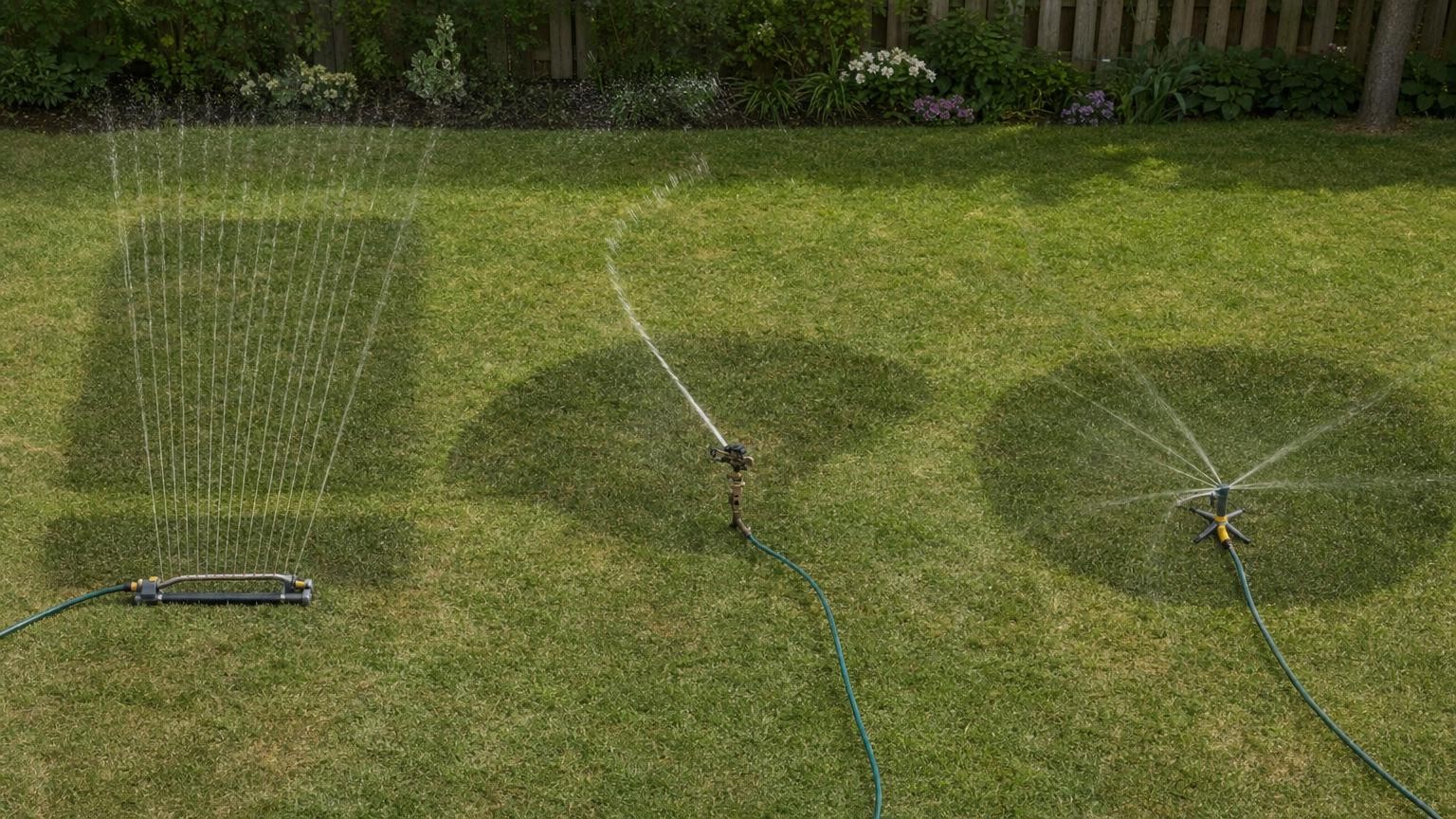
A sprinkler’s headline coverage figure tells only part of the story. Oscillating, impact and rotary sprinklers turn water pressure and flow into movement in different ways, producing distinct spray patterns, droplet sizes and watering characteristics. Two models quoting a similar maximum area may therefore perform very differently on the same lawn.
The best choice depends on more than distance. The shape of the space, available water supply, wind exposure, nearby borders and the need to reposition the sprinkler all matter. Understanding how each mechanism distributes water makes it easier to judge whether its pattern will provide useful, reasonably even coverage rather than simply reaching the furthest point.
How oscillating sprinklers build a rectangular spray pattern
An oscillating sprinkler usually has a straight bar containing a row of small nozzles. Water leaves these nozzles as multiple streams while the bar moves slowly from side to side. This sweeping action builds a broadly rectangular watering pattern, making the design a natural match for many conventional lawns.
Some models allow the user to adjust how far the bar moves in one or both directions. This can restrict the spray to one side, shorten its range or help keep water away from a path, wall or seating area. Spray-width controls may also reduce how much of the nozzle row is active, although the available adjustments vary by design.
The neat geometry shown in a product diagram should not be treated as an exact boundary. Streams lose momentum as they travel, and the outer edges may receive less water than the centre. Low pressure can shorten the sweep or range, while excessive pressure may create a finer mist that drifts more readily. Wind can push the top of the spray sideways because oscillating sprinklers often send water along a relatively high trajectory.
Nozzle condition also affects uniformity. Small openings can be disrupted by grit or mineral deposits, creating blocked, weak or misdirected streams. Models with accessible or cleanable nozzles may be easier to maintain, particularly where the water supply tends to leave deposits.
How impact sprinklers deliver water in rotating pulses
An impact sprinkler directs water through a concentrated jet. That jet pushes against a spring-loaded arm, which repeatedly moves into and out of the stream. Each impact interrupts the flow and helps advance the sprinkler head around its rotation. The familiar ticking sound is a direct result of this mechanism.
Rather than laying down many parallel streams, an impact sprinkler distributes water in rotating pulses. It may cover a full circle or an adjustable sector, depending on its controls. Sector adjustment is useful beside boundaries or when the sprinkler needs to water a broad arc without completing a full rotation.
The concentrated jet generally produces larger, more energetic droplets than a fine spray. These tend to hold their path better in moderate breezes, but they can hit delicate foliage, seedlings or loose exposed soil more forcefully. The effect depends on pressure, distance and adjustment, so a long jet should not automatically be assumed suitable for every planting area.
Positioning is particularly important. The repeated action of the arm and the reaction from the water jet can make an unstable sprinkler shift or tilt. A firmly planted spike or a broad, secure base helps preserve the intended arc. Spikes can work well in suitable ground but may be awkward in very hard, stony or waterlogged soil. A base is more portable and can be used on hard surfaces, provided it has enough stability.
Impact sprinklers are also noticeably noisier than most oscillating or rotary designs. That may be unimportant in a large open garden, but it is worth considering near windows, seating areas or neighbouring properties.
How rotary sprinklers divide flow between spinning arms or jets
Rotary sprinklers usually distribute water through multiple outlets mounted on spinning arms or a rotating head. In simpler designs, the reaction force from angled water jets makes the assembly turn. Other designs use an internal drive to control rotation. The resulting pattern is normally circular, although some models provide sector or distance adjustment.
The term rotary is sometimes used broadly, but a typical multi-arm rotary sprinkler is different from an impact sprinkler. Rotary models generally create a more continuous sequence of moving streams or sprays, whereas an impact mechanism repeatedly interrupts a concentrated jet. This difference influences sound, droplet character and how water is distributed during each revolution.
Available pressure and flow must be sufficient to operate both the outlets and the rotating mechanism. If the supply is weak, a reaction-driven sprinkler may turn slowly, stall or cover a smaller radius. Higher pressure does not guarantee a better result either. It may alter droplet size or rotation speed in ways that reduce useful uniformity.
Rotary patterns suit open areas where circular distribution is practical. On a rectangular lawn, however, a full circle may either miss the corners or throw water beyond the edges. Sector controls can improve the fit, but shoppers should check what can actually be adjusted rather than assuming every rotating design offers precise pattern control.
Why stated coverage is conditional rather than guaranteed
Coverage claims are commonly based on a particular water supply and favourable setup. Real reach depends on several connected factors:
- Water pressure: This provides the force behind the jets and may also operate the moving mechanism.
- Available flow: A supply can have reasonable static pressure yet struggle to deliver enough water once multiple nozzles are open.
- Hose length and diameter: Water loses pressure through a hose, with long runs, narrow internal diameters, bends and restrictions increasing those losses.
- Fittings and connectors: Small internal passages, partially closed valves, leaks or mismatched connections can reduce usable flow.
- Elevation: Supplying a sprinkler uphill can reduce the pressure available at the outlet.
- Simultaneous use: Taps, appliances or other watering equipment sharing the supply may change performance.
- Adjustment settings: Restricting width, arc or distance changes where and how much water is delivered.
Maximum reach is also not the same as evenly watered area. A few droplets landing at the quoted limit do not mean the entire pattern receives equal water. The more useful question is how much of the intended space can be watered consistently under the conditions at home.
If supply performance is uncertain, it is sensible to evaluate the sprinkler using the hose and tap that will actually be used. A design that performs well close to a tap may behave differently at the end of a long hose.
Droplet size, spray height and wind change where water lands
Water does not necessarily land where a still-air pattern suggests. Fine droplets have less momentum and are more easily carried sideways by wind. A high spray trajectory keeps them airborne for longer, increasing their exposure to both drift and evaporation. This can create a visibly distorted pattern even when the sprinkler itself is operating normally.
Heavier droplets and lower trajectories tend to resist drift more effectively. The trade-off is that larger drops can disturb uncovered soil or strike tender plants with greater force. A powerful jet may also be unsuitable where avoiding splash onto walls, furniture or paths is important.
Calmer conditions usually make any sprinkler easier to position accurately. If a site is regularly exposed, look beyond nominal distance and consider trajectory, droplet character and whether the pattern can be adjusted to limit overspray.
Pattern shape and overlapping placement determine evenness
An oscillating sprinkler’s rectangle can align efficiently with a long or square lawn. Rotary and impact sprinklers naturally create circles or sectors. None of these shapes is automatically superior – the useful pattern is the one that fits the space with the least unwanted watering.
Pattern edges are often weaker than central areas because fewer passes or droplets reach them. Circular patterns also create practical gaps when arranged across a rectangular space. Deliberate overlap can compensate for this. Instead of placing one pattern exactly beside another, position successive patterns so their weaker outer zones receive water from the neighbouring placement.
Overlap does not need to mean leaving multiple sprinklers running at once. A single unit can be moved between planned positions. Marking those positions or using fixed visual references can make repeat watering more consistent.
Watch for the opposite problem as well. The area close to a sprinkler may receive repeated passes while a distant margin gets much less. Containers placed at several points can provide a simple visual comparison of distribution, helping reveal dry edges or heavily watered centres without relying on spray appearance alone.
Matching the mechanism to the watering task
Rectangular and narrow lawns
An oscillating sprinkler is often the easiest pattern to align with straight lawn edges. Width and range controls are particularly useful for narrow spaces, although wind drift from a high arc may still wet adjoining paths or borders. Check whether adjustment is independent on each side if off-centre placement is likely.
Open circular areas
A rotary sprinkler can distribute water continuously around a central position with relatively little mechanical noise. It is a straightforward fit for open areas where a circle does not create substantial overspray. Corners and irregular boundaries may require repositioning or sector control.
Large arcs and boundary watering
An adjustable impact sprinkler can be useful when a strong rotating jet and defined sector are desirable. It may cope better with some breezy conditions than a fine elevated spray, but noise, secure anchoring and the force of the droplets deserve attention.
Borders and delicate planting
No single mechanism is always best for borders. Adjustable range and sector controls can help, but plant sensitivity and exposed soil matter too. A hard impact jet may be disruptive, while a fine spray may drift onto surrounding surfaces. For a very narrow or densely planted border, a sprinkler may be less precise than a more targeted watering method.
Irregular plots and larger spaces
An irregular area usually requires several positions regardless of sprinkler type. A long headline range may reduce the number of moves, but only if the resulting pattern remains useful. In larger spaces, repeatable placement and sensible overlap can matter more than extracting the greatest possible distance from one position.
Specifications, construction and ownership details worth interpreting
Useful specifications describe control as well as size. Look for arc adjustment, independent range limits, spray-width control and a clear indication of the base pattern. Nozzle count can describe how an oscillating model is arranged, but more nozzles alone do not prove greater reach or more even watering.
Connector fit should suit the intended hose system without relying on leaks or improvised adaptors. Stability also deserves attention: broad bases distribute weight, while spikes provide direct anchoring in compatible ground. Consider where the sprinkler will actually be placed rather than choosing either form in isolation.
Materials need interpretation rather than simple ranking. Metal components can add weight and resist some forms of wear, but they remain exposed to corrosion depending on the metal, finish, water and storage conditions. Plastics can reduce weight and avoid rust, yet their strength and resistance to sunlight or impact vary. Material names alone do not establish overall durability.
Seals, bearings, gears, springs and moving joints may influence long-term operation as much as the visible body. Serviceable nozzles and accessible filters can make routine cleaning easier. Draining the sprinkler after use, preventing trapped water from freezing and storing it away from unnecessary weather exposure can help protect moving parts and seals.
Choose for distribution quality, not headline distance
Oscillating sprinklers sweep rows of streams across a broadly rectangular area, impact sprinklers rotate a pulsed jet, and rotary sprinklers use spinning outlets to create mainly circular distribution. Those mechanisms shape the pattern, droplet behaviour, sound and adjustment options.
The right choice is the one that works with the site’s shape, water supply and local conditions. Treat advertised coverage as a best-case reference rather than a promise, and distinguish the furthest wet point from the area watered consistently. A controllable pattern, stable position and planned overlap will usually be more valuable than the largest quoted distance.
Continue exploring on Frowse
Discover More Frowse Insights
- What a Sleeping Mat’s R-Value Reveals – and What It Leaves Out
- Phillips, Pozidriv and JIS: Why Cross-Head Drivers Are Not Interchangeable
- Suction, Airflow and Floorheads: What Really Determines Vacuum Cleaning Performance
- How Fabric Softener Affects Absorbency, Static and Fabric Feel
- How Denim Weight, Weave and Stretch Change a Pair of Jeans