




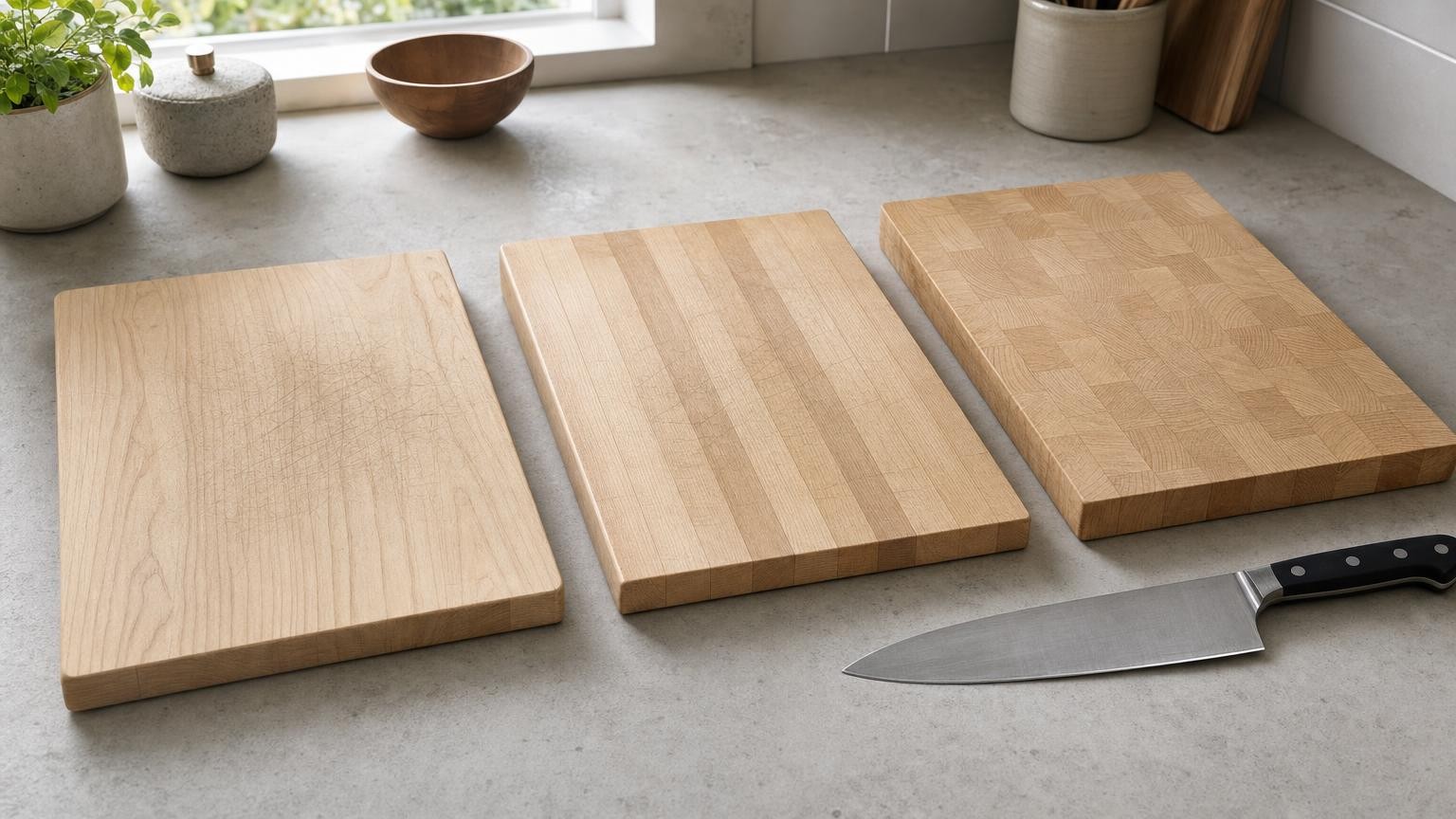
Choosing a wooden cutting board is not simply a matter of selecting a wood species or an attractive pattern. The way the wood is cut and assembled changes how the working surface meets a knife, responds to moisture and develops wear. It also affects weight, maintenance and whether the board can eventually be resurfaced.
Face grain, edge grain and end grain describe the orientation of the wood fibres at the cutting surface. None guarantees a good board by itself. Grain orientation needs to be considered alongside workmanship, dimensions, flatness, joint quality and the amount of care the board will receive.
Why construction matters as much as the wood itself
Wood is directional. Its fibres run mainly along the length of the tree, while its dimensions change differently across and along those fibres as moisture conditions vary. Turning a piece of wood changes which part of that structure becomes the cutting surface.
This orientation influences several practical characteristics:
- How readily knife marks become visible
- How the board expands and contracts as it gains or loses moisture
- How many pieces and glued joints are needed to form the board
- How thick and heavy the finished product is likely to be
- How straightforward it may be to sand or resurface later
Wood species still matters because woods vary in density, pore structure and colour. However, two boards made from the same species may perform and age differently if one is made from broad face-grain planks and the other from many end-grain blocks.
Face grain, edge grain and end grain explained
Face grain
A face-grain board presents the broad face of a plank as its working surface. The long wood fibres run roughly parallel to that surface. Depending on how the original log was sawn, the growth-ring pattern may appear as flowing lines, arches or straighter bands.
Face-grain boards can show off the natural figure of the timber and may require relatively few pieces. They are often thinner than substantial butcher-block designs, although thickness varies considerably. Their broad surfaces can show scratches clearly, especially on dark, finely finished or highly figured wood.
Edge grain
An edge-grain board is usually assembled from strips turned so that their narrower edges form the working surface. As with face grain, the long fibres generally run parallel to the board surface. The difference is which side of each sawn strip faces upwards.
Edge-grain construction commonly creates a linear, striped appearance. It can provide a practical balance between material use, thickness and structural simplicity. However, appearance alone is not a reliable identifier: narrow face-grain strips can also look striped, and product terminology is not always applied consistently.
End grain
On an end-grain board, the ends of the fibres face upwards. It is typically made by gluing strips into a panel, cutting that panel across the grain and rearranging the resulting blocks before another glue-up. The familiar chequered or block pattern comes from this construction process.
End grain should be identified by fibre orientation rather than by the number of squares or colours. Decorative boards can imitate a block pattern while presenting long grain at the surface, and genuine end-grain boards can use blocks arranged in more complex patterns.
How grain orientation changes knife contact and surface wear
On face- and edge-grain surfaces, a descending blade meets the sides of long fibres. Repeated cutting can score across or separate those fibres, leaving lines that become more visible as they accumulate. The severity depends on the wood, knife edge, cutting technique and force as well as grain orientation.
On end grain, a knife approaches the exposed fibre ends. With light cuts, the edge may enter between fibres and they may partly close afterwards. This is why end-grain boards are often associated with a more yielding cutting feel and less conspicuous shallow scoring.
That effect has limits. End grain is not self-repairing in a literal sense, and no wooden cutting board is immune to marks. Heavy chopping, serrated blades, cleavers and repeated work in one area can cut, crush or remove fibres. Deep gouges remain visible, while dents can alter the surface without actually slicing fibres.
Visible wear is not necessarily structural damage. Fine scoring is an expected sign of use. Cracks, splinters, raised areas and opening glue lines deserve more attention because they can affect flatness, cleaning and the integrity of the board.
Wood movement, warping and the role of glued joints
Wood takes on and releases moisture in response to its environment. Most dimensional movement occurs across the grain rather than along the fibre length, and movement can differ in radial and tangential directions relative to the original growth rings.
In a broad face-grain plank, uneven moisture exposure can encourage cupping. An edge-grain panel divides the width into narrower strips, but its stability still depends on grain selection, drying and assembly. An end-grain board combines many blocks whose movement must be accommodated by the overall construction.
More glued joints do not automatically make a board weak. Properly prepared surfaces, suitable adhesive, accurate alignment and compatible grain orientation can create a durable assembly. Conversely, even a board with few joints can warp if the timber was poorly prepared or if one face repeatedly becomes wet while the other remains dry.
Shopper-friendly signs of sound construction include a flat surface, neat seams, consistent alignment and an absence of visible gaps. Decorative complexity should not be mistaken for structural quality. Very small pieces and elaborate patterns demand precise workmanship, but the pattern alone cannot reveal how well the board was made.
Thickness, size and weight: the practical stability trade-off
Thickness can add stiffness and provide material for future resurfacing. A thick, broad board may also feel planted on a worktop, particularly when combined with sufficient weight and a stable base. These qualities are useful for forceful chopping or preparing several ingredients.
The same board can be awkward to lift, wash and turn for drying. It may not fit comfortably in a sink, rack or cupboard. A heavier end-grain board might therefore remain in a permanent worktop position, while a thinner face- or edge-grain board may suit a kitchen where it must be stored after every use.
Size and weight should be considered separately. A large but thin board can flex or feel unstable, whereas a small, very thick board may be heavy without offering enough working area. Feet can improve grip and airflow but usually prevent use of both faces and may complicate resurfacing.
Thickness is not a cure for poor construction or moisture exposure. A substantial board can still warp or split if soaked, heated or dried unevenly. Before buying, consider whether the board can be handled comfortably when wet, not only how solid it feels on display.
Maintenance requirements in everyday use
Wooden boards benefit from prompt hand washing and thorough drying. Prolonged soaking allows moisture to penetrate more deeply, while a dishwasher combines extended wetting with heat and aggressive drying. Unless the maker explicitly states otherwise, conventional wooden boards should not be treated as dishwasher-safe.
After washing, both faces should be allowed to dry with airflow rather than leaving the board flat on a wet surface. Exposing both sides more evenly helps reduce moisture differences that can encourage distortion. Standing a board securely on an edge can help, provided it cannot fall or remain trapped against a damp surface.
Some boards are intended to be conditioned periodically with a suitable food-contact product. Conditioning can slow rapid moisture exchange and refresh a dry-looking surface, but it does not waterproof wood or repair an open joint. The maker’s instructions should take priority because finishes and composite constructions vary.
Maintenance tolerance is a genuine buying criterion. A board that is too cumbersome to wash or too demanding for the owner’s routine may be a worse practical choice than a simpler, lighter construction.
Resurfacing, knife marks and when damage is permanent
Shallow scoring, staining and minor unevenness may sometimes be removed by sanding or professional resurfacing. The board must retain enough thickness to stay stiff and usable, and material needs to be removed evenly so that the surface remains flat.
End grain can be more demanding to refinish because exposed fibre ends do not sand exactly like long grain. Uneven pressure may leave low areas, while an intricate pattern can make flatness harder to judge visually. Mechanical planing can also require specialist technique. For a valuable or badly worn board, professional assessment may be preferable to aggressive home resurfacing.
Not every defect should be sanded away. Deep cracks, loose blocks, open glue lines and severe warping are structural issues rather than cosmetic wear. Removing enough wood to reach the bottom of a deep gouge may make a board too thin or alter features such as juice grooves and feet. A board with unstable, splintered or separating areas may have reached the end of its practical service life.
Buyers interested in future refinishing should look for adequate usable thickness and a simple, flat cutting surface. Deep perimeter grooves, attached hardware and raised features can reduce resurfacing options.
Where bamboo and wood-fibre composites fit
Bamboo boards are often grouped with wooden boards, but bamboo is a grass and is typically processed into laminated strips or pieces. Their cutting surfaces may be described using grain-like language, yet their behaviour depends heavily on strip arrangement, adhesive and manufacturing quality. They should not automatically be treated as face-, edge- or end-grain hardwood equivalents.
Bamboo can offer a rigid board at a manageable thickness, but the many laminated elements make joint integrity and care important. Whether a particular bamboo board can be sanded depends on its construction, surface layer and remaining thickness.
Wood-fibre composites are another distinct category. They are generally made from wood fibres combined under pressure with a binder rather than from intact boards or blocks. They can be thin, rigid and relatively convenient to maintain, with some products designed for dishwasher cleaning. That capability must be confirmed for the specific board rather than assumed.
Composite surfaces develop wear differently from solid timber and usually have limited scope for substantial resurfacing. They suit shoppers who prioritise slim storage and straightforward handling, while a thick solid-wood board may appeal more to someone who values mass, natural variation and the possibility of future refinishing.
Choosing the construction that matches how you cook
There is no universally best grain orientation. The useful choice is the one that balances cutting feel and wear with the realities of the kitchen.
- Consider face grain if natural figure, lighter construction and a relatively simple panel are priorities, and visible knife marking is acceptable.
- Consider edge grain for a practical middle ground with a linear appearance, long-grain surface and a range of possible sizes and thicknesses.
- Consider end grain if cutting feel, substantial weight and less conspicuous shallow scoring matter enough to justify extra bulk, cost and maintenance effort.
- Consider bamboo or composite when storage, rigidity or care requirements are more important than owning a conventional solid-wood construction.
Whichever category you choose, examine flatness, dimensions, weight, seams and finish rather than relying on a grain label alone. Think about sink size, drying space and how often the board will be moved. Grain orientation shapes how a cutting board behaves, but good workmanship and realistic ownership habits determine whether those theoretical advantages remain useful in everyday cooking.
Continue exploring on Frowse
Discover More Frowse Insights
- Why Bathroom Scales Give Different Readings on Different Floors
- What Dishwasher Salt and Rinse Aid Actually Do
- Refresh Rate, Response Time and Input Lag: What Each Monitor Specification Means
- Forged, Stamped and Socketed: What Makes a Garden Spade Last
- Why Rechargeable AA Batteries Are 1.2 Volts – and When That Matters