




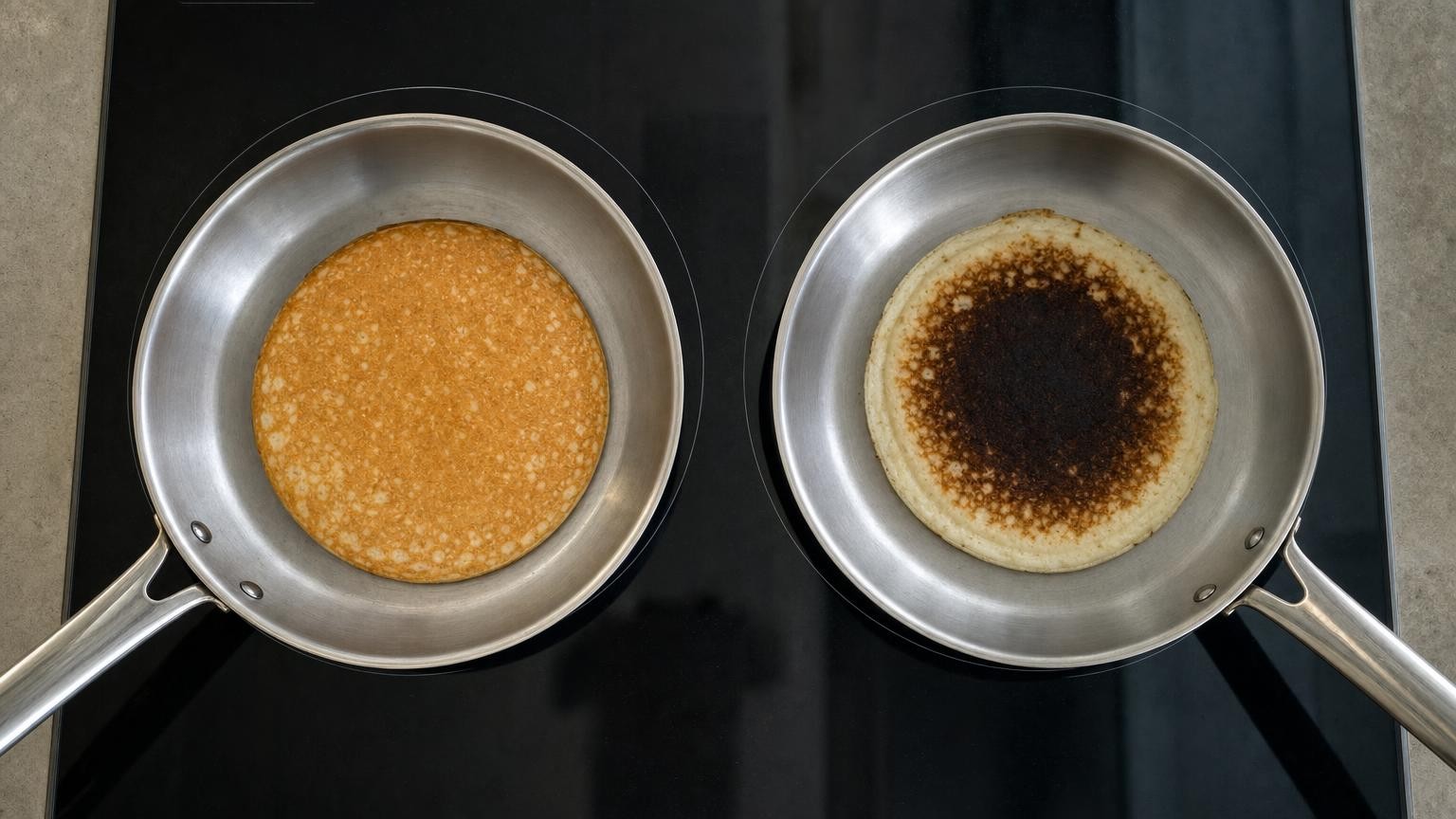
A pan can attract a magnet and still produce a scorched centre, slow-cooking edges or distracting buzzing on an induction hob. That is because magnetic compatibility is only the entry requirement. Cooking performance also depends on how the pan is built, how effectively it spreads heat and how well its base matches the hob’s active induction zone.
Understanding those differences helps you look beyond an induction symbol and choose cookware suited to the way you actually cook.
A magnet confirms compatibility, not cooking quality
Induction cookware needs a base containing a ferromagnetic material – one that responds to the hob’s magnetic field. Magnetic stainless steel, cast iron and many carbon-steel pans meet this basic requirement. Aluminium, copper and some grades of stainless steel do not work by themselves, although they can be combined with a magnetic outer layer.
A simple magnet test can therefore indicate whether a pan is likely to be recognised by an induction hob. It cannot reveal how quickly the pan will respond, how evenly heat will reach its edges or whether its base will remain stable after repeated heating.
Even the apparent strength of the magnetic attraction is not a reliable performance score. A strongly magnetic but thin base may heat intensely over the coil and spread that heat poorly. A layered base with a suitable magnetic exterior and a substantial aluminium core may distribute the energy much more evenly.
How induction creates heat in the pan
An induction hob passes alternating electrical current through a coil beneath its glass surface. The resulting magnetic field induces electrical currents and associated losses in compatible cookware, generating heat in the pan rather than heating a conventional element first.
The energy is not necessarily delivered across the pan’s entire visible diameter. It is concentrated around the hob’s active coil or coil arrangement. The printed zone marking can help with positioning, but it does not tell you everything about the exact shape or coverage of the field.
Once heat has been generated in the induction-compatible part of the base, the pan’s conductive layers must spread it. This is where construction becomes critical. If the conductive material is thin or covers only a small central area, the part directly above the coil can become much hotter than the surrounding surface. A thicker, continuous heat-spreading layer can reduce that temperature difference.
Pan position matters too. An off-centre pan receives an uneven energy pattern, especially on a single-coil zone. Flexible cooking areas may use several coils, but performance still depends on which coils are activated and how the pan overlaps them.
Bonded disc bases and fully clad bodies
Many induction pans use one of two broad constructions: a bonded disc attached to the bottom of the vessel, or a clad structure in which multiple materials continue across the base and into the sidewalls.
Bonded disc bases
A disc-base pan usually has a stainless-steel vessel with a separate sandwich of magnetic steel and conductive aluminium, or another conductive material, bonded underneath. This can provide excellent base performance when the disc is wide, substantial and securely attached.
Disc construction can keep the sidewalls lighter and may cost less to produce than fully clad construction. It is often well suited to tasks where most cooking happens across the flat base, such as boiling, steaming or shallow frying.
The important limitation is coverage. Some discs stop well inside the outer edge of the cooking surface. Food near that boundary may cook more slowly, while the area over the disc becomes hotter. A pronounced step between the disc and the rest of the base can also make the usable heated diameter smaller than the pan’s advertised diameter.
Fully clad bodies
Fully clad cookware sandwiches conductive material between structural or magnetic layers throughout the base and sidewalls. This continuity can help heat travel beyond the central induction area and up the sides, which may be useful for sauces, reductions and foods that contact more than the bottom surface.
Cladding does not guarantee even heating. The conductive core can still be thin, and the specific materials matter more than the number of layers printed on the packaging. Fully clad pans can also be heavier or more expensive, depending on their dimensions and construction.
Neither design is automatically superior. A well-designed bonded disc can outperform a lightly constructed clad pan across the base. The better choice depends on disc coverage, conductive thickness, pan shape and cooking task.
What each layer contributes
Layered cookware combines materials because no single metal provides every desirable property.
- Magnetic stainless steel allows the hob to couple with the pan. It is durable and practical as an exterior, but it is not usually the main heat-spreading layer.
- Aluminium conducts heat effectively and is relatively light. In induction cookware it is commonly enclosed between stainless-steel layers or incorporated into a bonded base because aluminium alone is not normally induction compatible.
- Copper spreads heat readily and responds quickly to power changes. It also needs an induction-compatible outer layer and can add cost and weight.
- Interior stainless steel provides a durable cooking surface in many pans, while the material beneath it does much of the thermal spreading.
- Cast iron and carbon steel are naturally compatible in most cases. Their performance comes from their whole-body construction rather than a separate aluminium core, with cast iron tending to store substantial heat and carbon steel generally responding more quickly when made thinner.
Layer count by itself is weak evidence. Five very thin layers are not necessarily more useful than three properly proportioned ones. Look for a clear description of the materials, where they are located and whether the conductive core covers the whole base.
Base thickness, flatness and coil coverage
A substantial base can absorb concentrated induction energy and spread it before it reaches the food. It can also moderate the effect of a hob cycling between powered and unpowered intervals. However, greater thickness usually means more weight and slower response when you reduce the setting.
Flatness is also important. Induction does not require direct thermal contact in the same way as a traditional solid hotplate, but the pan must sit close to the coil and remain stable on the glass. A bowed base can rock, spin or heat less predictably. Oil may also collect at the centre or run towards the edges, making frying results appear even more uneven.
Compare the usable magnetic base diameter, not only the pan’s rim diameter, with your usual hob zones. A 28 cm frying pan may have a much smaller flat base, particularly if its sides flare outwards. A bonded disc may be smaller again.
Putting a broad pan over a small coil often creates a hotter central region and cooler perimeter. The pan’s conductive layers can reduce the difference, but they cannot make a small active area behave exactly like full-width heating.
Why hot spots, slow edges and pulsing occur
Uneven induction cooking is often caused by several factors working together. Limited thermal spreading can leave a visible ring or central patch where food browns first. An undersized disc can create a sharp temperature change near its edge. Poor centring or an unsuitable pan-to-zone match can make one side cook faster than the other.
Low-power pulsing is slightly different. Some induction hobs achieve lower average heat by switching energy on and off rather than supplying a perfectly continuous low output. This behaviour may be more noticeable with a thin pan because its temperature rises and falls quickly. A heavier or better-spreading base acts as a thermal buffer, although it may also respond less immediately when you change the control.
To identify the likely cause, try centring the pan and using a zone closer to the base diameter. If unevenness remains at moderate power, base construction may be the limiting factor. If the effect appears mainly at very low settings, hob cycling may be more influential. Consistent cool edges on several zones often point towards limited disc coverage or an oversized cooking surface.
Warping, buzzing and other practical consequences
Induction can deliver heat rapidly, which places stress on thin or unevenly constructed cookware. If the centre expands faster than the surrounding metal, the base may distort. Abrupt temperature changes, such as cooling a very hot pan suddenly, can add further stress. A thicker, well-supported base is generally more resistant, although no construction is immune to misuse.
Layered pans also depend on sound bonding between materials that expand at different rates. Construction quality therefore matters alongside the layer specification, even though it can be difficult to judge from a product description alone.
Buzzing, humming or clicking does not automatically indicate a defective pan. Alternating magnetic forces can make cookware layers, handles or lids vibrate, particularly at higher power. The hob’s electronics, relays or cooling fan may create their own sounds. Noise can change with pan position, power level and the amount of food in the vessel.
Persistent rattling from a loose handle or obvious movement between bonded parts is a separate mechanical concern. Otherwise, modest operating noise should be considered alongside heating performance rather than used as a stand-alone quality test.
How to assess induction cookware before buying
Product descriptions do not always disclose every useful measurement, but a specification-led check can reveal more than the induction logo alone.
- Confirm the construction: Look for a clear statement that the pan is induction compatible and identify whether it uses a bonded base, full cladding, cast iron or carbon steel.
- Check base dimensions: Compare the flat underside diameter with your most-used hob zones. Do not assume the stated pan diameter represents the heated footprint.
- Examine disc coverage: Underside images may show whether a bonded disc extends close to the edges of the flat cooking area.
- Read the material description: Useful specifications identify the magnetic exterior and the aluminium, copper or other heat-spreading core. Vague references to multiple layers reveal little about thickness or placement.
- Consider thickness where disclosed: A more substantial conductive section can improve evenness and resist rapid temperature swings, but it adds weight and can reduce responsiveness.
- Assess manageable weight: A pan that performs well but is awkward to lift, tip or wash may not suit everyday use. Include the likely weight of food when judging larger cookware.
- Look for a stable base: The underside should be level and appropriate for a smooth glass hob. Inspect a new pan for rocking before use and follow its care instructions to limit distortion.
- Match the pan to the task: Wide frying and searing benefit from broad heat spreading. Sauces benefit from controlled response and useful sidewall conduction. Boiling is usually less demanding of perfectly uniform surface temperature.
Be cautious with claims based only on layer count, professional styling or a magnet symbol. These features may be relevant, but none confirms the dimensions and continuity of the conductive material that determines how heat travels.
Choose for the cooking task, not just the label
For searing, pancakes or shallow frying, prioritise a broad, flat base with conductive material extending across as much of the cooking surface as possible. For sauces and delicate temperature changes, balance evenness with responsiveness. For everyday handling, consider whether the added stability of a thick base is worth the extra weight.
A bonded disc may be entirely suitable when it is wide and substantial. Fully clad construction may offer more continuous heat flow, particularly around the sides, but it should still be judged by its materials and proportions. Cast iron offers heat retention, while lighter constructions may be easier to control and handle.
The induction label answers one question: can the hob generate heat in this pan? It does not answer how evenly that heat will spread, how stable the base will remain or how well the pan matches your cooking zones. Treat magnetic compatibility as the starting point, then assess construction, coverage and practical fit.
Continue exploring on Frowse
Discover More Frowse Insights
- Why Noise-Cancelling Headphones Work Better on Some Sounds Than Others
- Phillips, Pozidriv and JIS: Why Cross-Head Drivers Are Not Interchangeable
- Why Plastic Food Containers Stain, Warp and Hold Odours
- What Makes a Backpack Water-Resistant – and Why the Protection Wears Out
- Why an HDR Badge Does Not Guarantee a Convincing HDR Picture