


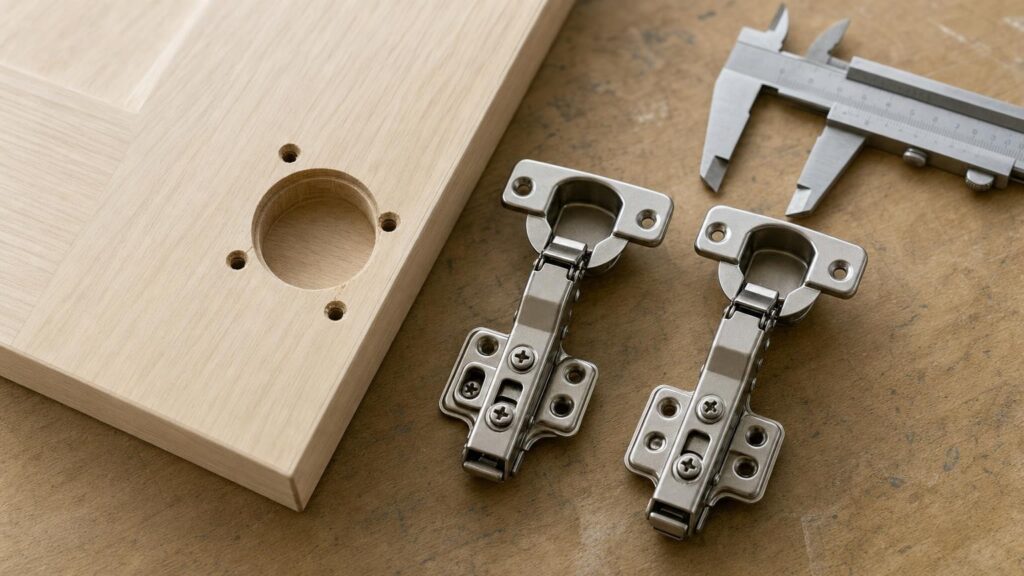
Concealed cabinet hinges often look remarkably similar. A round cup sits in the back of the door, a jointed arm connects it to the cabinet, and a mounting plate holds everything in place. That resemblance can make replacement seem as simple as finding a hinge with the same general shape.
In reality, a concealed hinge is part of a geometry-dependent system. Its cup, fixing holes, arm and mounting plate must suit the door position, door thickness and cabinet construction. Small differences that are difficult to see in a product photograph can change where the door sits, whether it clears the cabinet and whether the existing holes can be reused.
Why a visual match is not enough
The visible outline of a hinge reveals relatively little about its compatibility. Two models can share the same finish and silhouette while using different cup depths, fixing patterns, arm cranks or mounting-plate heights. They may also be intended for different door positions or cabinet types.
Compatibility therefore has several layers. The hinge must fit into the door, attach securely to both door and cabinet, position the closed door correctly and move it through the required arc without collisions. Matching only one characteristic, such as the cup diameter, does not establish that the whole system will work.
Start with the hinge cup and door drilling
The cup is the circular section recessed into the back of the cabinet door. Its diameter is one of the first measurements to check. A 35 mm cup is common in many cabinets, but other sizes exist, so the old hinge or drilled recess should be measured rather than assumed.
Cup depth matters too. A replacement cup must enter the existing bore without bottoming out, and the door must be thick enough to accommodate it without weakening or breaking through the front face. The depth of the drilled recess and the physical depth of the hinge cup are related, but they are not necessarily identical measurements.
Also record the cup’s position relative to the edge of the door. This is often described through a boring or edge-distance measurement. It affects the hinge geometry and the clearance between the door and cabinet as the hinge closes. Moving the cup towards or away from the door edge can alter the result even if every other component remains unchanged.
The cup may be secured with conventional screws, expanding dowels, press-fit fittings or another installation-specific arrangement. A cup with the correct diameter but the wrong fixing method might require different holes or inserts. That can turn a straightforward replacement into a drilling and repair job.
Drilling patterns must match as well as dimensions
After checking the cup itself, compare all surrounding fixing points. Important details include the distance between cup-fixing screws or dowels, their orientation around the cup and the size of any pre-drilled holes. The mounting plate on the cabinet side has its own hole spacing and position to verify.
A near match is not necessarily usable. If a new screw hole partly overlaps an old one, the screw may have too little sound material to grip securely. Shifting the hinge slightly to avoid the old holes can also change the door position or leave the cup misaligned with its recess.
Fresh holes may sometimes be possible, but their feasibility depends on the material, available space and condition of the door or cabinet. Chipboard and similar materials can be less forgiving after repeated removal and refitting. A direct replacement should ideally use the intended drilling pattern rather than rely on improvised placement.
Overlay, half overlay and inset describe different door positions
The required position of the closed door is a primary compatibility question. Common application descriptions include:
- Full overlay: the door covers most or all of the relevant cabinet side edge when closed.
- Half overlay: two doors commonly share a central partition, with each covering part of its front edge.
- Inset: the door closes within the cabinet opening or frame rather than covering its front edge.
These labels describe substantially different geometric arrangements. Installing a hinge intended for another application can leave a door too far in, too far out or displaced sideways. It may fail to close, strike a neighbouring door or expose more of the cabinet side than intended.
Overlay is not simply an aesthetic choice made after fitting. It is created by the relationship between cup position, hinge arm, mounting plate and cabinet structure. The target door position should therefore be identified before choosing a replacement.
Hinge-arm cranking and mounting-plate height work together
The hinge arm may be relatively straight or formed with a more pronounced bend, often called its crank. That shape helps determine where the door sits in relation to the cabinet side. However, the arm does not establish the final position by itself.
The mounting plate also has a height or offset that changes the hinge’s effective geometry. A different plate can move the arm and door relative to the cabinet. Replacing a hinge while retaining an apparently similar plate can therefore produce the wrong overlay, just as keeping the original hinge but changing the plate can alter the result.
Descriptions such as straight arm, half-cranked and fully cranked are useful starting points, but familiar labels do not guarantee identical dimensions between different hinge systems. The exact combination of arm and plate matters. Clip-on interfaces may look alike without being mutually compatible, and even a hinge that physically attaches to a plate may not reproduce the original door position.
When exact cross-compatibility is uncertain, it is safer to treat the hinge and mounting plate as a matched system and verify both parts together.
Cabinet construction changes the mounting problem
Frameless and face-frame cabinets present different fixing surfaces. On a frameless cabinet, the mounting plate is generally attached to the inside face of a cabinet side panel. Its position is closely related to the panel’s front edge and thickness.
A face-frame cabinet has a frame projecting around the front opening. The hinge may attach to that frame, to a bracket associated with it or to the cabinet side behind it, depending on the design. Frame width, projection and available fixing space can all influence the required hinge and plate.
This means a hinge sold for one style of cabinet may not transfer neatly to the other. The plate orientation might be wrong, the arm might not bridge the required distance, or there may be no suitable surface for the intended screw pattern.
Side-panel thickness also affects how much material is available for secure fixings and where the door must sit. Before buying, inspect where the existing plate attaches rather than judging the cabinet only from its exterior appearance.
Opening angle is about movement and clearance
The opening-angle specification indicates how far the door is designed to swing under the intended installation conditions. A larger angle can improve access, particularly where shelves, pull-outs or internal drawers would otherwise be obstructed. It is not automatically a better or more compatible choice.
As a door opens, its inner edge and outer corner follow paths determined by the hinge geometry and cup position. A different hinge may cause the door to sweep into an adjacent door, drawer front, end panel, wall or appliance. It may also interfere with internal fittings even when the door reaches the advertised angle.
Check both how far the door needs to open and what surrounds it throughout the movement. A nominal angle alone does not confirm clearance, and a wide-opening hinge cannot compensate for unsuitable drilling, arm geometry or cabinet construction.
Adjustment range cannot correct the wrong hinge
Many concealed hinges provide adjustment after installation. The usual adjustments address three types of alignment:
- Side-to-side adjustment changes the gap between neighbouring doors or aligns a door with the cabinet edges.
- Height adjustment raises or lowers the door, often through the mounting-plate fixing arrangement.
- Depth adjustment moves the door closer to or farther from the cabinet front.
These controls are intended for fine alignment. They can correct modest manufacturing and installation tolerances, even out gaps and help several doors form a consistent line. They do not provide unlimited movement.
An adjustment screw cannot make an incorrect cup fit its recess, move mismatched fixing holes or transform a full-overlay hinge into a properly configured inset system. It also cannot reliably overcome the wrong arm crank or a substantially different mounting-plate height. If a replacement only works with every adjustment pushed to its limit, the underlying components may not be a suitable match.
A reliable replacement-checking process
Removing one existing hinge and recording its details is usually more dependable than shopping from appearance alone. Use the following sequence:
- Identify the cabinet construction. Note whether it is frameless or face-frame and photograph where the plate attaches.
- Record the closed door position. Determine whether it is full overlay, half overlay or inset, and note nearby doors sharing the same panel.
- Look for markings. Check the cup, arm and plate for a manufacturer name, model code, angle or other identifiers. Record the complete marking rather than relying on one number.
- Measure the cup and recess. Check cup diameter, cup or bore depth and the distance between the cup recess and door edge.
- Measure the fixing pattern. Record screw or dowel spacing, hole sizes and orientation on both the door and cabinet.
- Identify the fixing method. Distinguish screws from dowels, expanding fittings and press-fit arrangements.
- Inspect the arm and plate together. Note the arm’s crank, how it joins the plate and the plate’s height or offset.
- Check the door. Measure its thickness and consider whether its material can accept any required new fixings.
- Confirm movement requirements. Record the needed opening angle and check for walls, neighbouring fronts and internal fittings.
Photographs taken square-on with a ruler in view can help preserve measurements and reveal details that are easy to forget. Keep left and right arrangements separate if the cabinet uses unusual or application-specific hardware.
Match the system, not the silhouette
A concealed cabinet hinge is a suitable replacement only when its installation and movement requirements agree with the existing door and cabinet. Before buying, confirm the cup diameter and depth, edge distance, fixing method, drilling pattern, intended overlay, arm crank, mounting-plate geometry, cabinet construction, door thickness and required opening clearance.
The central lesson is simple: matching the silhouette is not enough. Matching the complete hinge system gives the best chance of reusing existing holes, restoring the intended door position and achieving smooth movement without avoidable cabinet alterations.
Continue exploring on Frowse
Discover More Frowse Insights
- Full-Grain, Top-Grain, Split and Bonded Leather Upholstery Explained
- Powder, Liquid or Capsules? How Detergent Format Affects the Wash
- Ballpoint, Rollerball and Gel Pens: How Tip and Ink Design Change the Writing Experience
- What Binocular Specifications Actually Change in the View
- Behind a Kitchen Knife’s Edge: Geometry, Hardness and Sharpenability