


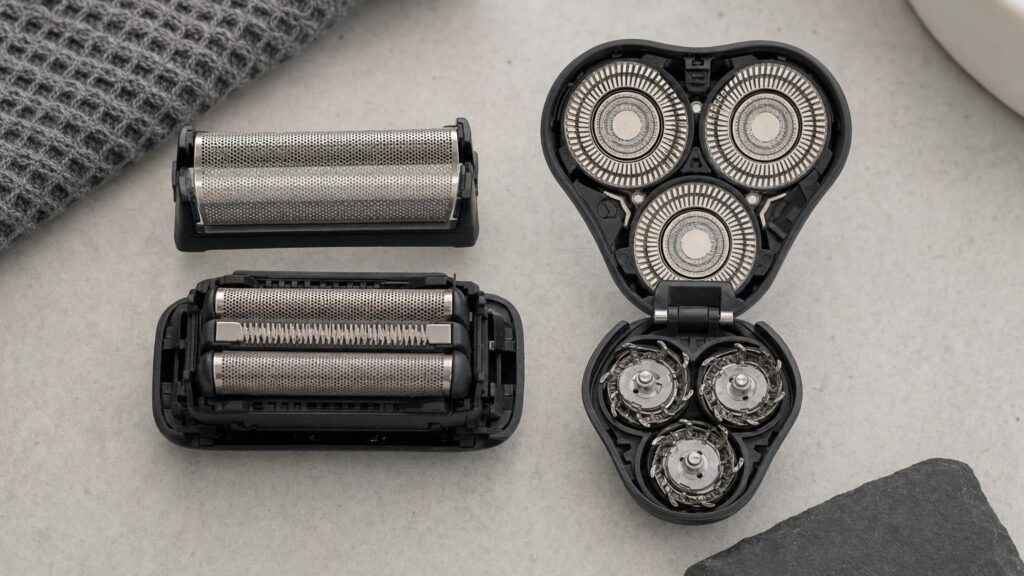
Foil and rotary electric shavers solve the same basic problem in different ways: they bring facial hair through a protective outer surface and cut it with powered blades underneath. A foil shaver generally uses straight perforated screens over oscillating cutters, while a rotary shaver uses circular guards over rotating blade assemblies.
That mechanical difference affects how the head moves across the face, how it approaches hairs growing in different directions and how easily it reaches edges or curved areas. Neither type is automatically better. The more useful question is which mechanism fits your facial hair, shaving technique, precision needs and approach to maintenance.
How foil shavers capture and cut hair
A foil shaver has one or more thin, perforated metal foils. Hair enters the holes or slots in a foil, and a cutter moving rapidly from side to side beneath it shears the exposed hair. The foil keeps the powered cutter away from direct contact with the skin while presenting hairs to the cutting elements.
Foil perforations are not necessarily uniform. A head may use different hole or slot patterns intended to admit hairs lying at different angles. Multiple foil elements can also divide the cutting work across the head, sometimes alongside a central element designed to deal with hairs that are less upright. The exact arrangement varies, so the number of visible elements alone does not establish how effectively a shaver will perform.
The long, relatively straight shape of a foil encourages controlled linear strokes. Users commonly move it against the direction of hair growth while keeping the foil surface in contact with the skin. This can make the shaving path easy to judge, particularly around straight beard boundaries and sideburns.
Foils are thin components, and their condition matters. A dent, tear or worn area can interfere with the intended spacing between skin and cutter. Foil thickness, perforation design, cutter alignment and the movement allowed within the head all contribute to the experience; the basic label “foil shaver” does not describe these details by itself.
How rotary shavers capture and cut hair
A rotary shaver typically has a cluster of circular heads. Each head combines an outer guard with slots or openings and a cutter that rotates underneath. As facial hair enters the guard, the moving cutter trims it within the circular assembly.
The heads overlap or sit closely together to cover the shaving area. Their curved layout naturally lends itself to small circular, arcing or overlapping hand movements rather than exclusively straight passes. Approaching the same patch from several directions can help present differently angled hairs to the openings.
This is relevant on areas such as the neck, where hair direction may change over a short distance. However, a rotary mechanism does not guarantee that every flat-lying or longer hair will be captured immediately. Slot geometry, cutter condition, head contact and shaving technique still matter.
The circular design also changes how the user sees the working edge. A cluster can cover a broad, uneven area, but it does not provide the same straight reference line as a foil. Precision trimming may therefore depend more heavily on an additional pop-up or separate trimmer.
Head geometry and contact with facial contours
The outer shape of a shaver determines where its cutting surfaces can make contact. Foil heads present elongated bars that can sit efficiently across flatter areas such as the cheeks. Rotary heads distribute contact through several smaller circles, creating a broader curved assembly that can approach the chin, jaw and neck from different angles.
Geometry should not be confused with articulation. A foil shaver may have independently moving foil elements, a pivoting head or both. A rotary shaver may allow individual circular heads to float while the entire housing also tilts. Alternatively, either type may offer relatively little movement.
This distinction matters because flexible components can help the cutting surfaces maintain contact as the face changes shape beneath them. More movement is not automatically preferable, though. A highly mobile head may feel less predictable when establishing a crisp edge, while a simpler head can require more deliberate wrist adjustments on tight contours.
Consider where shaving is most difficult for you. Long foil elements may feel intuitive across broad, flatter regions, whereas clustered circular heads may suit a routine built around the chin and jaw. In both cases, the size of the housing can be as important as the visible cutters when trying to reach narrow spaces.
Hair direction, length and shaving technique
Foil shaving usually rewards straighter, controlled passes. Identifying the direction of growth and moving against it can help guide hair into the perforations. If growth is uniform, this creates a simple routine. Where hairs change direction, several short passes from different angles may be needed.
Rotary shaving generally uses small circles or overlapping curved movements. This varies the angle of approach without requiring the user to stop and reposition the shaver for every change in growth direction. Large, rapid circles are not necessarily useful; compact movements help keep the heads in contact with the intended area.
Longer stubble can present difficulties for either mechanism because some hairs may lie flat, bend away or fail to enter the openings. A dedicated trimmer or pre-trim may be useful when growth exceeds what the main head handles comfortably. Buyers who shave after irregular intervals should examine whether a model includes a suitable trimming element rather than assuming the primary mechanism will manage every hair length equally well.
Frequently missed neck hairs are often a combination of growth direction, skin contour and technique. Stretching or repositioning the skin gently may expose hair more effectively, but users should follow the manufacturer’s operating guidance. Repeatedly passing over the same spot without changing angle may simply repeat the same miss.
Motor action, pressure and the feel of a shave
A foil shaver converts motor output into rapid side-to-side cutter movement. A rotary shaver drives cutters around circular paths. These systems produce different patterns of sound, vibration and feedback through the hand, although the exact feel depends on the complete construction rather than the mechanism alone.
Motor speed or power claims should not be treated as a complete measure of shaving performance. Results also depend on the interaction between guards, blades, head suspension, hair entry and battery behaviour. A powerful drive cannot compensate for damaged cutting parts, poor contact or unsuitable technique.
Pressure is similarly easy to misjudge. Pressing harder does not necessarily admit more hair. It may restrict the movement of floating components, deform the skin into the head or increase friction. Light, consistent contact followed by an adjusted angle is generally a more useful starting point than force. Any model-specific advice in the instructions should take priority.
Precision work and difficult areas
The straight edge of a foil head can provide a clear visual guide near sideburns and beard lines. Even so, a wide head or bulky frame may obstruct the area directly beneath the nose. Using the corner or leading edge may improve access if the design and instructions permit it.
Rotary clusters can follow rounded surfaces, but their overall footprint may make exact boundary work less intuitive. The centre of each circular head is also not a cutting edge in the same visual sense as the edge of a foil, so users may need to learn where effective contact occurs.
For either design, inspect the detail trimmer. It may be integrated into the body, fold or slide out, or be supplied as a separate attachment. Its width, orientation and accessibility affect how useful it is for sideburns, moustache edges and beard boundaries. A main head that excels at coverage may still need a narrower tool for visual control.
Cleaning and routine maintenance
Cut hair, skin debris and residue accumulate beneath both types of head. Foil shavers often allow the foil frame to be lifted away so that the cutter area can be emptied or brushed. Rotary designs commonly hold debris in chambers beneath the circular heads, which may open as an assembly or require further disassembly for deeper cleaning.
Some shavers and heads are designed to be rinsed, while others require dry cleaning or have restrictions around water exposure. “Wet and dry” shaving capability and cleaning instructions should be checked separately rather than assumed to mean that every component can be rinsed in every condition.
Foils require careful handling because their thin surfaces can be dented. Rotary guards and cutters should also be handled methodically. On designs where each cutter wears against its corresponding guard, mixing components between positions may affect how the paired surfaces work together. The model instructions should explain whether parts must remain matched.
Cleaning stations can automate parts of the process on compatible models, but they introduce additional ownership considerations such as space, consumables and the need to clean the station itself. Manual cleaning may be simple enough for some users, provided they are willing to open the head regularly and follow the correct brushing, rinsing, drying and lubrication guidance.
Replacement parts and long-term ownership
Foils, cutter blocks, rotary cutters and guards are wear components. Their eventual replacement should be considered before purchase, not only when performance changes. The relevant questions are what must be replaced, whether components come individually or as a set, and how exact compatibility is identified.
A foil system may use a combined cassette containing foil and cutters, or separate foil and cutter parts. A rotary system may offer complete head assemblies, cutter-and-guard sets or individual components. A cheaper-looking part is not necessarily a substitute if it does not match the precise model or head generation.
Model numbers, suffixes and regional variants can matter. Visual similarity is not proof of compatibility, and forcing an incorrect part can cause damage or poor operation. Check the manufacturer’s documented part reference and replacement procedure.
Ownership complexity is also personal. Some shoppers value a single cassette that can be exchanged with minimal handling. Others are comfortable cleaning and replacing several circular assemblies carefully. Availability, replacement format and storage of small parts may influence long-term convenience as much as the original purchase price.
Choose the mechanism that fits the routine
A foil shaver may be the more natural starting point if you prefer straight, deliberate strokes, want a visible linear edge and have a routine built around frequent precision work. A rotary shaver may make more sense if you favour circular movements, regularly navigate curved areas or need to approach multidirectional growth from overlapping angles.
Use those tendencies as guidance, not rules. Head articulation, housing size, trimming tools, cleaning design and replacement-part format vary substantially within both categories. Before buying, consider your most difficult facial areas, typical stubble length, preferred hand movement and tolerance for disassembly. Then check the documented design and maintenance requirements of the specific shaver. The mechanism shapes the experience, but its execution determines how well it fits your routine.
Continue exploring on Frowse
Discover More Frowse Insights
- Digital Piano Actions Explained: Weighted Keys, Hammers and Sensors
- Why Replacement Zip Sliders Are So Difficult to Match
- Why Thread Count Cannot Tell You How a Bed Sheet Will Feel
- Why a Paper Shredder’s Sheet Rating Tells Only Half the Story
- Why Badminton Rackets of the Same Weight Can Feel Completely Different