


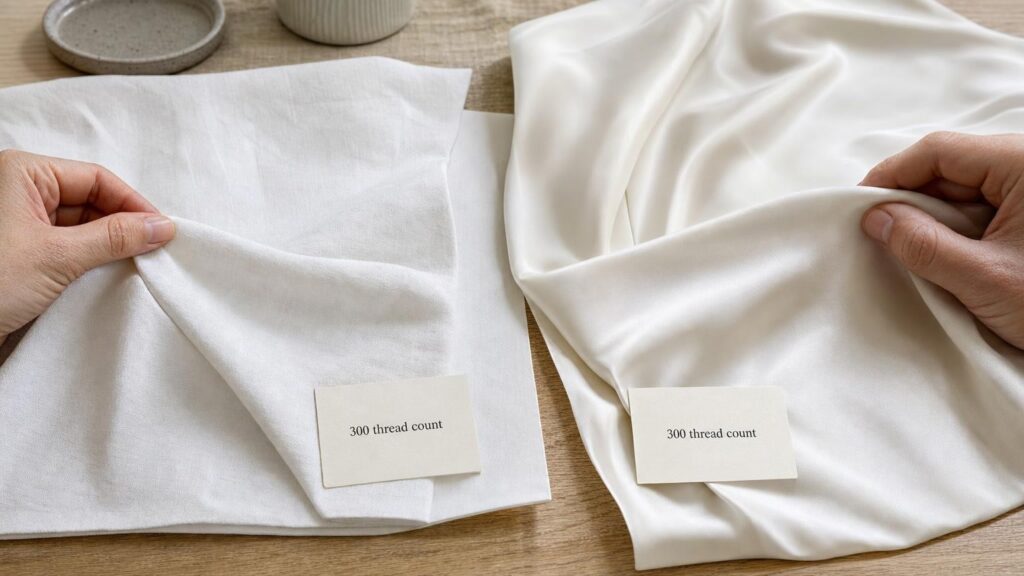
Thread count is one of the most visible numbers on bed sheet packaging, so it is easy to treat it as a simple quality score. Yet the number alone cannot tell you whether a sheet will feel crisp, silky, cool, warm, light, substantial or soft. Those qualities emerge from the interaction of fibre, yarn, weave, finishing and laundering.
This does not make thread count meaningless. It describes one aspect of how a fabric is constructed. The problem comes when it is used without context, particularly when comparing sheets made from different fibres or with different weave structures. Understanding the other variables makes it easier to choose sheets by the sensation and practical trade-offs you actually want.
What thread count actually measures
Woven fabric is made from two sets of yarns. Warp yarns run lengthways through the fabric, while weft yarns cross them from side to side. Thread count generally refers to the combined number of warp and weft yarns within a defined area of fabric, commonly a square inch.
In basic terms, fitting more yarns into that area produces a higher count. However, this number does not reveal how thick each yarn is, how tightly the yarns are packed, what they are made from or how the finished fabric has been treated.
There are also differences in how yarns may be counted. A single-ply yarn is one continuous strand, while a multi-ply yarn is formed by twisting two or more strands together. Depending on the counting method used, individual plies may contribute to a larger stated figure even though the woven fabric does not contain a correspondingly greater number of separate yarns. Without information about ply and yarn construction, comparing two headline numbers may therefore be misleading.
Thread count is most useful when you compare broadly similar fabrics: the same fibre, a similar yarn type, the same weave and comparable finishing. Once those elements differ, the count becomes only one clue among several.
Yarn fineness and ply change what the number means
Yarn fineness affects how many yarns can physically fit into a given area. Fine yarns can be woven closely while still creating a relatively supple fabric. Thicker yarns take up more room and may produce a lower thread count even when the resulting sheet feels substantial and durable.
This means that two sheets with the same stated thread count can have noticeably different characteristics. A fabric woven from fine, single-ply yarns may be light, flexible and smooth. Another woven from bulkier or multi-ply yarns may feel heavier, denser or less fluid, despite displaying the same number.
Ply is not automatically a sign of either good or poor quality. Twisting strands together can add body or strength, but it can also create a thicker yarn with a different surface character. What matters is whether the yarn construction suits the intended fabric. A high numerical count achieved through fine single yarns does not describe the same construction as one calculated using multiple strands within plied yarns.
Yarn evenness matters too. Consistent yarns can produce a more uniform surface, while irregularities may affect texture and wear. Thread count does not communicate this information, nor does it explain how tightly the yarn was spun. These details help determine flexibility, resilience and the likelihood of fibres working loose at the surface.
Fibre type sets the underlying character
Before considering the thread count, look at what the sheet is made from. Fibre type establishes much of the fabric’s underlying character, including how it manages moisture, retains warmth, drapes and changes with use.
Cotton is widely used because it can feel breathable and absorbent, but not all cotton yarns are identical. Fibre length, fineness, uniformity and processing all influence the finished cloth. Longer, more uniform fibres can generally be spun into smoother yarns with fewer loose ends, while shorter fibres may create a hairier surface. A label that gives only the fibre name and thread count does not reveal these distinctions.
Linen typically has a different feel and structure from cotton. It may begin with a firmer, more textured handle and soften progressively through washing and use. Its characteristic texture cannot be judged against cotton by thread count alone, particularly because the fibres and yarn dimensions differ.
Manufactured fibres and blends introduce other trade-offs. Some can create a smooth surface, resist wrinkling or dry relatively quickly, while their moisture handling and warmth may feel different from those of natural fibres. Blending fibres can balance cost, care, durability and touch, but the blend ratio and fabric construction matter more than a thread-count comparison with an all-cotton sheet.
Fibre quality also affects pilling. Pills form when loose or broken fibres become entangled on a fabric’s surface, and their appearance is influenced by fibre length, yarn structure, friction and laundering. A high thread count cannot guarantee that a sheet will remain smooth.
Weave determines crispness, drape and breathability
Weave describes how the warp and weft yarns cross one another. It can have a more immediately noticeable effect on feel than a difference between two thread-count figures.
Percale-style weaves
Percale-style constructions use a straightforward, balanced crossing pattern. They are often associated with a matte appearance and a fresh, crisp hand. Because of their structure, they can feel relatively light and airy rather than glossy or enveloping.
People who like the sensation of a freshly made hotel-style bed may favour this character. The trade-off is that a crisp fabric can feel less silky at first and may show creases more readily. It can soften with repeated laundering while retaining more of a dry, clean feel than a draping sheen.
Sateen-style weaves
Sateen-style constructions expose longer sections of yarn at the surface. This can create a smoother face, a subtle lustre and greater drape. The fabric may feel silkier and more enveloping than a comparable percale-style sheet, even if their thread counts are similar.
Those longer surface sections can also change how the fabric responds to friction and wear. Sateen may snag or show surface changes differently from a balanced weave. Its denser, draping character can feel warmer to some sleepers, although the fibre, yarn and overall fabric weight remain important.
Neither weave is inherently better. The useful question is whether you prefer crispness or fluid smoothness. Choosing the preferred weave first is often more informative than searching for the largest thread-count number.
Finishing can transform the first impression
Fabric rarely arrives on the shelf exactly as it leaves the loom. Mechanical and chemical finishing processes may alter softness, sheen, smoothness, stability and initial crispness.
Pre-washing can relax the fabric and give it a softer, less formal texture. Brushing raises fibres at the surface, producing a warmer, softer hand. Mercerising, a process commonly associated with cotton, can affect strength, lustre and how readily the material accepts dye. Other softening treatments can make a sheet feel unusually smooth when first removed from its packaging.
Finishing is not necessarily something to avoid. It is part of producing fabric with a desired appearance and handle. However, an impressive first touch does not always represent how the sheet will feel after months of washing. Some effects are durable, while temporary processing residues or softening agents may diminish.
Conversely, a new sheet that initially feels firm or crisp may become more comfortable as its yarns relax. When possible, product descriptions that mention garment washing, brushing or other finishing methods provide useful context. Thread count does not capture any of these treatments.
Why feel changes after washing and use
Laundering is part of a sheet’s development, not merely maintenance. Water, detergent, heat, drying and physical movement can remove temporary finishes and allow fibres and yarns to settle. As a result, the fabric you sleep on after several washes may feel different from the sample touched in a shop or the sheet taken straight from its packet.
Natural-fibre sheets often relax and soften with use. Crisp woven cotton may lose some initial stiffness, while linen can become increasingly supple. At the same time, washing can reveal characteristics that were initially less obvious, such as surface fuzz, pilling, distortion or shrinkage.
Care choices affect the outcome. Excessive heat may encourage shrinkage or place more stress on some fibres and finishes. Strong washing conditions and over-drying can also influence texture and wear. Following the supplied care instructions is more useful than assuming a high thread count makes a sheet resistant to demanding treatment.
The long-term feel depends on the complete construction: whether the fibres remain secure, whether the yarns retain their integrity, how the weave responds to movement and whether the finish was temporary. Thread count alone cannot predict this ageing process.
Read sheet specifications as a combination, not a score
A better comparison starts by treating specifications as a connected description. Look for the following information:
- Fibre composition: Check the material and, for blends, the proportions. This provides a starting point for understanding moisture handling, warmth, texture and care.
- Weave: Use terms such as percale or sateen to anticipate crispness, surface smoothness and drape.
- Yarn and ply: Single-ply or multi-ply information can help put the headline thread count into context, though it is not always supplied.
- Fabric weight: Where stated, weight can help distinguish a light fabric from a more substantial one. Compare it only across similar materials and constructions.
- Finishing: Pre-washing, brushing and other treatments can explain the initial texture.
- Care instructions: Washing and drying requirements indicate how practical the sheets will be for your routine.
- Thread count: Use it as a construction detail rather than a ranking of softness, durability or overall quality.
Missing information matters. If two products state only fibre and thread count, there may not be enough detail for a confident construction-based comparison. A larger number should not be used to fill those gaps.
Choose by the sensation and trade-offs you want
Begin with the sleeping experience you prefer, then work backwards towards suitable specifications.
For a crisp, fresh and airy feel, consider a balanced percale-style weave in a fibre that suits your moisture and care preferences. Expect a more matte appearance and potentially more visible creasing.
For a smooth, silky and draping feel, a sateen-style weave may be more appropriate. Its enveloping character can feel warmer or heavier, and the smoother face may respond differently to friction.
For a soft, warm surface, a brushed finish may be appealing. Raising the surface fibres changes the touch and can increase the sense of warmth, but it is not the same type of softness as a smooth sateen.
For gradual softness and a relaxed texture, some natural-fibre fabrics may reward repeated washing rather than feeling highly polished on day one. This can suit shoppers who accept initial firmness in return for a fabric that develops with use.
Also decide whether you value lightness or substance. A heavier sheet is not necessarily more durable, and a lighter one is not necessarily fragile. Yarn quality, weave, fibre and care all contribute. The best choice is the combination that matches your preferred feel, room temperature, laundering habits and tolerance for wrinkles or surface changes.
Use thread count as context, not a verdict
Thread count describes how many yarns are represented within a defined area, but it cannot independently measure softness or quality. It says nothing conclusive about fibre quality, yarn fineness, ply, weave, finishing or how the fabric will change after washing.
For a more useful comparison, consider fibre composition and weave first, then look at yarn construction, weight, finish and care information where available. Use thread count to add context within that group of details. A sheet feels the way it does because all these elements work together – not because of one number on the packet.
Continue exploring on Frowse
Discover More Frowse Insights
- Why a Washing Machine’s Kilogram Capacity Is Not the Size of Every Load
- What Dishwasher Salt and Rinse Aid Actually Do
- Why Floating Floors Need Expansion Gaps – and What Happens When They Cannot Move
- End Grain, Edge Grain and Face Grain Cutting Boards Explained
- What Ceramic, Titanium and Tourmaline Really Mean on Hair Straighteners