


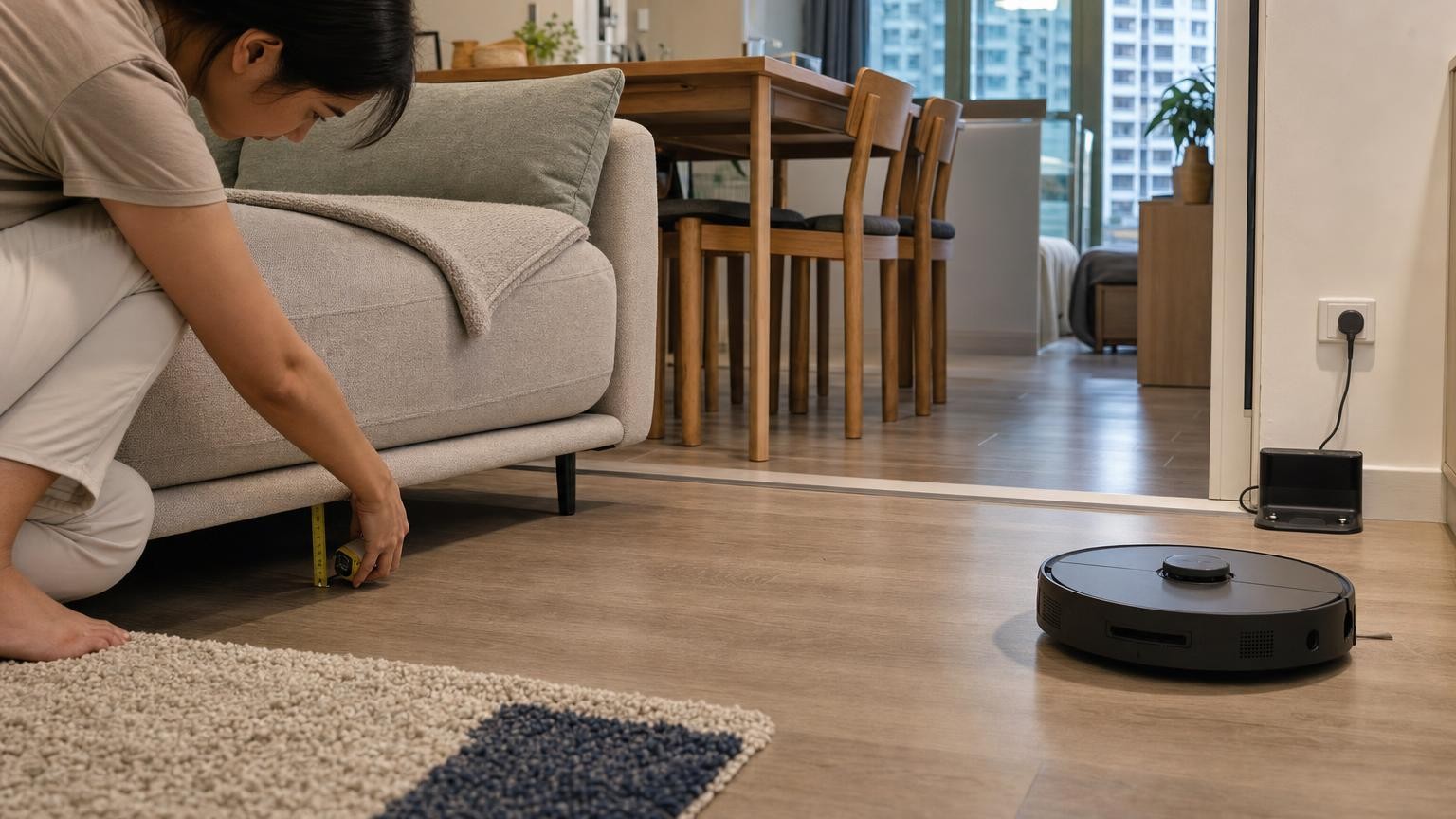
A robot vacuum can make routine floor care easier, but the right choice depends on more than suction claims or a long feature list. In a Singapore apartment, compact rooms, closely spaced furniture, mixed floor transitions and limited storage can matter more than headline specifications.
Before comparing models, examine where the robot will clean, what it will encounter and how much maintenance you are willing to do. A well-matched robot should be able to move reliably through the home, deal with its usual debris and return to a dock that does not obstruct daily life.
Start with the realities of a Singapore apartment
Apartment size alone does not reveal how easy a home is for a robot to clean. An open living area may be straightforward, while a smaller but furniture-dense room can present chair legs, narrow gaps, cables and awkward corners. Bedrooms, service yards and kitchens may also have different thresholds or floor finishes.
Begin by identifying where automated cleaning would provide the most value. Predominantly hard floors often suit frequent vacuuming because visible dust, hair and crumbs can be collected before they spread. Rugs complicate the task by introducing raised edges and surfaces that may require different brush or suction behaviour.
Also consider how often the layout changes. Dining chairs may move daily, drying racks may appear temporarily and toys, pet bowls or charging cables may be left on the floor. Navigation technology can help, but no feature eliminates the need to make the area reasonably robot-friendly.
Measure the spaces the robot must cross and enter
A few measurements can prevent a robot from repeatedly getting stuck or leaving important areas untouched. Check:
- The height and shape of thresholds between rooms
- Transitions between hard flooring and rugs
- Clearance beneath beds, sofas, cabinets and low shelving
- The width of passages between furniture
- Gaps around dining-chair legs and pedestal furniture
- The available floor and wall space for the dock
Robot height affects whether it can clean beneath furniture. Remember that the highest point may be a raised navigation sensor rather than the main body. Diameter influences how easily the robot can turn in tight spaces or pass between chair legs.
Climbing ability is also relevant, but a stated maximum should not be treated as a guarantee. The shape, material and angle of a threshold can affect whether the robot crosses it consistently. A rounded transition may be easier than a sharp vertical lip of similar height.
Measure the home rather than assuming that a compact-looking robot will fit everywhere. If a low sofa has insufficient clearance, the robot may avoid it, become wedged underneath or scrape against the frame.
Choose navigation for the layout, not for novelty
Basic robot vacuums may move using relatively simple patterns, changing direction when they detect obstacles. This can be adequate for a small, uncluttered space, but coverage may be less predictable in a multi-room apartment.
Systematic navigation and mapping can make cleaning more orderly. Depending on the model and its software, mapping may support room selection, scheduled cleaning by area and virtual boundaries. These functions are particularly useful when a robot should clean the kitchen after meals but avoid a play area or workspace at certain times.
Obstacle-recognition systems aim to identify objects such as cables or shoes. They can reduce interruptions, but they should not be regarded as infallible. Detection may be affected by object size, lighting, colour, sensor position and software behaviour. Thin cables, small toys, fabric edges and low-profile items can remain difficult.
Other environmental features can also create challenges. Very dark surfaces may affect some downward-facing sensors, while mirrors or reflective finishes can complicate certain mapping systems. Frequently moving furniture can make saved maps less representative of the current layout.
Choose navigation according to the consequences of missed areas and interruptions. If the home is simple and someone is usually available to rescue the robot, basic navigation may be acceptable. For several rooms, complex furniture arrangements or unattended scheduled cleaning, reliable mapping and editable boundaries may be more valuable.
Match cleaning hardware to floors, rugs and household debris
A larger suction figure does not by itself determine cleaning performance. Airflow, floor-head design, brush contact, seals, movement speed and debris size all affect what the robot collects.
For hard flooring, look at how the main roller directs fine dust and crumbs into the intake. Side brushes can move debris away from walls and corners, although aggressive spinning may scatter lightweight particles on smooth floors. Edge cleaning is useful, but round robots cannot physically place their main roller into every square corner.
Roller material influences maintenance. Bristled brushes can agitate rugs effectively but may collect long hair. Rubber or mixed-material rollers may be easier to clear, though no design is completely tangle-free. Households with long hair or shedding pets should examine how easily the roller, end caps and side brushes can be removed and cleaned.
For rugs, consider whether the robot can climb the edge without folding it or becoming trapped. Features that increase suction on carpet may help, but they can also raise noise and power use. Lightweight rugs, tassels and loose edges may need to be secured, removed or designated as exclusion zones.
Delicate flooring deserves additional care. Check the manufacturer’s guidance for brush and mopping suitability, and inspect wheels and rollers regularly for trapped grit that could drag across the surface.
Decide whether mopping will genuinely reduce work
Robot mopping ranges from a damp cloth pulled across the floor to systems with controlled water delivery or more active pad movement. The practical difference is how consistently the pad stays damp and how much mechanical action it applies.
Simple cloth wiping can collect light surface dust and deal with minor marks, but it is not equivalent to scrubbing by hand. More active systems may improve routine maintenance, yet dried or sticky spills can still require manual cleaning. A robot should not be expected to identify and properly treat every type of spill.
Think about the full mopping routine:
- How easy is the clean-water tank to fill?
- Can the robot avoid rugs while the mop is attached?
- Must the pad be removed to vacuum carpet?
- How often will the pad need washing during or after a run?
- Is there a convenient place to dry reusable pads fully?
Washing and drying pads promptly is especially important in a humid environment. Leaving a damp, dirty pad attached can lead to odours and transfers yesterday’s dirt during the next run. Even a dock that washes pads will itself require attention, including clean-water refilling, wastewater disposal and tray cleaning.
Consider the dock as part of the appliance
The dock is not merely an accessory. It determines where the robot lives and how reliably it can recharge. Check the installation guidance for surrounding clearance, floor conditions and socket access. A dock squeezed behind furniture may be difficult for the robot to approach consistently.
A charging-only dock has the smallest operational role and usually requires the robot’s onboard bin to be emptied manually. A self-emptying dock transfers dry debris into a larger container or bag, reducing how often the small bin needs attention. This adds bulk, creates noise during emptying and may introduce replacement bags or other consumables.
Mop-servicing docks can add clean- and dirty-water tanks, pad washing or drying functions. They may substantially reduce intervention during frequent mopping, but they occupy more space and do not eliminate maintenance. Wastewater cannot be left indefinitely, and removable trays, filters and internal surfaces still need cleaning.
Before buying, mark out the dock’s footprint on the floor. Include room for opening lids, lifting tanks and replacing bags. In a compact apartment, a feature-rich dock can be convenient only if it has a practical permanent location.
Check whether daily operation suits apartment living
Maximum runtime is less important than whether the robot can clean the intended area in a sensible period. A modest apartment may not require the largest battery, while complex navigation, high suction or active mopping can consume more power than a simple hard-floor run.
Recharge-and-resume can be useful if the robot cannot complete a job in one charge. However, a full cleaning cycle may then take longer because the robot must return to the dock, recharge and continue. Consider whether that extended process fits the household routine.
Noise also deserves attention. Normal vacuuming, high-power modes and dock emptying can have noticeably different sound profiles. Scheduled cleaning may be disruptive during online meetings, sleep or quiet periods. Pets may also react to movement, sound or an automatic emptying cycle.
Scheduling works best when the floor is ready at the chosen time. A robot that starts while cables, shopping bags or dining chairs block its route may deliver poor coverage. A short pre-cleaning routine – lifting small objects, checking curtains and moving vulnerable cables – often improves reliability more than an extra specification.
Look beyond cleaning performance to maintenance and ownership
Every robot vacuum needs recurring care. Typical tasks include emptying the bin, clearing hair from rollers, wiping sensors, cleaning wheels, washing or replacing filters and inspecting side brushes. Mopping adds tanks, pads and water-contact parts.
Check how easily these components can be removed without tools and whether replacement consumables are readily obtainable. Filters, brushes, dust bags and mop pads are ongoing ownership items. A convenient feature becomes less useful if its required consumables are difficult to source.
Connected features also deserve scrutiny. Find out whether initial setup or core operation requires an app, user account or particular Wi-Fi connection. Review the permissions requested by the app, the available data controls and how maps or camera-derived information are handled where relevant.
Consider what happens when connectivity is unavailable. Physical start, pause and return-to-dock controls can preserve basic usefulness even if the app, network or cloud service cannot be reached. Households that prefer minimal account dependence should distinguish between features that work locally and those that require online access.
Finally, assess your maintenance tolerance honestly. A self-emptying system may suit someone who dislikes daily bin handling, while a simple dock may appeal to someone who prefers fewer parts and consumables. There is no universally superior arrangement.
Build a shortlist from the apartment outward
Start with the home rather than the most prominent product claims. First, map thresholds, low furniture, narrow passages and a realistic dock location. Next, identify the floor types and recurring debris, including hair, fine dust, crumbs and rug-related challenges.
Then choose the level of navigation needed for the layout and decide whether mopping will replace enough routine work to justify tanks, pads and cleaning. Confirm that the dock fits with room to operate, and compare ongoing tasks, consumables and connected-service requirements.
The best robot vacuum for an apartment is not necessarily the one with the highest suction figure, longest runtime or most elaborate dock. It is the one that can reach the important areas, handle the household’s everyday mess and run regularly without creating an unreasonable amount of preparation or upkeep.
Continue exploring on Frowse
Discover More Frowse Insights
- Why Thicker String-Trimmer Line Is Not Always Better
- Airflow, Airspeed and Nozzle Shape: How to Judge a Leaf Blower’s Real Capability
- Why Noise-Cancelling Headphones Work Better on Some Sounds Than Others
- Why Hand-Blender Wattage Does Not Predict Blending Performance
- What Camera Sensor Size Changes – and What It Does Not