





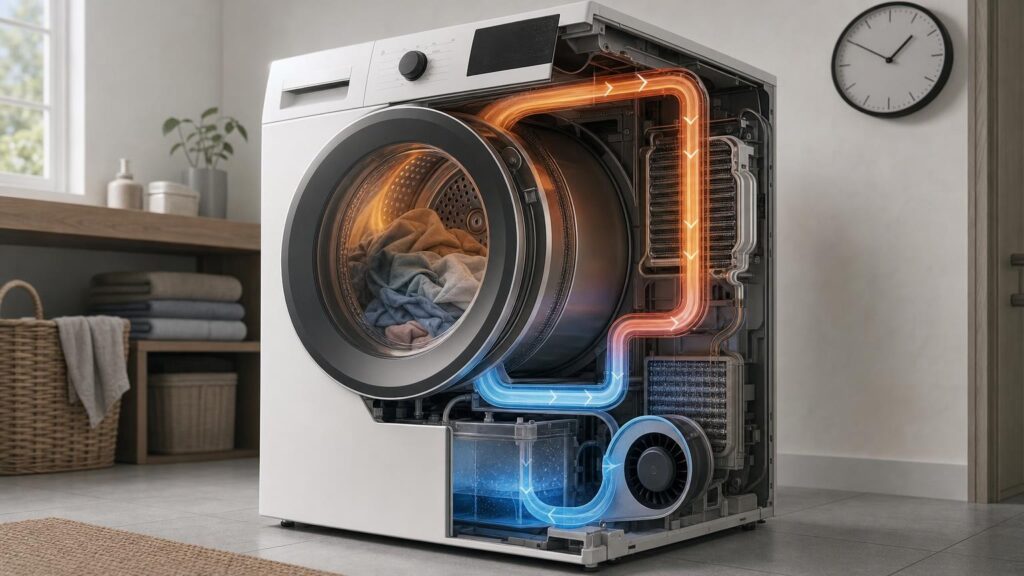
A heat-pump tumble dryer can behave quite differently from an older vented or conventional condenser machine. The drum may not feel especially hot, the estimated finishing time can change while the programme is running, and a full load may take longer than expected. These characteristics do not automatically indicate a fault. They are often consequences of a drying system designed to recover and reuse heat rather than continually create hot air and discard it.
For shoppers, the important question is not simply whether heat-pump drying is better. It is whether lower-temperature operation, potentially longer cycles and the appliance’s maintenance requirements fit the household’s laundry routine. Understanding the process makes those trade-offs much easier to judge.
Why “cooler and longer” is the key to understanding heat-pump drying
Tumble drying requires moving air, heat and somewhere for water vapour to go. A heat-pump dryer performs these jobs at comparatively moderate temperatures and repeatedly circulates much of the same air through a closed system. Because it is not relying on intense resistance heating to raise the air temperature rapidly, moisture can be removed more gradually.
This creates a central buying trade-off. Lower-temperature drying can reduce garments’ exposure to high heat, which may be helpful for suitable fabrics that are vulnerable to excessive temperatures. The heat-recovery process can also use less electricity than repeatedly heating replacement air. The other side of the exchange is time: some programmes may run considerably longer than shoppers accustomed to vented or conventional condenser dryers expect.
Cycle duration should therefore be considered alongside energy use, fabric care and convenience. A household that usually runs laundry overnight or has time between loads may find longer cycles easy to accommodate. Someone who regularly needs several loads dried in quick succession may place more value on turnaround time.
How the closed-loop drying process works
Inside a heat-pump dryer, warm air passes through the rotating drum and absorbs moisture from the laundry. The resulting warm, humid air then travels through the appliance’s air path rather than being expelled outdoors.
The air first meets a cold heat exchanger, associated with the evaporator side of the refrigeration circuit. Cooling causes water vapour to condense into liquid. That water is directed either to a collection container or to a drain, depending on the appliance and how it has been installed.
After losing moisture, the air passes through a warm heat exchanger, associated with the condenser side of the refrigeration circuit. It is reheated and sent back through the drum to collect more moisture. A compressor moves refrigerant around the sealed circuit, allowing heat to be transferred from one part of the system to another.
This cycle repeats until the programme ends or the moisture-sensing system determines that the selected dryness level has been reached. The process is described as closed-loop because the drying air is recovered and reused. It is not perfectly isolated from the room, and the appliance still releases some heat, but it does not intentionally discharge the main stream of moist drying air through an external vent.
Heat-pump, condenser and vented dryers: what actually differs
Vented dryers
A vented dryer heats air, moves it through the laundry and sends the warm, moisture-laden air outside through a hose or fixed duct. It therefore needs a suitable external air route. Installation can be straightforward where a proper vent is already available, but positioning is more limited where one is not.
Because heat leaves with the exhaust air, the appliance must keep heating incoming replacement air. Vented models can provide relatively direct and rapid drying, but they do not recover heat in the same way as a heat-pump system.
Conventional condenser dryers
A conventional condenser dryer does not require an external moisture vent. It cools humid air so that water condenses and can be collected or drained. However, it generally uses electric resistance elements to create drying heat rather than transferring and recovering heat through a refrigeration circuit.
This design offers more placement flexibility than a vented dryer, subject to the manufacturer’s installation instructions. It can also operate at higher drying temperatures than a heat-pump model and may complete some loads more quickly, although programme, load and appliance design all matter.
Heat-pump dryers
A heat-pump dryer is also a condensing appliance, but it recovers heat and reuses it. Its lower-temperature, closed-loop process distinguishes it from a conventional condenser design. It normally requires no external moisture vent, but it still needs an appropriate location, clearance around the cabinet and the surrounding conditions specified by the manufacturer.
These categories describe the basic drying method, not the performance of every individual machine. Drum design, airflow, sensors, programmes and maintenance can all affect real-world results.
What determines how long a load takes
Quoted programme times are not reliable predictions for every basket of laundry. Several variables influence how quickly water can move from fabric into the circulating air.
- Load weight: A larger load contains more water and requires air to reach more fabric. Filling beyond the permitted programme capacity can reduce tumbling space and restrict airflow.
- Initial wetness: Laundry that leaves the washing machine after a lower spin speed carries more water into the dryer. A suitable higher-speed spin, where the fabric and washer programme allow it, can shorten the drying task.
- Fabric type: Thick cotton towels, bedding and dense garments often retain more water than lightweight synthetic items. They may also dry unevenly when folded or tangled.
- Mixed materials: Lightweight pieces can become dry while waistbands, seams and heavier items remain damp. The dryer must either continue for the slowest-drying pieces or stop when its sensing logic concludes that the load has reached the target.
- Tangling: Sheets, duvet covers and long garments can wrap around smaller items. Trapped fabric receives less effective airflow, even when the total load is within the stated capacity.
- Dryness selection: A setting intended to leave laundry suitable for ironing should finish earlier and damper than a cupboard-dry or more intensive target.
Very small loads can present a different challenge. If only one or two pieces are tumbling, they may make inconsistent contact with the moisture sensors. An uneven load can also remain pressed against one area of the drum rather than falling freely through the air stream. Programme guidance may therefore specify minimum, maximum or recommended loads for particular cycles.
Why room temperature and placement matter
Although a heat-pump dryer recirculates its drying air, it still interacts with the room around it. The compressor, heat exchangers and controls are designed to operate within conditions stated by the manufacturer. A very cold installation space can make heat transfer and warm-up less effective, potentially lengthening cycles or affecting operation.
Restricted airflow around the cabinet can also be unhelpful. The appliance needs the clearances and ventilation described in its instructions so that heat does not build up where it should not. Pushing it tightly into an unsuitable cupboard or obstructing ventilation openings may lead to poor performance.
Shoppers considering a garage, outbuilding, utility cupboard or under-counter position should check the installation documentation rather than assume that the absence of a vent hose makes every location suitable. Relevant questions include permitted ambient conditions, required clearances, door ventilation, floor requirements and whether hoses can be routed without kinks.
How moisture sensors change the cycle
Many heat-pump dryers offer sensor-controlled programmes. Instead of running for a fixed period, the appliance estimates the remaining moisture in the load and adjusts the programme towards the chosen dryness level. As a result, the time shown at the start is an estimate rather than a countdown that must fall by exactly one minute per minute.
The displayed time may pause, increase or fall sharply as the dryer learns more about the load. Early in a cycle, surface moisture and load temperature can make accurate prediction difficult. Later readings allow the controls to revise the estimate.
Sensor performance can be affected by the load itself. Mixed fabrics may produce inconsistent readings, while a very small load may not touch sensing surfaces often enough. Residue from laundry products can also build up on accessible sensor strips and interfere with contact. Cleaning should follow the manual, using only the recommended method.
If laundry repeatedly finishes too damp or too dry, first check the chosen programme, dryness target, load composition and sensor care instructions. A timed programme may be useful for some loads, but it removes the appliance’s ability to stop according to sensed dryness and can expose already-dry items to unnecessary tumbling.
Filters, heat exchangers and the cost of neglected airflow
Efficient drying depends on air moving freely through the drum and heat-exchange system. Lint on a filter increases resistance, so the appliance may need more time to move moisture out of the load. Continued neglect can undermine both performance and efficiency.
Routine lint-filter cleaning is therefore part of normal operation, not an occasional repair task. Some dryers have more than one filter, and the required cleaning frequency varies. Owners should also check for lint around filter seals and ensure that each filter is correctly refitted.
Heat-exchanger maintenance is more model-dependent. Some appliances provide user access for cleaning, while others use protected or self-cleaning arrangements. A component that looks removable should not automatically be pulled out, rinsed or brushed. Incorrect cleaning can damage delicate surfaces or move debris deeper into the air path.
The safest buying approach is to inspect the maintenance instructions before purchase. Look for the number and location of filters, how easily they can be reached, the stated cleaning routine and whether any heat-exchanger care is assigned to the user. An efficient design still depends on maintenance being completed correctly.
Choosing around real household priorities
Capacity is important, but a kilogram figure alone does not describe how quickly every load will dry. A large drum can help bulky laundry tumble, yet heavy towels, mixed garments and tangled bedding still behave differently. Programme-specific capacity limits may also be lower than the headline cotton capacity.
Before choosing, consider the household’s normal pattern rather than its occasional maximum load. Think about how often loads must be turned around quickly, whether washing can be spun thoroughly first, and whether different fabric types can be separated. Also decide whether emptying a condensate container is acceptable or whether a compatible drain connection would be preferable.
Maintenance habits matter too. Easy filter access may be more valuable than a rarely used programme if the dryer will operate several times a week. Likewise, a machine intended for a cold or enclosed space needs especially careful checking against its stated installation conditions.
A heat-pump dryer is most likely to suit shoppers who value lower-temperature, heat-recovery drying and can plan around longer or more variable cycles. Those who prioritise the fastest possible succession of loads should compare programme information and drying methods particularly carefully.
Setting realistic expectations before buying
Product documentation can reveal more than a headline capacity or estimated cycle duration. Before purchasing, verify:
- the available sensor-controlled and timed programmes;
- the dryness levels and programme-specific load limits;
- the stated installation and ambient operating conditions;
- the required clearances and ventilation around the cabinet;
- whether condensate is collected, drained or supports either arrangement;
- the location and cleaning routine for each filter;
- the manufacturer’s heat-exchanger maintenance instructions;
- guidance for bedding, delicates, mixed fabrics and small loads.
Heat-pump drying has a different rhythm from high-temperature drying. Cooler air, changing time estimates and longer programmes are often integral to the way heat is recovered and reused. When the installation, load preparation and maintenance routine are suitable, that difference can be an informed trade-off rather than an unwelcome surprise.
Continue exploring on Frowse
Best Sellers · Top Rated · Best Value · Under £50 · Fresh Finds · Premium Picks
Discover More Frowse Insights
- Why Some Induction Pans Heat Evenly – and Others Only Pass the Magnet Test
- Hair Clipper Cutting Length Explained: Blades, Taper Levers and Guards
- What Makes a Backpack Water-Resistant – and Why the Protection Wears Out
- Why Replacement Zip Sliders Are So Difficult to Match
- Why Vacuum Storage Bags Slowly Reinflate – and What to Check Before Buying