





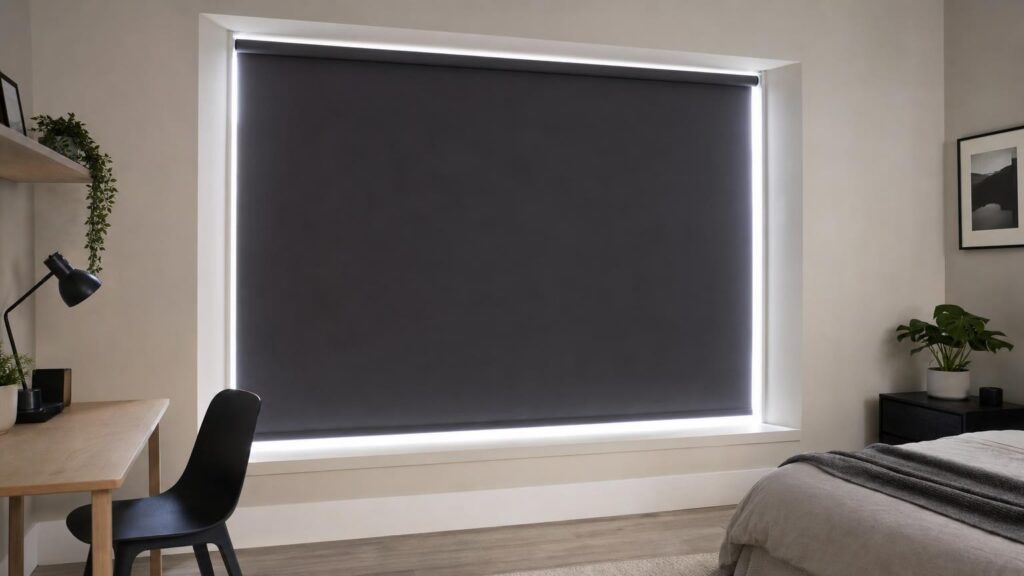
A blackout roller blind can use fully opaque fabric and still leave a room noticeably bright. That is not necessarily a fault in the material. In many installations, daylight is travelling around the blind rather than through it.
The final result depends on the whole system: the size of the fabric, its position relative to the window, the mounting method, the roller direction and the gaps needed for brackets and controls. Understanding these details before buying makes it easier to choose between a standard roller blind, a wider overlapping installation or a more enclosed system with a cassette and side channels.
Why “blackout” does not always mean a dark room
The term blackout generally describes the ability of the blind material to stop light passing through it. It does not automatically mean that the installed blind will seal the entire window opening.
A roller blind needs room to operate. Its fabric hangs from a tube, the tube sits between brackets, and one side may contain a control mechanism. These components can make the fabric narrower than the complete blind assembly. The material also needs enough clearance to move without rubbing against handles, trim or the sides of a recess.
As a result, strips of uncovered glass can remain at the sides. Light may also enter above the fabric, around the roller tube or beneath the bottom bar. In strong daylight, even relatively narrow openings can create bright lines that illuminate walls, floors and furnishings.
A useful shopping question is therefore not simply, “Is the fabric blackout?” It is, “How much of my window will the fabric cover once the complete blind is installed?”
Fabric opacity versus whole-window light control
Blind fabrics are commonly described according to how they manage light. The exact terminology can vary, so it is important to read the seller’s description rather than relying on colour or appearance alone.
- Blackout fabric is intended to prevent light from passing directly through the material.
- Dim-out fabric reduces incoming light but may still show a glow, particularly in strong sunshine.
- Light-filtering fabric softens daylight and adds privacy while deliberately allowing some light into the room.
A pale blackout fabric may look brighter from inside the room because its surface reflects more ambient light, but that does not necessarily mean light is passing through it. Conversely, a dark-looking fabric is not automatically blackout. Its colour and its opacity are separate characteristics.
Coatings or layered constructions may provide opacity, but they cannot close physical gaps between the fabric and the window. Product descriptions focused on the fabric should not be interpreted as promises of total room darkness unless the complete fitting system is designed to control edge leakage as well.
Where light gets around a roller blind
Before choosing a blind, inspect the window as a three-dimensional structure rather than a simple rectangle. Several features can create a path for light.
Side gaps and bracket clearance
The overall blind width may include brackets, pins and the control mechanism. The fabric itself can therefore be narrower. With an inside-recess installation, the resulting gap may expose a strip of glass on each side.
The area around the roller tube
The fabric leaves the roller at either the front or back of the tube. This creates space between the cloth and the window. Depending on the tube position and direction of the light, daylight can travel through this space and appear as a bright band near the top.
The sill and bottom edge
A blind that finishes just above the sill can leave a visible line of light. Uneven, sloping or tiled sills can make this more obvious because a straight bottom bar cannot follow an irregular surface.
Handles, vents and decorative trim
Window handles can prevent the blind from sitting close to the glass. Beading, frames, vents and projecting trim may have the same effect. Moving the fabric forwards to avoid these obstructions can create a larger channel through which light reaches the room.
These gaps can look minor during measurement, but direct sun creates high contrast between a shaded window and an illuminated edge. Light can then reflect from pale walls, ceilings, mirrors and glossy furniture, making the whole room feel brighter than the size of the gap suggests.
Inside-recess and face-fixed mounting compared
Inside the recess
Mounting a roller blind within the window recess gives a contained appearance and may leave the surrounding wall or frame unobstructed. It can also preserve access to nearby fittings, depending on the window design.
The trade-off is that the blind must fit inside the narrowest part of the opening. Recesses are not always perfectly square, so enough clearance is needed to prevent the brackets or bottom bar from catching. The fabric is narrower than the complete mechanism, which can leave visible side strips even when the blind itself fits neatly.
An inside-recess blind may therefore be suitable when the aim is to reduce glare, add privacy or shade a room without covering surrounding trim. It is less likely to provide near-total darkness unless edge gaps are managed by a compatible system.
Over the recess or frame
A face-fixed blind is installed in front of the recess, wall or window frame. This allows the fabric to overlap the opening at the sides and bottom instead of fitting within it. Greater overlap can reduce direct light leakage without requiring side channels.
This arrangement has its own compromises. The blind occupies more visible wall or frame space, and its position must not obstruct the opening window, nearby furniture or controls. Projecting trim may hold the blind away from the surface, creating a light path behind it. A wider blind also needs a suitable, secure fixing area.
Neither method is universally better. The choice depends on whether a compact appearance, access to the window or maximum overlap matters most.
How roll direction and bracket position change coverage
Roller blinds can be configured so that the fabric drops from the side of the tube nearer the glass or from the front of the tube farther into the room. These arrangements are often described as back or standard roll and front or reverse roll, although terminology can differ between sellers.
Dropping the material from the back generally keeps it closer to the window. This may reduce the space through which light can travel, particularly when the mounting surface is flat and there are no projecting handles. However, the fabric may collide with window hardware or rub against the frame.
A front roll brings the fabric forwards, which can help it clear handles, vents or deep trim. The disadvantage is that the greater distance from the window can make side and top leakage more visible. From an angle, daylight may pass behind the cloth even if its front view appears to cover the opening.
Bracket position matters too. Moving the roller forwards, downwards or away from the frame changes the geometry of the gaps. Shoppers should consider the blind in both raised and lowered positions, ensuring that it can operate freely while remaining as close to the window as practical.
Why accurate measurements need more than width and drop
Width and drop are the starting measurements, not the complete assessment. Measure the recess at the top, middle and bottom, and check the height in more than one place. Use the appropriate measurement instructions for the particular blind rather than applying an assumed deduction yourself.
Differences between measurements may reveal an out-of-square opening. A blind selected from only the widest measurement could catch, while one based on an unsuitable narrow point may leave more exposed glass than expected.
Also inspect the route the fabric will follow. Relevant obstacles include:
- window handles and locks;
- air vents and projecting frame sections;
- tiles, skirting or decorative mouldings;
- deep or uneven sills;
- curtain poles, furniture and radiators;
- windows that tilt or open into the room.
One of the most important distinctions is between overall blind width and fabric width. A listed size may refer to the full assembly rather than the cloth. The brackets and control components occupy some of that span, so confirm which dimension is being stated before deciding how much glass will remain covered.
For an overlapping installation, think in terms of fabric extending beyond the light-producing opening, not merely beyond the outer frame. For a recess installation, allow for operational clearance while recognising that this will usually leave some edge space.
When cassettes, side channels and overlapping coverage help
A head cassette encloses or shields the roller tube. This can reduce light entering around the top while giving the mechanism a more integrated appearance. It does not automatically solve side or bottom gaps, and its housing requires suitable installation space.
Side channels guide or contain the fabric edges, restricting the path that light can take around them. When combined with suitable top and bottom detailing, they can provide more complete light control than an open roller blind. Their effectiveness depends on compatible components, careful alignment and surfaces that allow the channels to sit properly.
Channels also add hardware around the window. That may affect access, cleaning, appearance and the available opening width. An uneven recess or obstructing handle can make installation more complicated.
Not every room needs this level of enclosure. A simpler face-fixed blind with useful overlap may provide enough shading for everyday purposes. Curtains used with a roller blind can also reduce light at the sides, although their folds and fit will influence the result. The appropriate solution depends on the desired darkness rather than on the assumption that more hardware is always better.
Match the solution to the darkness the room actually needs
Start by defining the practical problem. If the aim is to soften strong sun, limit glare or make a screen easier to view, an opaque blind with modest edge gaps may be sufficient. If the room needs to be very dark during daylight, the gaps become much more important.
Room conditions affect perception. A window facing strong daylight may expose leakage more clearly than a shaded window. Outdoor lamps can remain visible at night through small openings. Pale walls, mirrors and glossy surfaces spread incoming light, while darker, non-reflective finishes may make the same installation seem less bright.
Consider when the blind will be used and where the light is most disruptive. A bright line at floor level may not affect television viewing, while a side gap aligned with a bed or monitor could be distracting. Matching the fitting method to the actual use of the room avoids both disappointment and unnecessary complexity.
A realistic pre-purchase check for better light control
- Confirm the fabric type. Check whether it is described as blackout, dim-out or light-filtering, and do not infer opacity from colour alone.
- Identify likely leakage paths. Look at the sides, sill, roller area, handles, vents and projecting trim.
- Choose the mounting position. Compare the neat fit of an inside-recess blind with the additional overlap possible from a face-fixed installation.
- Consider roll direction. Keep the fabric close to the glass where possible, but allow enough room for handles and free operation.
- Check the actual fabric coverage. Distinguish the cloth width from the total width including brackets and controls.
- Decide how much edge control is justified. Wider overlap may be enough for general shading, while demanding darkness may call for a cassette, side channels or another layered treatment.
The word “blackout” is useful when assessing fabric, but it describes only part of the buying decision. The darkness of the finished room is determined by how the material, roller, brackets, window shape and installation position work together. Planning for those details is the most reliable way to set realistic expectations before buying.
Continue exploring on Frowse
Discover More Frowse Insights
- Where Ink Goes When an Inkjet Printer Is Not Printing Pages
- HDMI ARC, eARC or Optical: Which Soundbar Connection Do You Need?
- Forged, Stamped and Socketed: What Makes a Garden Spade Last
- Why the Number on a Toaster Dial Usually Is Not Minutes
- Why Some Induction Pans Heat Evenly – and Others Only Pass the Magnet Test