





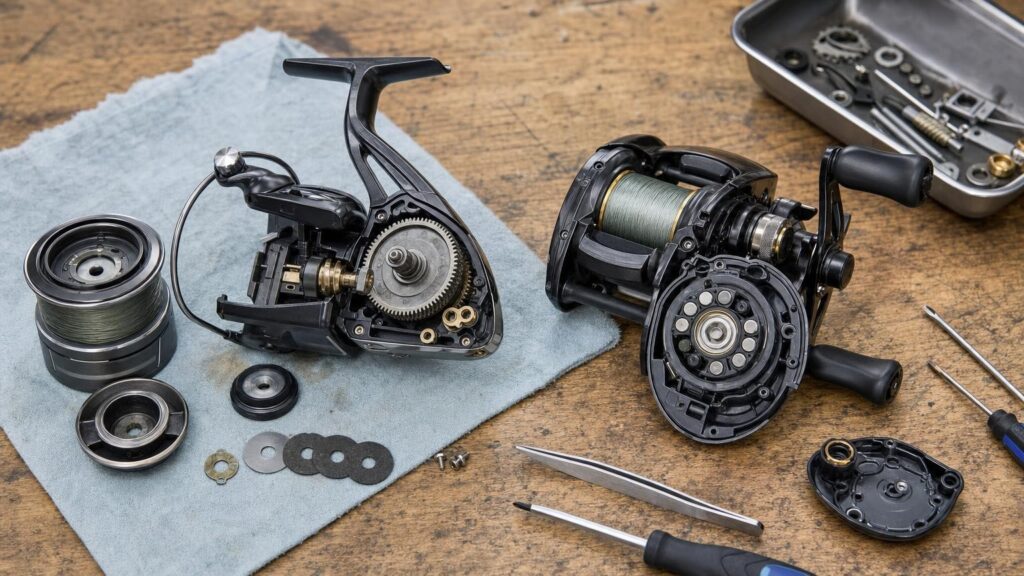
A fishing reel does more than hold line. Its internal mechanism determines how line leaves the spool during a cast, how quickly it returns, how resistance is applied when a fish runs and how much control the angler has throughout the process.
Specifications such as maximum drag, gear ratio, bearing count and line capacity can be useful, but none is a complete measure of performance. A reel with larger numbers is not automatically smoother, stronger or better suited to a particular technique. The useful question is what each feature changes in real fishing and how the parts work together.
Spinning, spincast and baitcasting reels: three ways to manage line
The clearest difference between common reel types is how they store and release line.
Spinning reels
A spinning reel has a fixed spool. During a cast, line peels off the spool lip in coils while the spool itself remains stationary. On the retrieve, a rotating bail and line roller wrap the line back onto the spool as it moves up and down.
This arrangement makes spinning reels relatively forgiving because casting does not require the angler to control a rapidly rotating spool. They handle a wide range of lines and are often convenient for lighter lures. However, line can retain coils from the spool, and poor line loading or excessive twist may contribute to loops, tangles and uneven lay.
Spincast reels
A spincast reel also uses a fixed spool, but the spool and line-pickup mechanism sit behind a protective cover. Pressing and releasing a button controls the cast. The enclosed design makes basic operation approachable and helps protect the line spool from direct knocks.
The trade-off is reduced access when clearing tangles or inspecting the line path. The cover and relatively small opening can also introduce friction as line leaves the reel. Spincast designs are useful where simple operation is the priority, but they generally offer less direct line and spool control than open spinning or baitcasting mechanisms.
Baitcasting reels
On a baitcaster, the spool revolves as line leaves during the cast. This gives the angler direct control over spool speed, usually through a combination of thumb pressure, spool-tension adjustment and a braking system.
That control can support accurate lure placement and efficient handling of certain heavier lures and lines. It also introduces a learning curve: if the spool continues turning faster than the lure pulls line away, loose coils can build into an overrun or backlash. Baitcasters therefore reward careful set-up and casting technique. Their exposed spool also makes line access straightforward, although their braking and spool systems may require more familiarisation.
Drag systems: controlled slip rather than stopping power
A reel’s drag allows line to leave under a chosen amount of resistance. Its purpose is not simply to stop a fish. Controlled slip can reduce sudden loading on the line, leader, knots, hook hold and rod.
Maximum drag is the highest resistance a reel claims to apply, but this figure says little by itself about how the drag behaves through its usable range. For many anglers, smooth start-up, predictable adjustment and consistent resistance matter more than an extreme maximum. A drag that changes abruptly can load tackle unevenly even if its headline rating is high.
The appropriate setting depends on the complete tackle system. Lighter line and leaders usually require more caution, while hook size, hook hold, rod action and the amount of line in the water also affect how force reaches the fish. Drag may need adjustment as conditions change, rather than being tightened fully and left there.
Spinning reels commonly use a knob at the front of the spool, although some designs place the control at the rear. Front controls act at the spool and can offer a direct adjustment arrangement, while rear controls may be easier to reach during a fight. Baitcasters commonly use a star wheel beside the handle, while some larger revolving-spool reels use a lever. Location affects convenience and adjustment style, but does not establish drag quality on its own.
Gear ratio and line retrieve are not the same measurement
Gear ratio describes how many times the relevant line-recovery mechanism turns for one handle rotation. On a baitcaster this relates to spool rotations; on a spinning reel it refers to the rotor turning around the fixed spool.
A higher ratio generally means more rotations per handle turn, but it does not state exactly how much line is recovered. Actual line pickup also depends on the effective circumference of the filled spool. A large, full spool retrieves more line per rotation than a smaller or partly depleted one.
This is why line retrieve per handle turn, when provided, can be more useful than ratio alone. Even that figure may change as line leaves a revolving spool or as the working diameter of the line package changes.
Faster gearing can help pick up slack, keep contact with a moving lure or recover line quickly before another cast. Lower gearing is often associated with a more measured retrieve and may provide a mechanical advantage under load. However, handle length, gear size, spool diameter and internal efficiency also influence how powerful or controlled a reel feels. Gear ratio should therefore be matched to retrieve style rather than treated as a quality score.
Spool geometry: what diameter, depth and lip design change
Spool dimensions affect capacity, casting behaviour, retrieve rate and reel size. On a spinning reel, a wider spool allows line to sit in larger coils. This can reduce the severity of line memory compared with a very narrow spool, but it may also increase the reel’s overall bulk.
The shape and finish of the spool lip influence how line leaves during a cast. Line must pass over this edge repeatedly, so a smooth, well-finished path and suitable fill level are important. Overfilling can encourage loose loops to jump from the spool, while substantial underfilling increases the distance line must climb over the lip and reduces effective spool diameter.
A shallow spool holds less line and can be convenient where only a modest working length is needed. It may reduce the amount of backing or unused line required. A deep spool offers greater capacity for thicker line or situations where long casts and sustained runs are realistic, but unnecessary depth can mean paying for and carrying more line than the technique requires.
On a baitcaster, spool mass and rotational inertia also matter because the spool must accelerate during the cast and then slow under braking and thumb control. A lighter spool can respond readily with suitable lures, while a spool intended for greater capacity or heavier tackle may have different start-up characteristics. These are system-level differences, not a simple rule that lighter is always better.
Line capacity: matching the spool to realistic use
Capacity markings should be read alongside line diameter. Two lines with the same nominal breaking strain can have different diameters because of their material and construction. The reel can only accommodate the physical volume of line, so diameter is the more direct guide when comparing a line with the capacity information on a spool.
Capacity should cover realistic casting distance, any line that may be taken during a run and a sensible reserve. Too little line can limit casting and reduce that margin. On revolving-spool reels, substantial line loss also reduces the working spool diameter, changing line pickup and potentially the feel of the retrieve.
More capacity is not automatically beneficial. A very deep spool may require a large quantity of line, add weight or leave much of the line unused. Backing can fill part of the spool beneath the main line, reducing the quantity of more expensive working line required. It must be attached and loaded securely, with enough main line remaining for the intended fishing.
Correct fill level matters as much as headline capacity. Follow the reel and line guidance rather than filling to the absolute edge. Poorly tensioned or uneven line can bury into lower layers, form loose coils or interfere with smooth casting.
Bearings, bushings and where smoothness really comes from
Bearing count is easy to compare, which makes it tempting to use as a shortcut for quality. In practice, placement and execution matter more than the total alone.
Bearings can support shafts, gears, the handle, line roller or baitcaster spool, depending on the design. A well-placed bearing may reduce friction or stabilise a rotating component. Extra bearings in lightly loaded locations may make less difference than good support around the main gear or spool.
Quality, alignment, protection from contamination and suitable lubrication all affect how bearings perform over time. Gear machining, rigid construction and accurate assembly are equally important. A reel with many bearings can still feel rough if its gears are poorly aligned or the body flexes under load.
Bushings are not automatically inferior. In an appropriate location, a well-fitted bushing can be simple, durable and tolerant of load. Bearings may feel freer in some applications, but they can require care where water, grit or salt reaches them. Smoothness should be assessed as the result of the complete mechanism, not a number printed on the box.
How the specifications interact in real fishing
For easy general-purpose casting, a spinning reel may reduce the amount of spool management required. A suitable spool size, sensible line fill and predictable drag are likely to matter more than an unusually high bearing count.
For controlled lure placement, a baitcaster can provide direct influence over spool speed. Its usefulness depends on matching lure weight, line, spool characteristics and braking adjustment. A fast gear ratio may retrieve slack promptly, but it does not compensate for a spool that is poorly set up for the lure.
When a technique repeatedly creates slack line, faster line pickup can help restore contact. When resistance is sustained, a lower ratio, comfortable handle and rigid gear support may feel more controlled. Neither arrangement is universally superior.
Heavier line requires enough spool volume and a line path designed for the intended use. Strong runs call for adequate capacity and a smooth drag, but simply selecting the largest spool and highest maximum-drag figure may produce an unnecessarily bulky or unbalanced outfit.
The rod also changes how the reel feels. Reel weight, mounting position and handle ergonomics affect balance and fatigue, while rod action influences how sudden loads reach the line and drag. Reel specifications make the most sense when considered with the rod, line, lure or rig and expected conditions.
Choosing with fewer specification traps
Start with the fishing method rather than the biggest number on the specification sheet. Decide whether simple casting, direct spool control, rapid line pickup, heavier line capacity or compact handling matters most.
- Choose the reel mechanism according to the level of casting control and learning curve you are comfortable with.
- Match the spool to the line by considering diameter, realistic working length and fill level.
- Judge drag by usability, including smooth engagement and useful adjustment, rather than maximum resistance alone.
- Compare retrieve rate as well as gear ratio, while remembering that spool diameter affects both.
- Treat bearing count cautiously and consider construction, gear support, sealing and maintenance access.
- Check comfort and balance with the intended rod, especially if the outfit will be cast or retrieved repeatedly.
No single reel type or specification is best for every technique. The better choice is the reel whose line management, drag, gearing, spool and capacity form a balanced system for the intended tackle and conditions. Understanding what happens inside the reel makes it easier to ignore specification traps and concentrate on the features that will genuinely change how fishing feels.
Continue exploring on Frowse
Discover More Frowse Insights
- Why a Power Bank Delivers Less Capacity Than Its Label Suggests
- End Grain, Edge Grain and Face Grain Cutting Boards Explained
- Why Noise-Cancelling Headphones Work Better on Some Sounds Than Others
- Why Garden Hoses Lose Flow and Why Their Connectors Do Not Always Fit
- Why the Number on a Toaster Dial Usually Is Not Minutes