





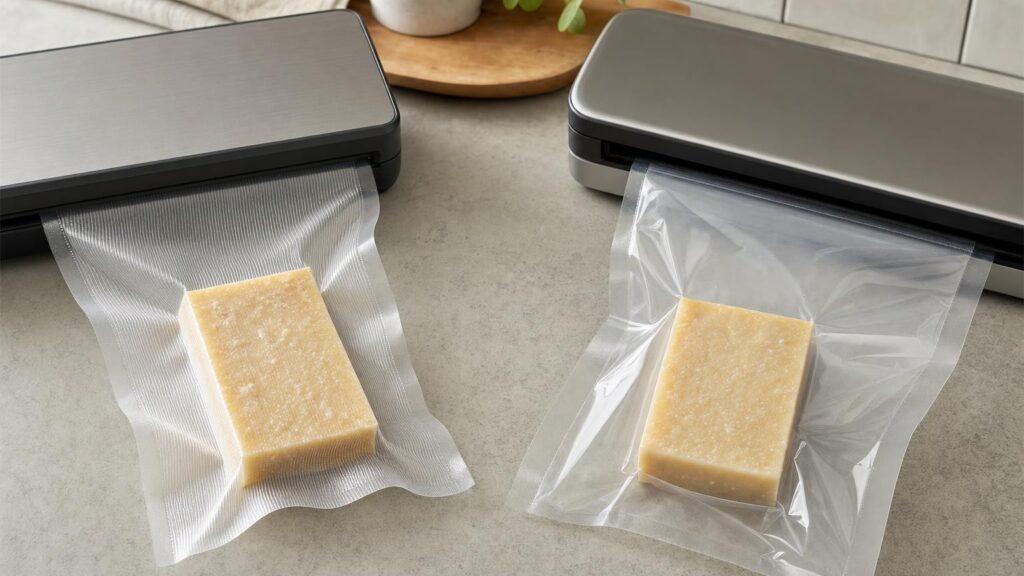
A vacuum-sealer bag is not simply a plastic wrapper. It is a working part of the sealing system, and its surface determines whether air can travel from around the contents to the machine’s pump inlet. Choosing an unsuitable bag can leave pockets of air or produce an unreliable seal even when the sealer itself is operating correctly.
The crucial distinction is between external-suction sealers and chamber sealers. External machines usually need bags with an embossed or textured surface, while chamber machines can generally use smooth pouches. Understanding why makes it easier to compare bag formats, avoid incompatible consumables and estimate the real ongoing cost of a sealer.
Two sealer designs, two ways of removing air
How an external-suction sealer works
An external-suction machine holds the open end of a filled bag at the edge of the appliance. It draws air through the bag mouth, then closes the opening with a heated seal bar. The body of the bag and its contents remain outside the machine at normal surrounding pressure throughout the process.
As suction begins, atmospheric pressure presses the flexible film tightly around the contents. It also presses the two inner surfaces of the bag together. The machine therefore needs a route through which air can continue moving after the bag starts to collapse.
How a chamber sealer works
With a chamber machine, the filled pouch is placed inside a sealed compartment, usually with its open edge positioned across a seal bar. The machine lowers the pressure throughout the chamber, so pressure falls around the outside of the pouch as well as inside it. Once the evacuation stage is complete, the pouch is sealed and normal pressure returns to the chamber.
Because the outside of the bag is not being held at normal atmospheric pressure during evacuation, the two smooth layers do not clamp together in the same way. Air can leave through the open mouth without relying on embossed channels. This is why apparently similar sealers may require fundamentally different consumables.
Why external-suction bags have a textured side
External-suction bags commonly have one textured side and one smooth side. The textured layer contains small ribs, dimples or crossing channels. When the machine clamps the bag and suction draws the film together, these raised features preserve narrow passages between the layers.
Those passages allow air from deeper in the bag to reach the opening and pump inlet. The pattern does not create the vacuum by itself; it prevents the route to the pump from closing too early.
A fully smooth bag can flatten near its mouth as soon as suction starts. Once the inner surfaces cling together, they can form a temporary blockage. The pump may continue running, but little air can travel from the rest of the pouch. The machine might then seal a bag that still contains visible air, or it may fail to complete an automatic cycle as expected.
This means texture is a functional compatibility feature, not a simple indication that one bag is more premium than another. Different embossed patterns may all serve the same basic purpose, but that does not make every textured bag suitable for every machine. Dimensions, film construction and heat-sealing requirements still matter.
Why smooth bags work in chamber sealers
A chamber machine changes the pressure around the whole pouch rather than pulling only through a narrow channel at the bag mouth. Smooth pouches can therefore remain open to airflow during evacuation without an embossed surface. After sealing, the return to normal atmospheric pressure makes the bag draw tightly around its contents.
There are important exceptions and naming traps. A machine with a hose port for canisters is not necessarily a chamber sealer. It may still be an external-suction model that requires textured bags for ordinary pouch sealing. Likewise, a specialised mode does not automatically make every type of smooth pouch compatible.
Shoppers should identify the actual evacuation mechanism and consult the machine’s permitted consumable specifications. The word vacuum on a machine, bag or accessory is not enough to establish compatibility.
Bag construction matters beyond the surface pattern
Vacuum pouches are often made from multiple film layers, with each layer serving a different purpose. One may provide strength or resistance to punctures, while an inner heat-sealable layer is designed to soften and bond under the seal bar. The combined material must remain flexible enough to conform around food or other contents while resisting ordinary handling damage.
Thickness can be useful when packing firm items or objects with harder edges, but thicker is not automatically better. A very stiff bag may not settle around irregular contents as readily. Unusually heavy material may also need more heat or a longer sealing time than a particular machine can provide reliably.
Conversely, a light film may be easier to shape but more vulnerable to damage from sharp bones, hard corners or rough handling. No bag should be expected to resist every pointed object. Positioning sharp edges away from the film, adding an appropriate protective layer or choosing a more suitable container can be more effective than simply buying the thickest available bag.
Check the machine guidance for accepted bag materials and construction rather than treating a single thickness figure as a complete measure of quality.
Match bag width and seal area to the machine
The open edge must fit within the machine’s usable seal-bar width. If a bag is wider than the heated area, part of the mouth may remain unsealed. Nominal appliance width and usable sealing width are not always the same, so the relevant specification is the maximum accepted bag width.
Placement matters too. The bag mouth should normally lie flat and reach the designated vacuum channel or sealing position. Wrinkles can create tiny paths through an otherwise closed seal. Grease, moisture, crumbs and powder can also prevent the inner layers from bonding evenly.
Leave enough empty material above the contents to position the opening without stretching or folding it. Overfilling saves little material if it causes repeated failures. An extra margin is particularly helpful when the contents are bulky, uneven or moist.
Pre-cut bags versus rolls
Pre-cut pouches are quick to load and have a factory-finished seal at one end. Rolls let the user choose the bag length, which can reduce excess material when portion sizes vary. However, every roll bag must first be cut and sealed at one end before it is filled, adding preparation time and another potential failure point.
Rolls can also create offcuts, especially when users leave generous margins or correct uneven cuts. The better choice depends on whether fixed convenience or flexible sizing has greater value in everyday use.
Liquids, moist foods and fine powders change the process
External suction can pull more than air towards the machine. Liquid may travel up the bag as pressure falls, while fine particles can be drawn towards the opening. Either can soil the sealing margin, interfere with the heat seal or enter areas that need cleaning.
Useful precautions include chilling moist contents, leaving additional headspace and keeping the opening clean while filling. On machines that allow suitable manual control, suction may be stopped before liquid reaches the sealing area. These options vary, so buyers should not assume that every external sealer offers the same degree of control.
Chamber evacuation handles liquids differently because pressure changes around the entire pouch. It does not rely on aggressively pulling air and liquid towards an external inlet in the same manner. Even so, liquids can react as pressure falls, and the chamber must have enough space for the pouch. Users should follow the operating instructions for liquid-rich contents rather than viewing a chamber design as permission to seal anything without preparation.
Powders deserve similar care. Fine material near the mouth can compromise the seal even if none reaches the pump. Keeping the product low in the bag, allowing dust to settle and wiping the intended seal area can improve consistency.
Reusable bags and containers are separate compatibility questions
Heat-sealed pouches are usually closed by melting their inner layers together. Reusable zip-style bags and rigid canisters work differently: they commonly use a valve connected to a hose, handheld pump or accessory port. Compatibility therefore depends on the connector, valve design and operating mode, not just the presence of the word reusable.
A reusable bag intended for one valve system may not connect securely to another. A machine may support canisters but not zip bags, or it may require a separate adaptor. Some containers are evacuated through their lids rather than through the appliance’s normal bag channel.
Before buying accessories, check all parts of the system: the machine port, hose ends, adaptor, container valve and specified operating procedure. Reuse also depends on what the bag held and whether it can be cleaned and dried adequately without damaging the valve or seal. A theoretical reuse claim is less useful than a format that suits the shopper’s actual filling and cleaning routine.
Calculate ownership cost by usable seals
The lowest bag price does not necessarily produce the lowest packing cost. A fair comparison considers how many reliable, appropriately sized packs come from the box or roll. Failed seals, excessive margins and discarded offcuts all raise the cost per usable result.
Consider these factors when estimating ongoing expense:
- Compatibility: inexpensive smooth pouches are poor value if an external-suction machine cannot evacuate them properly.
- Portion size: oversized pre-cut bags waste material, while rolls may suit frequently changing lengths.
- Seal reliability: repeated cycles and routine double-sealing use more material, time and energy.
- Preparation: rolls require measuring, cutting and an initial end seal.
- Realistic reuse: count reuse only where cleaning, drying and maintaining the closure are practical.
- Accessory dependence: proprietary valves, hoses or bag formats may narrow future replacement choices.
A compatible bag that seals consistently may cost less in practice than a cheaper option that regularly needs trimming, repositioning or replacing.
A practical compatibility checklist
- Identify the mechanism. Establish whether the machine is external-suction, a full chamber design or an accessory vacuum system.
- Confirm the bag type. Check whether ordinary sealing requires embossed bags, smooth chamber pouches or a specific valve format.
- Check dimensions. Compare bag width with the usable seal bar and make sure typical portions fit with adequate headspace.
- Consider the contents. Moist foods, liquids, powders and sharp-edged items may require different preparation or materials.
- Review construction requirements. Make sure the film and heat-sealable layer are within the machine maker’s stated guidance.
- Verify accessories separately. Match hoses, ports, adaptors and valves rather than assuming universal fit.
- Estimate consumable use. Include failed seals, roll offcuts, bag length and realistic reuse in the calculation.
Texturing exists primarily to maintain airflow in an external-suction system. Smooth bags often fail in those machines because their inner surfaces collapse together and block the route to the pump. In a chamber sealer, the different pressure process usually makes those channels unnecessary. Once shoppers understand that mechanical distinction, bag texture becomes more than a visual detail: it becomes the starting point for choosing compatible materials, sensible dimensions and a sealing system with manageable ongoing costs.
Continue exploring on Frowse
Discover More Frowse Insights
- Bicycle Tyre Sizes Explained: The Numbers That Determine Rim Fit
- A Travel Plug Adapter Does Not Convert Voltage: What to Check Before You Travel
- Single-Coil, Humbucker and Active Pickups: How the Hardware Shapes the Signal
- Why Some Induction Pans Heat Evenly – and Others Only Pass the Magnet Test
- Why Floating Floors Need Expansion Gaps – and What Happens When They Cannot Move