





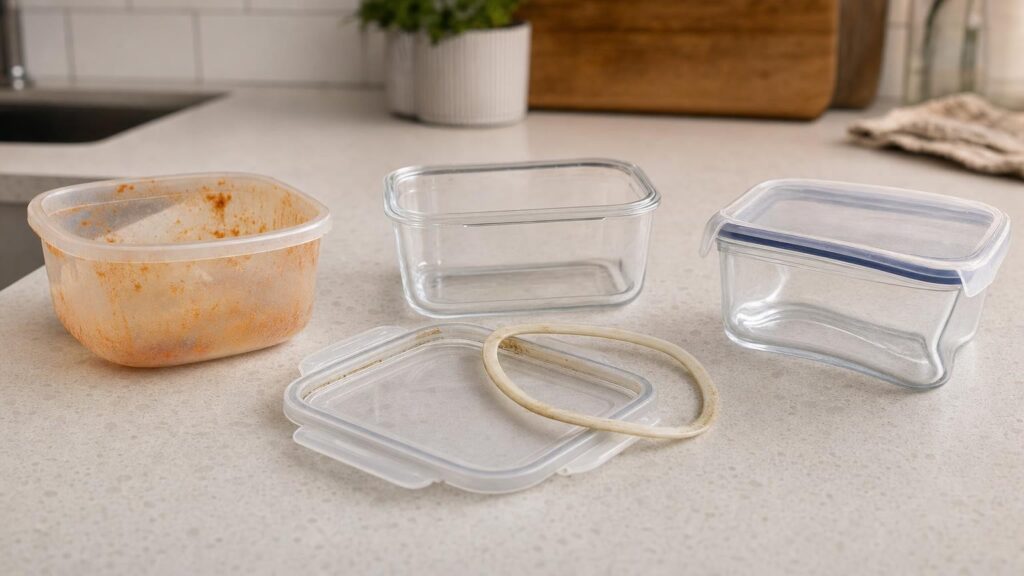
A reusable food container can remain functional while looking permanently orange, develop a lingering curry smell despite repeated washing, or suddenly stop sealing because its rim has changed shape. These are separate forms of ageing, caused by different combinations of food, heat, washing, material and construction.
Understanding those differences makes it easier to choose containers for the foods you actually store. It also helps you judge whether visible wear is merely cosmetic or whether a damaged container, lid or seal is becoming difficult to clean or use reliably.
Staining, odour retention and warping are different problems
Staining is visible discolouration. It often occurs when strongly coloured food compounds come into prolonged contact with a polymer, especially in the presence of oil. The surface may be clean to the touch while some colour remains.
Odour retention happens when aromatic compounds remain on or within the container, lid, gasket, scratches or concealed channels. A container can retain a smell without showing a stain, and a stained container need not smell.
Warping is a change in shape. Heat, pressure and internal stresses from manufacturing can cause a wall, base, lid or rim to flex or deform. The important distinction is between temporary flexibility and a permanent change that prevents stacking, closing or sealing.
Because the mechanisms differ, no single feature prevents all three. A rigid, clear container may resist obvious staining but still have a soft gasket that holds odours. A flexible silicone container may tolerate bending but attract oily residue. Buying well means examining the complete container system rather than judging the main body alone.
How container materials respond differently
Polypropylene
Polypropylene is widely used for reusable food containers and lids because it can be lightweight, relatively flexible and suitable for moulding into hinges, clips and thin walls. It is often translucent rather than glass-clear. It can resist ordinary knocks well, but repeated contact with oily, colourful food may leave visible staining or retained aromas.
Heat response depends on the formulation, thickness and moulded design. A polypropylene item may be intended for reheating or dishwasher cleaning, but shoppers should not assume that every product bearing the same general material name has identical temperature limits or care requirements.
Copolyester
Copolyester is commonly chosen when a rigid, clear appearance is wanted. Its smooth transparency can make contents easy to identify, while its stiffness can give the container a more solid feel. However, clarity also makes fine scratches, cloudy areas and surface wear easier to see.
Different copolyester formulations have different care limits. Apparent rigidity does not prove that a container is suitable for a microwave, freezer or high-temperature dishwasher programme. The product’s stated instructions remain more useful than assumptions based on look or feel.
Silicone
Silicone is flexible and is used for collapsible containers, lids, valves and sealing gaskets. Its flexibility can help a seal conform to a rim, but soft surfaces may hold oily films and aromatic compounds more readily than a smooth, rigid body. Dust and lint can also be more noticeable on some finishes.
Not every flexible part is silicone. Some seals and lids use thermoplastic elastomers or other soft polymers. These can look similar while differing in feel, heat response and care requirements. Product information is therefore more dependable than trying to identify a material by touch.
Why colourful, oily foods leave stains
Tomato sauces, turmeric-rich dishes and other intensely coloured foods contain pigments that can be carried by oils. When oily food sits against a polymer, these colour compounds can cling to the surface or move slightly into it. Warmth and long contact times can make the effect more noticeable.
This explains why washing away the grease does not always restore the original colour. What remains may not be a removable layer of sauce. Scrubbing harder can be counterproductive if it roughens the interior and creates more places for future oils and pigments to collect.
Surface condition matters as much as the base material. A new, smooth container is generally easier to rinse than one covered in fine utensil marks. Textured finishes can disguise scratches, but their small recesses may also make oily residue harder to see and reach.
Staining is especially visible in pale, white or clear components. Dark or coloured materials may conceal it rather than prevent it. Shoppers who regularly store highly pigmented sauces should distinguish between actual stain resistance and a colour scheme that simply makes discolouration less obvious.
Where persistent food odours come from
Many familiar food smells are produced by volatile or oil-soluble compounds. These can remain in a thin oily film, interact with a polymer surface or gather in places that routine washing does not reach. Soft gaskets, scratched interiors and textured lid parts are common retention points.
Lid construction is particularly important. A container body may look spotless while residue remains beneath a removable seal, around a steam valve or inside a narrow channel. Fixed gaskets can reduce the number of loose parts, but they may be harder to inspect. Removable gaskets provide better access only if they are designed to come out without stretching or damage.
Time and ventilation also influence perceived odour. Leaving strongly aromatic food in a closed container for several days gives compounds more opportunity to linger. Reassembling and storing components while damp can create a stale smell that may be mistaken for the original food aroma.
An odour after washing does not by itself identify the cause. It may come from the body, the gasket, trapped residue, a washing product or incomplete drying. Smelling components separately can help locate the source before the entire container is written off.
What makes a container warp
Warping usually reflects an interaction between heat, shape and mechanical stress. Polymers soften to different degrees as their temperature rises. Thin sections may move more easily than reinforced rims, and uneven heating can make one area expand or relax before another.
A dishwasher can add both heat and physical constraint. A light container wedged tightly between rack supports may be held in a distorted position while warm. Strong water jets can move unsecured lids, while nearby items may press against softened walls. This does not mean all dishwasher cleaning causes warping, but loading and the manufacturer’s placement instructions matter.
Microwave reheating can also be uneven. Hot food, concentrated oil and steam may create localised heating even when the rest of the container feels cooler. Microwave suitability should never be inferred solely from the fact that an item is plastic.
Shape can also be altered after heating. Forcing a cool, rigid lid onto a still-warm container may hold the rim out of its natural position as it cools. Stacking heavy items on warm containers can have a similar effect.
A wall that flexes under hand pressure and returns to shape is not necessarily warped. More meaningful warning signs include a rocking base, a rim that no longer sits flat, clips that cannot engage evenly or a lid that repeatedly lifts at one corner.
Moulding and design details that affect ageing
Two containers made from the same named material can age differently because their geometry is different. Useful details to assess include:
- Wall and rim thickness: Thin walls reduce weight but may flex more. A substantial or reinforced rim can help preserve the shape needed for lid alignment.
- Reinforcing ribs: Ribs can stiffen a base or side without making the whole container thick. On the inside, however, complex contours may create additional cleaning edges.
- Corners: Broad, rounded internal corners are generally easier to wipe than sharp angles where sauce and grains can collect.
- Surface finish: Glossy surfaces reveal scratches, while textured surfaces can conceal them. Texture may also retain films if it is pronounced.
- Mould seams: Seams and transitions can become visible wear points. Raised or complicated edges around lids deserve particular attention because residue can gather beside them.
- Stacking design: Nesting saves cupboard space, but tightly jammed containers can be awkward to separate. Heavy stacking pressure can also be unhelpful when components are still warm.
These details rarely appear as a single performance claim, so photographs and care diagrams can be informative. Look at the inside corners, underside of the lid and seal channel rather than concentrating only on external styling.
Lids, gaskets and seals often age first
A container remains useful only while its lid works with its rim. Rigid lids can develop stress around clips and hinges, while flexible lids may stretch or lose their original fit. Soft seals can retain oil, become discoloured or sit incorrectly after washing.
Gasket grooves improve seal positioning but create another area to clean. A removable gasket can be inspected and dried separately, although frequent removal may damage it if the instructions do not call for that treatment. A fixed seal avoids reinstallation mistakes but can make hidden residue more difficult to investigate.
Availability of replacement lids, seals or valves can extend useful ownership when the main body remains serviceable. Replacement parts must be intended for the exact container model or range. Similar dimensions and appearances do not establish cross-brand compatibility, especially where clip positions, rim profiles and gasket compression differ.
Matching construction to the foods and routines that matter
There is no universally best container material. The better choice depends on the task:
- For pigmented sauces: Prioritise smooth interiors, accessible corners and a design you can rinse promptly. Accept that some cosmetic colour change may still occur.
- For oily meals: Examine lid channels and seals closely. Simple, accessible construction can matter more than the appearance of the container body.
- For carrying food: Focus on closure design, gasket condition and correct lid fit. Material rigidity alone does not indicate how well the assembled product will contain food.
- For frequent reheating: Check the stated microwave and venting instructions, including whether the lid should be removed, loosened or vented. Do not generalise from another container made from a similar material.
- For dishwasher use: Verify that all components are covered by the instructions and note any specified rack position or programme limits.
- For freezing: Follow the stated freezer guidance and leave appropriate room for food expansion where instructed. A flexible-looking container is not automatically freezer-compatible.
It can be sensible to use different containers for different jobs. A clear, rigid container may suit foods that benefit from easy identification, while a less visually pristine container can be reserved for tomato-based or heavily spiced dishes.
Care choices that can slow staining, smells and distortion
No care routine guarantees permanent restoration, but several habits can reduce avoidable wear:
- Rinse oily and strongly pigmented residue reasonably soon after use rather than letting it dry in place.
- Use non-abrasive cleaning tools appropriate to the manufacturer’s instructions.
- Avoid cutting food inside the container, as knife marks create deep scratches and cleaning difficulties.
- Remove gaskets and valves only when they are designed to be removed, and reinstall them in the correct orientation.
- Dry bodies, lids and seals fully before reassembly or closed storage.
- Allow warm components to return to shape without a forced lid or heavy stack pressing on them.
- Load lightweight pieces securely in the dishwasher and follow any specified placement guidance.
Home remedies may change the appearance or smell of some materials, but they are not universal solutions. Cleaning substances, soaking times and temperatures that suit one product may damage another. The supplied care instructions should take priority.
When wear is cosmetic and when it affects usefulness
Discolouration alone may be a cosmetic change if the surface remains intact, cleanable and free from retained residue. Likewise, fine external scuffs may matter little to function. The assessment changes when damage creates areas that are difficult to clean or prevents the parts from working together.
Inspect containers periodically for deep cuts, cracks, rough damaged surfaces, distorted rims, loose closures and seals that are split, stretched or no longer seated correctly. Persistent residue in an inaccessible channel is different from colour that remains after thorough cleaning. A lid that has to be forced into place is also giving more useful information than a stain on the base.
Reusable polymers inevitably show some evidence of use. The most practical buying approach is not to expect every container to remain visually new, but to choose a material and design that fit your food, heating and washing routines. Accessible seals, straightforward interiors and replaceable model-specific components can make ordinary ageing easier to manage.
Continue exploring on Frowse
Discover More Frowse Insights
- Why Heat-Pump Dryers Run Cooler, Longer and Differently
- How Small Bluetooth Speakers Produce More Bass Than Their Size Suggests
- Why Baking Trays Warp in the Oven and Sometimes Flatten Again
- Porcelain, Stoneware and Earthenware: What the Names Really Mean
- What Makes a Backpack Water-Resistant – and Why the Protection Wears Out