





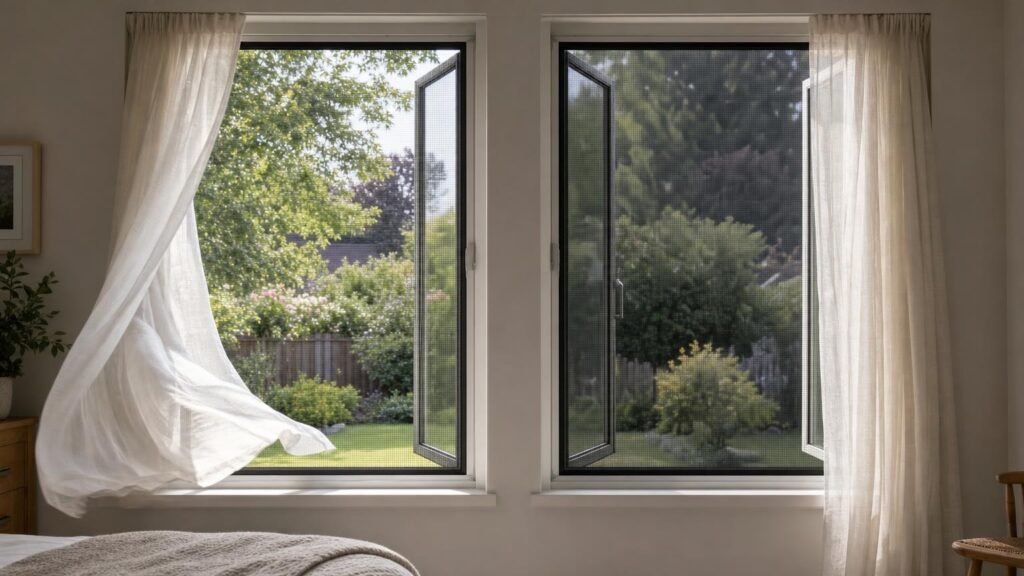
A finer insect screen may sound like an automatic upgrade. Smaller openings can prevent smaller insects from passing through, but they also change how air, light and sightlines move through the screen. The result can be lower ventilation, a softer or darker-looking view, and different cleaning and durability requirements.
The best choice is therefore not necessarily the finest mesh available. It is the screen that balances insect exclusion with the airflow, visibility, exposure and maintenance needs of a particular window or door. Understanding aperture size, strand thickness, open area, weave and material makes that balance easier to judge.
The hidden trade-off in a finer insect screen
Every insect screen places a physical barrier across an opening. To exclude smaller insects, a manufacturer generally needs to reduce the clear spaces between strands. This may involve placing strands closer together, using a different weave or changing the relationship between strand diameter and aperture size.
As more of the opening is occupied by screen material, less unobstructed space remains for air and light to pass through. More strands can also become visible against the background, particularly when the screen is brightly lit or viewed at an angle.
This does not mean fine screening is a poor choice. It can be useful where very small insects are the main nuisance. The important point is that improved exclusion comes with practical compromises. A screen designed for a sheltered bedroom window may not be the best construction for a frequently used door, a kitchen requiring strong ventilation or an opening exposed to dust and debris.
Aperture size matters more than mesh count alone
Mesh count describes how many openings or strands occur across a given distance, depending on the convention used by the manufacturer. It is a useful starting point, but it does not fully describe the size of the clear opening through which an insect would need to pass.
Strand diameter matters as well. Two screens can have the same nominal mesh count but use strands of different thicknesses. The screen with thicker strands will usually have smaller clear apertures because more of each measured interval is occupied by material. Weave construction and manufacturing consistency can also alter the finished opening.
For insect exclusion, actual aperture dimensions are therefore more informative than mesh count by itself. If those dimensions are provided, check whether they refer to the clear opening rather than the overall spacing from one strand centre to the next. Rectangular apertures should be assessed in both directions because their width and height may differ.
Nominal measurements should not be treated as absolute guarantees. Flexible mesh can shift slightly, and installation tension may alter the shape of individual openings. Variations at edges, seams or damaged areas can also be more significant than the central mesh specification.
How strand thickness and open area affect airflow
Open area is the proportion of the screen that is not occupied by strands. In general, a screen with a greater open area presents less physical obstruction to moving air than one with a lower open area. Finer apertures and thicker strands tend to reduce that proportion.
Airflow is not determined by open area alone, however. Wind speed and direction, indoor and outdoor pressure differences, the dimensions of the window opening and the presence of another ventilation path all influence how much air moves through a room. A partly opened window behind a large screen may be more restrictive than the mesh itself.
Screen condition matters too. Dust, pollen, fibres and other debris can accumulate within small apertures, effectively reducing their size. A fine screen that performs adequately when clean may feel more restrictive after a period in an exposed location.
When comparing products, open-area information can be helpful if it has been calculated on a consistent basis. If it is unavailable, consider aperture size and strand diameter together. A fine mesh made with relatively slim strands may preserve more airflow than one using thicker strands, although material strength and resistance to damage must also be considered.
Why finer mesh can make the view look darker or less sharp
A screen affects visibility because its strands interrupt light and create a pattern in front of the scene. As strand density rises, the eye receives less uninterrupted detail. The view may appear darker, lower in contrast or slightly softened, especially when looking through several layers such as mesh, glass and reflections.
Colour has a less obvious effect than shoppers may expect. A light-coloured or shiny mesh can reflect ambient light towards the viewer, making the screen itself more noticeable. A dark mesh absorbs more light and may visually recede when the viewer focuses on the scene beyond it. For that reason, black or charcoal mesh can sometimes appear less intrusive than a pale mesh even though its colour sounds less transparent.
Surface finish and viewing angle also matter. Reflective metallic strands may catch highlights, while matt finishes generally produce less glare. A screen viewed square-on may be less noticeable than the same screen seen from an oblique angle, where the apparent density of the strands increases.
Visibility is also affected by lighting conditions on each side. Looking from a dim room towards a bright exterior is different from viewing a screen illuminated from the front. Product photographs cannot reproduce every installation, so colour and finish should be considered alongside the room’s orientation and typical lighting.
Weave and tension change performance
The regularity of the weave determines how consistent the apertures are. Uneven spacing can create local openings that are larger than the nominal specification, while distorted intersections can affect both the view and the way air passes through the screen.
Strand shape contributes as well. Round, flattened or coated strands occupy space and reflect light differently. Intersections may be bonded, woven or otherwise stabilised, affecting how readily the mesh shifts under pressure. These construction details are not always captured by a simple count.
Installation tension should hold the screen flat without excessively distorting it. Too little tension can allow sagging, rippling or movement in wind. Too much can pull flexible apertures out of shape, strain the edges or bow a lightweight frame. Consistent fitting is particularly important on doors and larger openings, where small errors become more visible.
Fibreglass, aluminium and polyester compared
Fibreglass
Fibreglass screen is flexible and is commonly straightforward to cut and fit into suitable frames. Its flexibility can make it forgiving during installation, and it does not crease in quite the same way as rigid metal mesh. However, flexible construction can stretch, sag or be damaged by repeated contact, depending on the strand thickness, coating and installation.
Visibility varies with colour and construction. Dark-coated fibreglass often recedes visually, but a dense or thick-stranded version can still reduce airflow and light.
Aluminium
Aluminium mesh is more rigid and holds a defined shape, which can suit applications where a crisp, taut screen is wanted. That rigidity also means it may retain creases, dents or bends if mishandled during transport, installation or everyday use.
Metallic finish can influence glare and visibility. Coatings and local exposure conditions matter where corrosion or surface deterioration is a concern, particularly near salt, persistent moisture or incompatible materials. Suitability should be judged from the stated finish and intended environment rather than from the word “aluminium” alone.
Polyester
Polyester mesh can provide useful resilience and flexibility, especially in constructions intended to tolerate repeated contact. Performance still depends on strand dimensions, coating, weave and edge support. A heavy polyester mesh intended for demanding use may be more visible and restrictive than a lighter version.
Material names therefore describe only part of the screen. Compare the complete construction rather than assuming all fibreglass, aluminium or polyester meshes share the same visibility, strength or lifespan.
Match insect exclusion to the actual nuisance
Standard screening may be suitable where the aim is to deter ordinary flies, mosquitoes and similar insects, while finer screening may be considered for smaller nuisances. The necessary aperture depends on the insect’s body size and shape, and these can vary by species and life stage.
A very fine central mesh will not solve gaps elsewhere. Insects may enter around a poorly fitted frame, beneath a door, through damaged corners or where the spline has lifted. Sliding panels also need appropriate overlap and alignment. Before choosing denser mesh, inspect the whole opening and identify whether the current problem is the mesh aperture or the installation.
It can be sensible to use different screening in different parts of a home. Fine mesh might be worthwhile on openings closest to the source of small insects, while a more open screen could preserve ventilation elsewhere.
Durability, cleaning and repair over the screen’s life
Small apertures can trap dirt more readily and may require more frequent attention in dusty, coastal or pollen-heavy locations. Cleaning should suit the material and coating. Gentle vacuuming with an appropriate attachment, rinsing or washing with mild soapy water may be suitable in many cases, but the frame and manufacturer’s care guidance should be checked first. Abrasive tools, harsh chemicals and forceful scrubbing can damage coatings or distort fine strands.
Minor local damage can sometimes be patched, although a patch adds another layer of material and may be conspicuous. It can also change airflow at that point. If the mesh is brittle, extensively stretched or damaged near the frame, full re-meshing is usually more coherent than accumulating repairs.
Loose mesh does not always require replacement. If the material remains sound, replacing or reseating the spline may restore tension. The spline must match the frame channel and mesh thickness: an unsuitable diameter can fail to grip or can place excessive pressure on the frame and screen.
Repairability should be considered before purchase, especially for large panels or frequently used doors. Check whether the screen is designed for replaceable mesh, whether compatible spline is available and whether the frame can be opened without damage.
How to compare screen specifications intelligently
When product information is available, compare the following points rather than relying on a “fine”, “high visibility” or “heavy-duty” label:
- Clear aperture dimensions: Check the actual width and height of the openings where stated.
- Strand diameter: Thicker strands can reduce open area even when mesh count is unchanged.
- Open area: Use this as a comparative indicator, while remembering that real ventilation depends on the full installation.
- Material and coating: Consider flexibility, creasing, environmental exposure and likely contact.
- Colour and finish: Dark, matt mesh may visually recede, while reflective surfaces can be more noticeable.
- Weave and stability: Look for a consistent construction appropriate to the panel size and expected use.
- Frame and spline compatibility: Confirm thickness, channel size and fitting method before replacing existing mesh.
- Location: Account for wind, moisture, salt, dust, pets, children and frequency of door use as relevant.
- Maintenance: Consider how easily the mesh can be cleaned, tensioned, patched or replaced.
Where specifications are incomplete, avoid treating mesh count as a complete performance measure. It cannot by itself reveal airflow, optical quality, aperture consistency or resistance to everyday wear.
Choosing the right compromise for each opening
The right insect screen is a balance, not a race towards the highest mesh count. Start with the insects that actually need to be excluded, then consider how much ventilation and visual clarity the opening should retain. Add the practical demands of weather exposure, cleaning, repeated contact and future repair.
Different openings may justify different answers. A door exposed to frequent handling may prioritise resilience, while a window with an important view may favour slim strands and a dark finish. A window near very small insects may justify finer apertures despite lower airflow.
By comparing aperture size, strand thickness, open area, material and installation details together, shoppers can avoid assuming that finer always means better. The most useful screen is the one whose compromises fit the location.
Continue exploring on Frowse
Explore products on Amazon
Looking for products related to this guide? to enter your own search term.
Discover More Frowse Insights
- Why Knitwear Pills: The Roles of Fibre Length, Yarn Twist and Fabric Structure
- What Determines How Long a Cool Box Stays Cold?
- Why Stainless-Steel Cutlery Can Still Rust, Stain and Bend
- Machine-Woven, Tufted and Hand-Knotted Rugs: What Construction Changes
- Roller Skate Wheels Explained: Diameter, Hardness, Profile and Hubs