





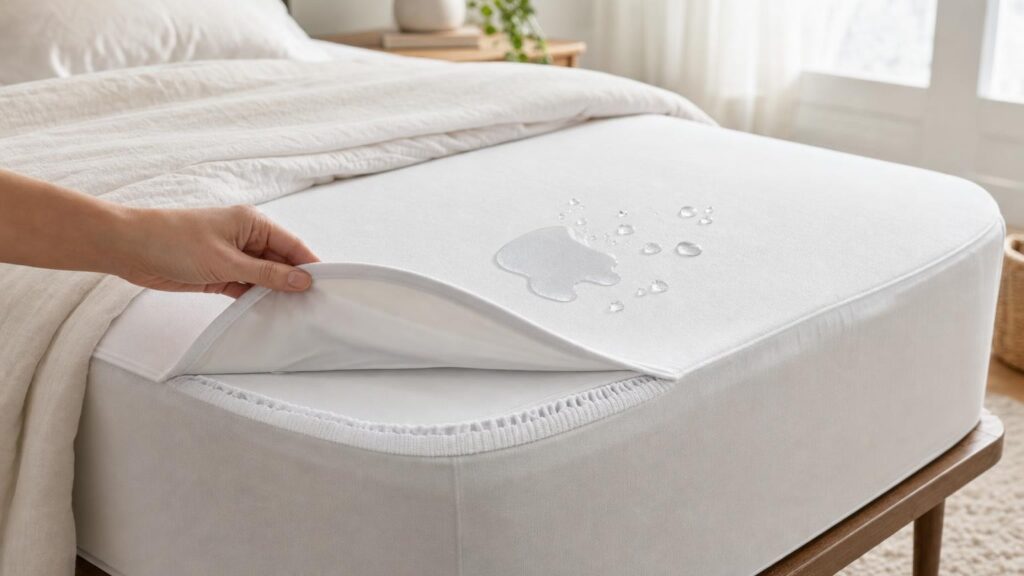
A waterproof mattress protector has several jobs that do not always sit comfortably together. It must provide a dependable barrier against spills and other moisture, yet ideally remain soft, quiet and unobtrusive beneath a fitted sheet. It also needs to fit securely and tolerate regular laundering.
These demands create unavoidable trade-offs. A substantial barrier may feel more noticeable, while a thin and flexible construction can be more sensitive to heat, abrasion or incorrect washing. Understanding the layers, materials and coverage designs makes it easier to decide which compromises matter for a particular bed.
Why waterproofing changes how a mattress protector feels
Ordinary woven and knitted fabrics contain spaces between their fibres and yarns. These spaces help the fabric bend, allow air to move and contribute to a familiar textile feel, but they also allow liquid to pass through. Even an absorbent fabric only holds moisture temporarily; it does not necessarily stop it reaching the mattress.
A genuinely waterproof protector therefore needs a continuous barrier. This is commonly a membrane, film or coating attached to a textile surface. The barrier closes the routes through which liquid could otherwise travel, but it also changes flexibility, airflow, sound and heat perception.
No construction maximises every quality. A shopper who prioritises substantial liquid protection may accept more bulk or warmth. Someone particularly sensitive to texture and rustling may favour a thinner, softer laminate while paying closer attention to care instructions and condition over time.
How the waterproof layer blocks liquid
Most protectors combine at least two functional layers. The textile face provides the surface closest to the sleeper, while the backing or internal layer creates the liquid barrier. Some designs add padding, a second fabric backing or a fitted skirt.
A continuous film stops liquid because droplets cannot readily pass through it. Some membranes also permit a degree of moisture-vapour movement at a microscopic level. Vapour movement is different from allowing spilled liquid or unrestricted air through, so a protector can be described as both waterproof and breathable when those terms refer to different forms of moisture transfer.
Construction details matter alongside the barrier material. Needle holes, damaged seams, an exposed zip or unprotected side panels can create routes around an otherwise waterproof surface. Shoppers should therefore check which parts of the protector are actually backed by the barrier rather than assuming that the whole product is protected.
Polyurethane, vinyl and coatings: the practical trade-offs
Polyurethane membranes
Polyurethane is widely used as a thin film laminated to a textile face. It can be flexible and relatively unobtrusive, which helps a protector conform to the mattress and move with the sleeper. Some polyurethane membranes support moisture-vapour transfer, although the extent depends on the formulation, thickness and complete construction.
Thinness is not an automatic guarantee of comfort or durability. Bonding quality, face fabric, seam design and laundering all affect performance. High drying temperatures and unsuitable chemicals may damage some polyurethane laminates, so the care label is especially important.
Vinyl barriers
Vinyl can provide a straightforward continuous barrier and may be used where robust liquid blocking is the main priority. Compared with softer laminates, it can feel heavier or stiffer and may produce more obvious crinkling when it bends. It also tends to permit little vapour movement through the barrier itself.
These are general material tendencies rather than promises about every product. A thin, well-fitted vinyl construction may be less noticeable than a loose one, while a poorly constructed protector made from a nominally softer material may still feel noisy or rigid.
Applied coatings
Instead of attaching a separate film, a manufacturer can apply a waterproof coating to a textile. This may create a light and flexible product, but its feel and longevity depend on the coating composition, thickness and adhesion. Repeated flexing, abrasion and unsuitable washing can gradually expose weak areas or lead to cracking and peeling.
The name of the barrier material is therefore only a starting point. It does not by itself establish quietness, comfort, washing tolerance or useful life.
Why the face fabric matters as much as the membrane
The sleeper normally encounters the face fabric rather than the waterproof layer directly. Its fibres, knit or weave, weight and padding can change how strongly the membrane is felt and heard.
Cotton-faced protectors often provide a familiar fabric feel and can absorb some surface moisture. Absorption may reduce the immediate clammy sensation of a small spill or perspiration, but retained moisture also needs time to dry. The presence of cotton does not make the protector waterproof unless a suitable barrier sits underneath.
Polyester surfaces generally absorb less moisture into the fibre and may dry more quickly. Their feel varies considerably according to yarn and construction. Blends combine fibres to adjust softness, drying behaviour, durability or cost, but the percentage shown on a label does not explain the full sleeping experience.
Quilted or padded faces put more material between the sleeper and the barrier. This can make the backing feel less obvious and may soften minor mattress irregularities. The trade-offs are extra bulk, potentially slower drying and a greater possibility of changing the feel of a responsive or deeply cushioned mattress.
Lamination, airflow and the meaning of ‘breathable’
Lamination bonds the textile face to the waterproof membrane. A consistent bond helps the layers move together, reducing loose-film movement that can cause noise. However, adhesive choice, bonding pattern and membrane thickness also influence flexibility and vapour transfer.
Breathability is an easily misunderstood description. Air permeability means that air can pass through a material. Moisture-vapour transfer describes the movement of water in vapour form. A continuous waterproof barrier generally does not offer the same free airflow as an open textile, even if it permits some vapour to migrate through.
Temperature comfort also depends on more than the membrane. Bedding, room conditions, sleepwear, mattress construction and the protector’s face fabric all contribute. Shoppers who sleep warm should look at the full build rather than treating a single breathable claim as a guarantee of a cool bed.
What causes rustling, crinkling and a less natural bed feel
Noise occurs when layers flex, rub or snap back as the sleeper moves. A stiff film is more likely to make itself heard, but looseness can be just as important. An oversized protector may wrinkle under the sheet, while a stretched or poorly anchored one may shift across the mattress.
Friction between the protector, mattress cover and fitted sheet can add further sound. Deep wrinkles and trapped air can make movement more noticeable. A soft laminate, textile face and secure fit may reduce rustling, but no layered protector is guaranteed to be silent in every bed arrangement.
A less natural feel can also come from thickness or tension. Heavy quilting can alter the contouring of the mattress, while a taut protector may resist the movement of a soft comfort layer. People who value the precise feel of their mattress may prefer a thin fitted design, provided it offers the coverage they need.
Coverage choices: fitted protectors, pads and full encasements
Fitted protectors
A fitted protector resembles a fitted sheet. The waterproof panel commonly covers the sleeping surface, while an elasticated textile skirt grips the sides. This design is relatively easy to remove and wash, making it practical where spills are the main concern.
The skirt and mattress sides are not necessarily waterproof. Seams around the top panel may also define the limit of protection, so checking the stated coverage is important.
Flat or anchored pads
A pad protects a defined area and may be held by straps or tucked edges. It can be convenient when protection is needed mainly in one part of the bed, and a smaller item may be easier to launder. Its limitations are incomplete coverage and a greater chance of shifting, bunching or exposing the mattress.
Full encasements
An encasement surrounds the mattress and closes with a zip. It offers more complete surface coverage than a top-only protector, but installation and removal require more effort. The zip, seams and any closure flap are important parts of the construction because they interrupt the main panels.
More enclosing material can also add warmth, friction or noise. Encasements may be less convenient for frequent laundering, particularly with a large or heavy mattress. Coverage should therefore be matched to the actual risk rather than maximised automatically.
Fit, mattress depth and compatibility in everyday use
Mattress length and width are only part of sizing. Depth is equally important, especially when a topper is added. Shoppers should measure the full height from the bottom edge of the mattress to the top of any topper that will remain underneath the protector.
A skirt that is too shallow may ride up, put stress on seams or fail to grip below the mattress. Excessively deep or loose fabric can gather underneath the sheet and contribute to movement and noise. Strong elastic cannot compensate for fundamentally unsuitable dimensions.
Also consider the space available for the fitted sheet. A protector and topper add to the total depth, and a previously suitable sheet may become difficult to secure. On adjustable beds, the protector must accommodate repeated bending without pulling away from the corners or becoming excessively taut.
How washing and drying gradually affect performance
Laundering removes spills, body oils and residues, but it also exposes the protector to water, detergent, movement and heat. Over time, repeated flexing and abrasion can affect a laminate or coating. Elastic can lose recovery, and seams may weaken. Excessive drying heat may be particularly harmful to some waterproof backings.
Following the product’s care label is more reliable than applying a general washing routine. Avoid assuming that a protector can tolerate the same temperature, bleach or stain treatment as ordinary bed linen. If incompatible fabric treatments leave residues, they may also change how the textile face handles moisture.
The protector should be completely dry before returning to the bed. Thick, quilted and encasement styles may need more drying time than a thin fitted design. Periodically inspect the backing and seams for peeling, bubbles, cracks, worn patches or separation. If liquid protection is critical, visible deterioration is a reason to reassess the protector rather than relying on appearance from the top alone.
Choosing the right balance for the way the bed is used
Begin with the likely exposure. Occasional small spills may call for a different balance from frequent or substantial liquid contact. Next, decide whether protection is needed only across the sleeping surface or around the sides as well.
Then consider sensitivity to warmth, texture and sound. A flexible polyurethane laminate with a soft face may suit someone who wants the protector to feel less obvious, while a padded surface may better mask the barrier at the cost of bulk and drying time. A more substantial barrier may be appropriate when liquid blocking takes priority over an almost unchanged mattress feel.
- Check coverage: Identify exactly which panels, seams and closures are intended to resist liquid.
- Measure the complete bed: Include mattress depth and any topper.
- Assess the layers: Consider the barrier, face fabric, padding and skirt as one construction.
- Interpret breathability carefully: Vapour transfer is not the same as unrestricted airflow.
- Plan for care: Choose a size and design that can realistically be removed, washed and dried as often as needed.
- Inspect over time: Fit and waterproof performance can change as elastic, seams and laminates age.
The best choice is not simply the protector with the thickest barrier or softest top. It is the design whose waterproofing, comfort, coverage and care demands align with how the bed is actually used.
Continue exploring on Frowse
Explore products on Amazon
Looking for products related to this guide? to enter your own search term.
Discover More Frowse Insights
- Why Knitwear Pills: The Roles of Fibre Length, Yarn Twist and Fabric Structure
- What Clutches, Gearboxes and Impact Mechanisms Change in a Cordless Drill
- Foil vs Rotary Electric Shavers: How the Cutting Mechanism Changes the Shave
- Why Replacement Casters Need More Than the Right Wheel Diameter
- Suction, Airflow and Floorheads: What Really Determines Vacuum Cleaning Performance