





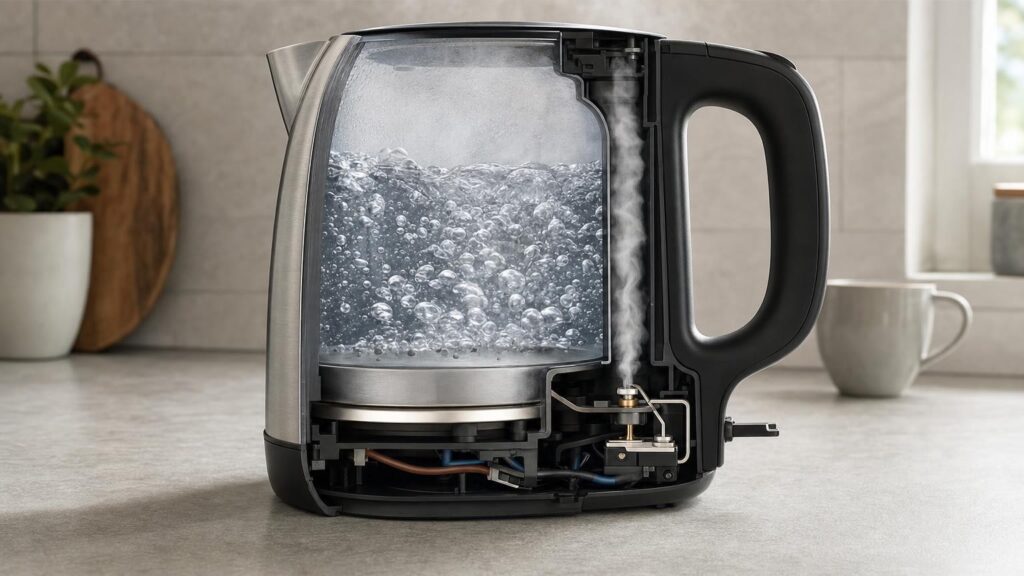
An automatic electric kettle appears to make a precise decision: the water boils, the switch clicks and the power turns off. In most basic kettles, however, there is no sensor continuously measuring the temperature of the water. The shut-off system usually relies on steam reaching a thermostat, which then releases a mechanical switch.
This distinction matters when comparing kettles. The lid, steam channel, thermostat, heating element and water level all contribute to normal operation. Element construction affects cleaning and minimum-fill requirements, while variable-temperature models add sensors and electronic controls. Limescale can influence several parts of the system over time.
From boiling water to click: tracing the steam path
When a kettle is switched on, electricity flows through a resistive heating element. The element converts electrical energy into heat, which passes into the water. In an exposed-element kettle, the metal element is immersed directly in the water. In a concealed-element design, it sits beneath a metal plate forming the bottom of the water chamber.
As the water becomes hotter, small bubbles may form on the heated surfaces. These early bubbles do not necessarily mean that the whole volume has reached boiling point. Some may contain dissolved gases escaping from the warming water, while others may be water vapour that condenses before reaching the surface.
Once boiling becomes vigorous, the kettle produces a sustained flow of steam. With the lid properly closed, some of this steam is directed through a passage towards the thermostat. Depending on the design, that passage may run through the handle area, close to the lid or down towards the base.
The steam rapidly heats the thermostat. At its switching threshold, the thermostat changes shape or triggers a release mechanism. This opens the electrical contacts, cuts power to the element and usually makes the familiar click. The external lever may then return to its off position.
This explains why visible bubbling is not, by itself, the shut-off signal. The system needs enough hot vapour to reach and heat the thermostat. It also explains why the lid is more than a splash cover. If it is left open or does not close correctly, steam may escape instead of following the intended path, potentially delaying normal automatic shut-off. The operating instructions should always be followed regarding lid position.
What the thermostat actually senses
Many automatic kettles use a bimetallic thermostat. A bimetal component consists of two bonded metals that expand by different amounts when heated. Because one layer changes dimension more than the other, the component bends. Some designs use a shaped disc or strip that snaps from one position to another at a particular temperature.
That snap action can release a latch or separate electrical contacts. It creates a decisive on-or-off response rather than allowing the contacts to drift apart slowly. After the kettle cools, the thermostat returns towards its original state so the kettle can be switched on again.
The thermostat is therefore generally reacting to heat delivered by steam rather than directly confirming an exact temperature throughout the water. The point at which the kettle switches off can vary slightly because of the position of the thermostat, steam-channel design, manufacturing tolerances and residual heat in the element and base.
Altitude also affects the process because water boils at a lower temperature when atmospheric pressure is lower. A steam-actuated kettle can still respond to the steam produced at boiling, but its behaviour and the resulting water temperature need not be identical in every location. This is one reason not to treat an ordinary automatic kettle as a precision temperature instrument.
Automatic shut-off, boil-dry protection and temperature control are different features
Several kettle functions are sometimes grouped together even though they respond to different conditions.
- Automatic shut-off after boiling commonly uses steam to operate a thermostat and switch off the element once sustained boiling occurs.
- Boil-dry protection responds when the heating system becomes excessively hot because there is too little water, or no water, to absorb the heat. It is a protective mechanism, not the normal way to finish a boiling cycle.
- Variable-temperature control uses additional sensing and control components to stop heating at a selected temperature below boiling, or to regulate the water around a chosen setting.
One feature should not be assumed merely because another is present. A kettle that shuts off automatically at boiling is not necessarily a variable-temperature model. Equally, protective cut-outs do not remove the need to observe the stated minimum and maximum water levels.
Exposed and concealed heating elements: what changes in use
An exposed element is a visible metal loop or coil inside the water chamber. Because it is immersed, the kettle must usually contain enough water to cover it appropriately during operation. The shape and height of the element can therefore influence the stated minimum fill.
Mineral deposits tend to collect directly on the exposed metal. Its curved shape may take more effort to clean around, although its condition is easy to see. Care is needed not to damage the element or surrounding fittings during cleaning.
A concealed element sits below a metal base plate. This gives the chamber a flatter floor, which is generally easier to wipe or rinse. Scale still forms, but it is likely to appear across the plate rather than around an immersed coil. Concealment does not make a kettle immune to mineral build-up.
A flat base can support a relatively low minimum fill in some designs, but construction type alone does not determine this. The steam system, thermostat arrangement, chamber shape and manufacturer’s operating limits also matter. Shoppers who regularly heat one mug should compare the marked minimum fill rather than assuming every flat-base kettle is economical for small quantities.
Repair considerations differ too. An exposed component is visually accessible, but that does not mean it is intended to be replaced by the user. A concealed assembly may integrate the element, plate, seals and electrical connections. In either case, repairs involving mains electricity should be treated according to the manufacturer’s guidance and the services available locally.
Variable-temperature kettles and sensor accuracy
A kettle designed to stop below boiling cannot rely solely on a boiling-steam thermostat. It commonly uses an electronic temperature sensor, such as a thermistor, along with a controller. A thermistor changes electrical resistance with temperature, allowing the controller to estimate how hot the water or nearby metal surface has become.
Sensor position matters. A sensor may measure the base plate rather than every part of the water directly. Water near the element heats first, while mixing and circulation distribute that heat through the chamber. The controller may stop supplying power before the sensed area reaches the exact target to account for heat that continues moving into the water. This is sometimes described as managing overshoot.
Control granularity also varies. Some kettles provide a small number of preset temperature levels, while others offer finer adjustment. More selectable settings do not automatically mean greater real-world accuracy. Sensor placement, calibration, the quantity of water and the control logic can all affect the result.
A keep-warm function periodically cycles the heater or otherwise regulates power to maintain a temperature range. That adds convenience for repeated use, but also increases energy consumption compared with allowing the kettle to switch off and cool. Electronic displays, memory functions and touch controls add capability, yet they also make the control system more complex. A straightforward boil-only switch may be the better fit when sub-boiling temperatures are not needed.
Why minimum-fill and maximum-fill marks matter
The minimum-fill mark indicates the least water the kettle is designed to heat in normal use. With an exposed element, sufficient depth may be needed to cover the heated part. More generally, the specified amount gives the heating and steam systems an appropriate operating load and can help steam reach the shut-off mechanism as intended.
Heating less than the stated minimum is not a good way to save time or electricity. It may expose a heating surface, cause unusually rapid temperature changes or prevent the kettle from operating as designed. Boil-dry protection should be regarded as a back-up rather than a routine control method.
The maximum line is equally functional. Water expands and moves vigorously as it boils. If the chamber is overfilled, boiling water, droplets or excessive steam may escape through the spout or lid area. The useful capacity is therefore the marked maximum, not necessarily the total volume the body could physically hold.
Capacity labels can also obscure everyday suitability. A large kettle may serve several drinks at once but still have a comparatively high minimum fill. For someone usually preparing one cup, the gap between minimum and maximum can be more informative than headline capacity alone. Checking whether the level markings are visible from the usual filling position is also worthwhile.
How limescale changes performance and shut-off behaviour
Limescale forms when minerals naturally present in water are left behind during heating. It is usually most noticeable in hard-water areas and accumulates on the hottest surfaces, including an exposed element or concealed base plate.
A scale layer acts as a barrier between the heater and the water. As deposits build, heating may become slower or noisier, and local hot spots can develop on scaled surfaces. Loose flakes may also appear in the chamber or poured water.
The automatic shut-off system can be affected if deposits or debris interfere with steam openings, channels or sensing areas. A restricted steam route may delay the thermostat’s response even if the element is still able to boil the water. Scale around the lid or seals may also make correct closure more difficult in some constructions.
Descaling effort depends on local water hardness, how often the kettle is used and how easy its interior is to access. A wide opening and smooth base can simplify routine inspection and cleaning. Any cleaning agent, concentration and procedure should follow the kettle manufacturer’s instructions, particularly where filters, coatings, seals or electronic components are involved.
What to assess before choosing a kettle
Understanding the shut-off chain makes it easier to compare practical details rather than focusing only on styling or maximum capacity. Useful questions include:
- How much water is normally heated? Compare the minimum fill with a typical one-cup or multi-cup batch.
- Is the element exposed or concealed? Consider interior shape, scale visibility and ease of cleaning rather than assuming one arrangement is always better.
- Does the lid close positively? The lid helps direct steam, so its mechanism and filling access are functional considerations.
- Are sub-boiling settings genuinely useful? Variable control can suit drinks or tasks requiring cooler water, but it adds controls and electronics.
- Are the controls easy to understand? Clear switches and readable indicators may be more useful than a large set of rarely used modes.
- How accessible is the interior? Look at the opening, base shape, filter arrangement and any narrow areas where scale might collect.
- How much maintenance is likely? Hard water and frequent boiling can make straightforward descaling access especially important.
- Can the level marks be read easily? Clear minimum and maximum indicators help users fill the kettle within its intended range.
More controls do not inherently make a better kettle. A basic steam-actuated model can suit someone who only needs boiling water, while selectable temperatures can be valuable when those settings will be used regularly. The strongest choice is the construction and control system that matches the household’s normal batch size, water conditions and willingness to descale.
Choose around the whole boiling system
An electric kettle does not usually identify boiling by taking a precise reading from the whole body of water. It uses a chain of events: the element heats the water, sustained boiling produces steam, the lid and internal channel guide that steam to a thermostat, and the thermostat releases the power switch.
Reliable operation therefore depends on more than the element alone. Water level, lid closure, steam flow, thermostat response and maintenance all play a part. By examining minimum fill, element construction, temperature controls and cleaning access, shoppers can judge how a kettle is likely to fit their routine rather than choosing on appearance or headline capacity alone.
Continue exploring on Frowse
Discover More Frowse Insights
- A Travel Plug Adapter Does Not Convert Voltage: What to Check Before You Travel
- Why Dimmable LED Bulbs Flicker, Buzz or Refuse to Dim Properly
- Why Bathroom Scales Give Different Readings on Different Floors
- Why Stainless-Steel Cutlery Can Still Rust, Stain and Bend
- How Denim Weight, Weave and Stretch Change a Pair of Jeans