





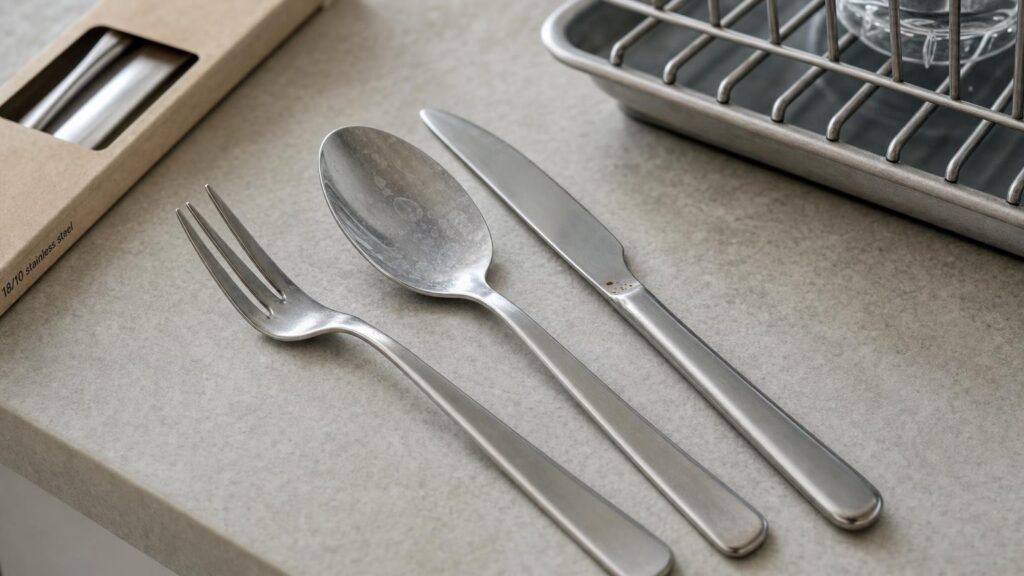
Stainless-steel cutlery is designed to resist corrosion, but the name can create unrealistic expectations. Stainless does not mean stain-proof, rust-proof or impossible to bend. A set’s durability depends on several interacting factors, including the steel composition, the thickness and shape of each piece, the way it was manufactured, the quality of the finish and how it is used and cleaned.
This explains why cutlery carrying an impressive-looking 18/10 label may still develop marks or feel less rigid than expected. It also explains why a knife in the same set can behave differently from its matching forks and spoons. Understanding these distinctions makes it easier to compare sets on more than one headline number.
What 18/10, 18/8 and 18/0 Actually Describe
The familiar 18/10, 18/8 and 18/0 descriptions refer to the nominal proportions of chromium and nickel in the stainless steel. In simple terms, the first number indicates approximately 18% chromium, while the second indicates the nominal nickel content.
- 18/10 stainless steel contains nominally 18% chromium and 10% nickel. It is commonly chosen for forks and spoons because it combines good corrosion resistance with a bright, polished appearance.
- 18/8 stainless steel contains nominally 18% chromium and 8% nickel. Its practical performance can be similar to that of 18/10 steel, depending on the exact grade, manufacturing quality and finish.
- 18/0 stainless steel contains nominally 18% chromium and little or no nickel. It is generally more magnetic and can be less resistant to certain forms of corrosion, although it can still provide good service when properly made and cared for.
These labels do not describe thickness, weight, stiffness, polishing quality or the steel used for the knives. Nor do they provide a complete chemical specification. Exact compositions can vary within recognised steel grades and manufacturing standards.
Nickel generally helps with corrosion resistance and contributes to the bright appearance associated with many tableware steels. It also affects the steel’s crystal structure, which is why 18/10 and 18/8 cutlery is often weakly magnetic or non-magnetic, while 18/0 is usually more strongly attracted to a magnet. Magnetism alone is not a reliable quality test, however. Forming and working the metal can alter its magnetic response, and knife blades frequently use a different, magnetic alloy for functional reasons.
Why Cutlery Can Rust or Develop Stains
Stainless steel resists rust because its chromium reacts with oxygen to form an extremely thin protective surface layer. This passive layer helps isolate the underlying metal from its environment and can reform after minor damage when oxygen is available.
That protection is effective but not unlimited. Salt, acidic food, persistent moisture, concentrated dishwasher detergent and food residue can create aggressive local conditions. Scratches, rough areas and unfinished joins can also give residue somewhere to collect. If cutlery remains dirty or damp for a long period, localised corrosion becomes more likely.
Not every mark is rust. Cloudy patches or pale rings may be mineral deposits left by hard water. Rainbow-like colours can result from thin surface films or heat-related effects. Tea, coffee and strongly coloured foods may leave deposits, while dark marks can sometimes be material transferred from another utensil or cookware surface.
True rust is usually reddish-brown and may be accompanied by a rough spot or pit. A tiny rust-coloured mark may also be contamination from ordinary carbon steel rather than corrosion originating deep within the stainless steel itself. Steel wool, rusty dishwasher components or contact with a corroding utensil can deposit iron particles that subsequently rust on the surface.
Prompt, gentle cleaning is preferable to aggressive scouring. Abrasive pads and unsuitable cleaners can scratch a polished surface, while cleaners containing chlorides can be particularly troublesome for stainless steel. Care instructions supplied for the specific set should take priority over general advice.
Why Knife Blades Often Use a Different Steel
The properties wanted in a spoon or fork are not identical to those wanted in a knife. Forks and spoons benefit from high corrosion resistance, formability and an attractive finish. A knife blade must also be hard enough to form and retain a useful cutting edge.
The steels commonly described as 18/10 or 18/8 are not generally the first choice for a conventional sharpened knife blade because they are comparatively difficult to harden to the level required for good edge retention. Manufacturers may therefore use a harder stainless blade steel with a different composition. Such steel is often magnetic and may be somewhat more susceptible to spotting if left wet or exposed to salt and acidic residue.
This is a functional trade-off rather than automatic evidence of poor manufacture. A knife that is optimised for cutting may need more attentive drying than the matching spoons. Conversely, some table knives use relatively modest cutting edges because they are intended mainly for softer foods. Shoppers should therefore look for separate information about the knife material and edge rather than assuming the alloy label for the set applies uniformly to every piece.
Gauge, Thickness and Shape: What Makes Cutlery Bend
An 18/10 marking says nothing about gauge. Two forks made from a similar alloy can differ substantially in rigidity if one is made from thinner sheet or has a flatter, narrower handle.
Thickness is important, but shape also contributes to stiffness. A gently curved or contoured handle can resist bending better than a flat strip of similar material. The width of the narrowest section matters, as do tine length, bowl depth and the transition between a utensil’s working end and handle. Long, slender pieces provide more leverage and may flex more readily.
Heavier cutlery often feels substantial, but weight alone does not guarantee strength. Extra mass can be concentrated in a thick handle while the fork neck or spoon bowl remains relatively thin. Hollow handles can also feel large without being solid throughout. Useful comparison points include the thickness at vulnerable transitions, the alignment of fork tines and whether the piece twists under normal handling.
Comfort is part of the trade-off. Very thick cutlery can feel cumbersome, particularly for children or people who prefer lighter utensils. A well-designed medium-weight piece may offer a better balance of stiffness, control and comfort than the heaviest option available.
Forged, Stamped and Hollow-Handle Construction
Construction descriptions can reveal how a piece acquires its shape, but no single method guarantees quality.
Stamped cutlery
Stamped pieces are cut or pressed from sheet metal and then formed, finished and polished. This method can produce light, consistent and durable utensils. The result depends on the gauge, shaping and quality of the edge finishing rather than on stamping itself. Poorly finished stamped pieces may have sharp edges or feel thin, while better examples can be smooth and rigid enough for everyday use.
Forged cutlery
Forging shapes metal using pressure, often allowing thicker sections, pronounced contours and substantial transitions. Forged pieces may feel weighty and well balanced, but the term does not by itself establish the alloy, corrosion resistance or final polishing standard. It is also worth checking whether the description applies to every utensil or mainly to the knives.
Hollow-handle cutlery
A hollow-handled knife usually has a separate blade joined to a formed handle shell. This allows the blade and handle to use different materials and can create distinctive weight distribution. The quality and sealing of the join are important because gaps can retain water or residue. Hollow-handled pieces may not tolerate severe impacts or inappropriate dishwasher conditions as well as a simple one-piece design, although well-made examples can remain durable with suitable care.
Polishing, Edges and Surface Finish
A smooth, well-polished surface is not merely decorative. Fewer scratches, pits and rough areas mean fewer places for moisture and food deposits to linger. Mirror finishes show fingerprints and fine scratches more readily, but their smoothness can make residue easier to remove.
Brushed, satin and textured finishes can conceal small scratches and reduce visible fingerprints. Their grooves or recesses may require more careful washing, especially around patterns, logos and handle joins. A textured finish is not inherently less durable, but deep or poorly executed detailing can make cleaning harder.
When assessing a set, inspect the handle edges, the spaces between fork tines and the underside of spoon bowls. Look for burrs, roughness or abrupt unfinished transitions. On knives, examine the junction between blade and handle. Consistent polishing and neatly finished joins can matter more in daily use than a decorative pattern or alloy number alone.
Dishwashers and Mixed-Metal Contact
Dishwashers combine heat, moisture, alkaline detergent and extended exposure to food residue. This can be more demanding than prompt hand washing, particularly if cutlery sits dirty before the cycle or remains damp after it ends.
Salt is a notable concern. Table salt, salty food and undissolved dishwasher salt can create concentrated deposits that challenge the passive layer. Acidic residue can add to the problem. Rinsing heavily soiled items, avoiding unnecessary soaking and removing cutlery when the cycle has finished can reduce prolonged exposure.
Mixed-metal contact may also contribute to marking. If stainless steel touches carbon steel or a rusting item in a wet, conductive environment, corrosion products can transfer. Aluminium can discolour or react under some dishwasher conditions. Direct contact between dissimilar metals in the presence of salty water or detergent can also support galvanic effects, in which one metal corrodes preferentially.
These risks do not mean different utensils can never share a dishwasher. Practical precautions include separating visibly rusty items, avoiding tight nesting, allowing water to drain and ensuring pieces dry properly. Knife blades should not be left pressed against forks or spoons where moisture and residue can be trapped. Manufacturer care guidance remains important, particularly for hollow handles, decorative finishes and sharpened blades.
How to Compare Durability Before Buying
A useful comparison looks beyond the most prominent number on the packaging. Consider the following points:
- Disclosed alloy: Check whether 18/10, 18/8 or 18/0 is stated and whether that description applies to all non-knife pieces.
- Knife material: Look for separate blade information, especially if cutting performance and dishwasher use are priorities.
- Thickness at weak points: Examine fork necks, spoon transitions and narrow handle sections rather than judging only the overall weight.
- Shape and balance: Consider whether each piece feels controlled and comfortable, not simply heavy.
- Construction: Identify one-piece, forged, stamped or hollow-handle designs and inspect any visible joins.
- Finish quality: Check for smooth edges, even polishing, aligned tines and cleanly finished recesses.
- Care requirements: Decide whether prompt drying, hand washing or occasional removal of deposits fits your routine.
Heavyweight feel can be appealing, but it should not substitute for examining geometry and finish. Similarly, an 18/10 label can indicate a corrosion-resistant tableware alloy without confirming that the set is thick, well polished or suited to every dishwasher routine.
Conclusion: Choose for the Whole Set, Not One Number
Long-lasting cutlery results from the interaction of alloy, thickness, shape, construction, polishing and care. The chromium and nickel shorthand is useful, but it describes only part of the material story. Knives may intentionally use harder steel, lightweight pieces can still be intelligently shaped, and substantial handles do not necessarily protect thin necks or vulnerable joins.
The best choice is therefore the set whose trade-offs suit its intended use. Compare the forks, spoons and knives individually, inspect the finish and think realistically about cleaning habits. That broader assessment is far more informative than assuming stainless steel can never stain or that one alloy number guarantees durability.
Continue exploring on Frowse
Discover More Frowse Insights
- What Makes an Umbrella Resist Turning Inside Out?
- What a Surge Protector’s Joule Rating Means and Why Protection Wears Out
- Why a Projector’s Lumens Rating Does Not Predict the Picture You Will See
- The Roof-Rack Fit Problem: Rails, Fixing Points and Clamp Systems Explained
- Full-Grain, Top-Grain, Split and Bonded Leather Upholstery Explained