





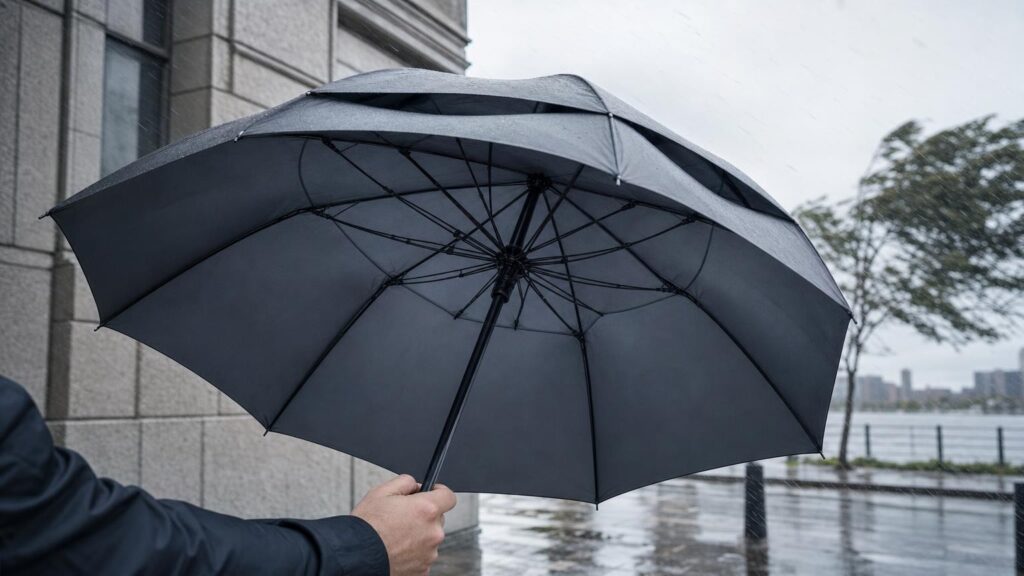
An umbrella turns inside out when wind forces the canopy and frame beyond the position they are designed to hold. Air pressure can build beneath the fabric, while uneven gusts pull some panels upwards and push others sideways. If the resulting load overwhelms the ribs, joints or shaft, parts of the frame may rotate past their intended position.
Wind resistance therefore depends on the complete structure. Rib count, materials, canopy tension, vents and shaft design all contribute, but no single feature guarantees reliable performance. The most useful choice is usually an umbrella that manages wind in a controlled way while still meeting your needs for coverage, carrying weight, folded size and ease of use.
Why umbrellas turn inside out
A canopy presents a broad surface to moving air. When wind reaches it from above, much of the load pushes the canopy towards its normal curved shape. Wind from below is more troublesome because it tries to lift and reverse that curve. Gusts arriving from the side can also twist the frame or load one section more heavily than another.
The pressure is not shared evenly in real conditions. Buildings, passing vehicles, corners and open spaces can redirect wind abruptly. A frame may cope with a steady breeze yet deform when struck by a short, angled gust.
Inversion happens when the canopy and ribs no longer contain or release that load effectively. A rib may flex upwards, a stretcher may change angle, a hinge may rotate too far or the entire shaft may twist. This is why broad claims about a single material or a high rib count reveal only part of the story.
Rib geometry: shape matters as much as rib count
Ribs create the canopy’s shape and carry forces from the fabric towards the umbrella’s central mechanism. Their length, curvature, spacing and support points affect how evenly those forces are distributed.
More ribs can divide the canopy into smaller sections and provide more support around its circumference. That may reduce the load placed on each individual rib. However, additional ribs also introduce weight, bulk, attachment points and often more moving parts. A large number of thin or poorly supported ribs is not necessarily more stable than a smaller number with suitable geometry and secure connections.
Curvature matters because a properly shaped rib supports the canopy as a three-dimensional surface rather than as a flat sheet. Support placement matters too. A long outer section with little reinforcement may bend or twist more easily, while a rib supported at useful points can transfer load more efficiently.
When comparing umbrellas, treat rib count as descriptive rather than decisive. Look at how the ribs are braced, whether they appear evenly spaced and how securely their tips connect to the canopy.
Joints, stretchers and folding mechanisms
Stretchers are the members that connect the ribs to the runner moving along the shaft. As the umbrella opens, they push the ribs outwards and hold the canopy in position. During a gust, they also transfer loads back towards the shaft.
A full-length umbrella can use relatively long, simple components with fewer folding hinges. Fewer joints may mean less free movement and fewer potential wear points. It can also make damage easier to see and, depending on the construction, easier to access for repair. The trade-off is an umbrella that remains long when closed.
Compact umbrellas use ribs and shafts that fold or telescope into several sections. This greatly improves packability, but every hinge must move freely when opening while remaining controlled under load. Small clearances in several joints can combine to allow more twisting or rattling. More complex frames can also be harder to straighten or repair after damage.
That does not make all full-length umbrellas stronger or all compact umbrellas fragile. Component dimensions, alignment, hinge design and assembly quality remain important. The practical decision is whether maximum portability justifies a more mechanically complicated frame for your use.
Why flexibility can outperform stiffness
A frame does not always resist wind best by remaining completely rigid. Controlled flex allows ribs to change shape temporarily, reduce peak stress and then recover. In some conditions, bending can help the canopy spill part of a gust rather than forcing every component to hold the full load.
An excessively rigid frame may keep its shape initially but transfer concentrated stress to hinges, seams, rib tips or the shaft. If one of those points yields, the damage can be permanent. A flexible component can still fail, but resilience and recovery may be more useful than stiffness alone.
It is also important to separate two related qualities:
- Resistance to inversion describes how well the umbrella avoids turning inside out in the first place.
- Recovery from inversion describes whether the frame can return to its intended shape without broken ribs, distorted joints or torn attachments.
An umbrella that can be reset easily after a gust may be durable even if it occasionally inverts. Another may resist inversion for longer but suffer more serious damage once its structural limit is exceeded.
Frame and shaft materials: useful properties and trade-offs
Material descriptions can indicate broad characteristics, but they do not tell you everything about a frame. Geometry, thickness, joint design and the way different materials are combined can matter as much as the label.
Steel
Steel components can provide useful stiffness and strength in relatively slim sections. They are commonly associated with a more substantial feel, but they can add weight. Exposed or damaged surfaces may also be vulnerable to corrosion, especially if the umbrella is repeatedly stored while wet. Thin steel parts may bend permanently if loaded beyond their limit.
Aluminium
Aluminium can reduce carrying weight and does not rust in the same way as ordinary steel, although its surface and connected hardware still require sensible care. Depending on the alloy and component shape, it may feel less rigid than steel or require a larger section to provide similar stiffness. Severe bending can produce a permanent kink rather than elastic recovery.
Fibre-reinforced composites
Fibre-reinforced rib components are often used where low weight and elastic flex are valuable. They can bend and recover effectively when the design keeps loads within their intended direction. However, composites are not indestructible. They can split, crack or separate after sharp impacts, crushing or repeated stress at an unsuitable joint.
Many umbrellas combine materials – for example, a metal shaft with flexible outer rib sections. A mixed construction can place stiffness and flexibility where each is useful. When assessing it, consider the transitions between materials because connectors and fasteners may determine how well the combination works.
Canopy tension, fabric and attachment points
A canopy needs enough tension to hold a stable curved profile. Loose or uneven fabric can flutter, distort and load individual ribs unpredictably. Excessive looseness may also let pockets of air form beneath particular panels.
Tension should appear reasonably even around the umbrella. Panels should not sag markedly between some ribs while being stretched hard across others. Seams should follow the intended shape without obvious pulling at isolated points.
The fabric itself also affects behaviour. Some compliance can absorb movement, but excessive stretch can allow the profile to deform. A very rigidly tensioned canopy may transmit gust loads more directly to the frame. Effective construction balances shape retention with enough give for the entire structure to respond together.
Rib-tip pockets, ties and other attachments deserve attention because they connect the fabric to the frame. Reinforcement can help spread loads beyond a single stitch line. If an attachment is inaccessible or permanently integrated, however, a small failure may be difficult to repair.
Vented canopies and pressure relief
A vented umbrella usually has overlapping canopy layers that allow some air to escape while the upper layer continues to deflect rain. By providing a pressure-relief route, vents can reduce the amount of trapped air pushing upwards beneath the canopy.
Performance depends on more than the presence of a vent. Its position, opening area, overlap and ability to remain open under load all matter. If the layers press tightly together, airflow may be limited. If the overlap is too small or poorly shaped, wind-driven rain may find a route through.
Vents also add fabric edges, seams and construction complexity. They cannot neutralise every gust, particularly when wind arrives at an awkward angle or changes direction rapidly. Consider a vent one part of a wind-management design, not proof that an umbrella is immune to inversion.
Shape, diameter and conditions of use
Coverage and wind loading are closely connected. A larger canopy protects a wider area from rain, but it also gives moving air more surface to act upon. This can increase the force transmitted to your hand and make the umbrella harder to control.
Canopy depth changes how an umbrella surrounds the user and how it meets the wind. A deep profile may provide more side coverage, while a shallower profile can be easier to see around. Neither shape is automatically better in every gust because the result depends on orientation, curvature and frame support.
Think about where you usually walk. An exposed route, a station entrance and a crowded pavement create different priorities. Walking direction and gust angle can matter as much as a construction feature. Even a well-designed umbrella becomes difficult to manage if held broadside to strong wind, and a large model may be impractical where space is limited.
How to assess construction before choosing
Specifications are most useful when you translate them into structural questions. Before choosing, consider the following:
- Rib support: Are the ribs braced at sensible points, and do the outer sections appear controlled rather than unsupported?
- Joint movement: Do folding hinges and the runner move cleanly without obvious binding, excessive looseness or uneven action?
- Canopy tension: Does the fabric form an even profile, with secure seams and reinforced attachment points?
- Shaft stability: Does the shaft resist unwanted twisting, and do telescoping sections fit together without excessive play?
- Vent construction: Do overlapping layers provide a plausible air path while retaining enough overlap to shed rain?
- Repair prospects: Are tips, ties, fasteners or other vulnerable components accessible, or would minor damage make the whole frame unusable?
Balance these observations against everyday ownership. A robust full-length frame may be inconvenient on public transport. A compact multi-fold model may fit a small bag but contain more joints. Automatic opening can be convenient, while its mechanism may add weight and complexity. The best compromise depends on which inconvenience you are most willing to accept.
Choose for recovery and ownership, not an absolute windproof claim
No handheld umbrella is immune to strong, turbulent or rapidly changing wind. Broad windproof wording is less informative than visible construction details and a clear explanation of how the frame manages load.
Look for controlled flex, well-supported ribs, secure canopy attachments, suitable coverage and joints that move without excessive play. Decide whether you value compact storage, lower weight, simple construction or easier recovery after inversion. A good choice is not necessarily the stiffest or the one with the most ribs. It is the umbrella whose complete design suits your conditions and remains manageable to carry, operate and maintain.
Continue exploring on Frowse
Best Sellers · Top Rated · Best Value · Under £50 · Fresh Finds · Premium Picks
Discover More Frowse Insights
- Suction, Airflow and Floorheads: What Really Determines Vacuum Cleaning Performance
- Why Lower Microwave Power Usually Means Switching Full Power On and Off
- Machine-Woven, Tufted and Hand-Knotted Rugs: What Construction Changes
- Why Candles Tunnel and What “Wax Memory” Really Means
- Why Badminton Rackets of the Same Weight Can Feel Completely Different