





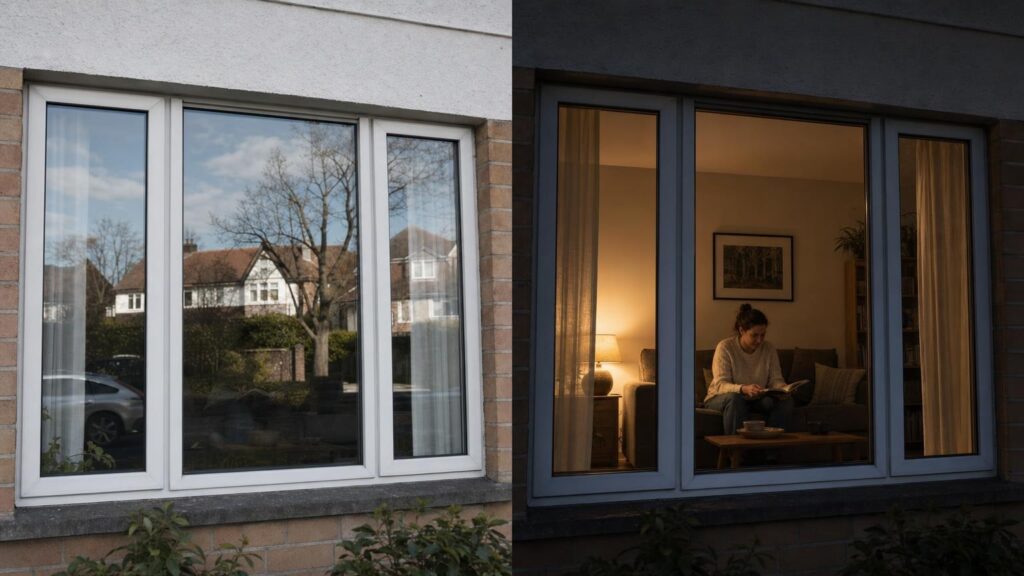
Reflective window film is often described as “one-way” privacy film, but that description can create the wrong expectation. The glass does not permanently allow sight in one direction while blocking it in the other. Instead, the film’s mirror-like effect depends largely on the difference in light levels between the two sides of the window.
During the day, a bright exterior and a darker room can provide useful screening from outside while preserving some outward visibility. After sunset, switching on indoor lights often reverses those conditions. The result is that people outside may see into the room while occupants mainly see their own reflections.
Understanding this limitation is essential when choosing between reflective, frosted, blackout, dyed and other solar-control films. The right option depends on whether the main goal is daytime screening, dependable privacy, glare reduction, room darkening or solar management.
The promise – and limit – of “one-way” window film
Reflective privacy film changes how much light a window transmits and reflects. Under suitable conditions, the brighter side of the glass develops the stronger mirror appearance, making it difficult for someone on that side to see into the darker space beyond.
This is a conditional optical effect, not permanent one-way vision. A reflective film cannot determine who should be able to see through the window. It simply interacts with the available light. Whichever side is brighter is generally more likely to see a reflection, while the relatively darker side has the better view through the glass.
That makes reflective film potentially useful for rooms where daytime screening is the priority. It is much less suitable as the only privacy measure for an illuminated room at night. Before buying, decide which outcome matters most:
- Maintaining an outward view during daylight
- Obscuring shapes and details throughout the day and night
- Blocking most light as well as visibility
- Reducing glare or managing solar energy
- Combining daytime screening with curtains or blinds after dark
How reflective film creates daytime privacy
When daylight strikes a reflective window, some light is reflected and some passes through. The balance varies by film, glass and lighting conditions. If the outside is brightly lit and the room is substantially darker, exterior observers receive a strong reflection of the outdoor scene. At the same time, someone inside can often see through the window because the scene outdoors is well illuminated.
The film has not made the glass optically one-way. Exterior reflection is simply competing successfully with the relatively small amount of light coming from the darker interior. Darker or more reflective films may strengthen this screening, but they also tend to reduce the natural light entering the room and can make the outward view appear dimmer.
Daytime privacy is not necessarily absolute. Someone close to the glass, shielding their eyes from reflections or looking towards a brightly lit part of the room may still see some interior detail. Cloud cover, shade, overhangs and the direction of the sun can also change the balance. Reflective film should therefore be treated as daytime screening rather than an unconditional visual barrier.
Why the effect reverses after dark
At night, the exterior is usually darker than an occupied room. Once lamps or ceiling lights are switched on, interior light reaches the window and is reflected back towards the occupants. They may see a clear image of themselves and the room, making the window seem mirror-like from indoors.
Outside, there may be much less competing reflection. A person in the darkness can therefore see light transmitted from the illuminated room. In practical terms, the privacy effect has reversed: the brighter interior is easier to observe, while the people inside have a poorer view out.
Outdoor lighting can alter the effect. A strongly illuminated patio or entrance may reduce the contrast between inside and outside, while dimming the room may make the interior less visible. Viewing angle, distance, curtains, furnishings and the precise film specification also affect what can be seen. However, these variables do not turn reflective film into dependable night-time privacy.
If privacy after sunset matters, the robust solution is a covering that physically obscures the window, such as a blind, curtain or shutter. Alternatively, use a film designed to obscure the view from both sides, accepting that it may also remove the clear outward view.
Reflective, frosted, blackout, dyed and solar-control films compared
Window-film labels describe different mechanisms and may overlap. A reflective film can also be marketed for solar control, for example, while a decorative frosted film may use either adhesive or static cling. It is better to assess the intended result and specifications than to rely on a single name.
Reflective privacy film
This type produces a metallic or mirror-like appearance and offers conditional screening when the opposite side is brighter. It can preserve a degree of outward visibility, but it usually reduces incoming light and can increase reflections. It should be paired with a closable covering if night-time privacy is required.
Frosted film
Frosted film scatters light so that shapes and details become difficult to distinguish. It can provide privacy regardless of which side is brighter, although silhouettes may remain visible with some products and lighting arrangements. It admits diffuse daylight but removes a clear view in both directions. This makes it a practical option for bathrooms, entrance glazing and street-level windows where constant obscuration matters more than the view.
Blackout or opaque film
Blackout and opaque films are intended to block visibility and most or nearly all transmitted light, depending on the product. They offer much more dependable obscuration than mirrored film but can make a room significantly darker. They are better suited to windows where both view and daylight are expendable than to living spaces where natural light is valued.
Dyed film
Dyed film absorbs selected light and changes the appearance of the glazing. It may reduce brightness and glare, but a dark tint should not automatically be interpreted as privacy. Its effect still depends on light levels, and some dark films are less reflective than metallic-looking alternatives. Absorbed heat and glazing compatibility also need consideration.
Solar-control film
Solar-control film is a broad category focused on managing solar energy, glare and ultraviolet transmission. Some versions are highly reflective, while others are designed for a more neutral appearance. Privacy may be a secondary daytime benefit, but it is not guaranteed. Buyers should examine both visual and solar-performance information rather than assuming that “solar control” and “privacy” mean the same thing.
The specifications that matter more than a mirrored appearance
Product photographs cannot show how a film will perform in every room. Several specifications provide more useful clues:
- Visible light transmission: This indicates how much visible light passes through the film and glazing system. Lower transmission generally creates a darker interior and dimmer outward view.
- Interior and exterior reflectance: These figures indicate how strongly each surface reflects visible light. Higher reflectance can create a more obvious mirror appearance, but its privacy effect remains dependent on relative lighting.
- Opacity: This describes the extent to which the material blocks the view. An opaque film is fundamentally different from one that merely looks dark or reflective.
- Haze: Haze describes the scattering of transmitted light. Greater haze can obscure detail while still admitting diffuse daylight, as with many frosted treatments.
- Solar-performance measurements: Manufacturers may provide information about solar transmission, reflection, absorption and overall energy rejection. These values describe different parts of the film’s behaviour and should not be treated as interchangeable.
Specifications may refer to the film alone or to a particular film-and-glass combination. Testing conventions can also differ. Compare like with like where possible, and do not assume two similarly dark or metallic-looking films will produce the same room brightness, reflectance or heat absorption.
Match the film to the privacy problem
The best choice begins with the room and the exact problem rather than with the most dramatic mirrored finish.
- Preserving a daytime view: Reflective film may suit a living room or office where the exterior is usually brighter and occupants want to retain outward visibility. Plan for blinds or curtains at night.
- Obscuring a bathroom: Frosted, patterned or opaque film provides more consistent screening because it does not rely on one side being brighter. Check whether silhouettes remain visible when a person is close to the glass.
- Protecting a street-level room: Frosted film can obscure the vulnerable lower portion of a window while leaving the upper section clear for daylight. Full reflective coverage offers a view but only conditional privacy.
- Darkening a bedroom: Blackout film blocks more light than reflective or frosted film, but it also removes the daytime view. A removable blind or curtain may offer greater flexibility.
- Reducing screen glare: A tinted, reflective or solar-control film may help, but lower visible light transmission will affect the whole room. Movable shading can respond more easily to changing sun positions.
- Managing solar gain: Look for relevant solar-performance specifications and glazing approval. A mirrored appearance alone does not establish how effectively or safely a film will perform on a particular window.
There is an unavoidable trade-off between a clear view, abundant natural light and reliable two-sided privacy. A transparent window cannot preserve a clear view in both directions while always preventing observers on one side from seeing through it. Combining film with a closable window treatment is often the most flexible answer.
Check glazing compatibility before installation
Not every film is suitable for every pane. Glass construction, existing coatings, tint, window orientation and the side on which the film is installed can all affect performance.
Single, double and triple glazing behave differently because insulated units contain multiple panes and sealed spaces. Toughened and laminated glass also have distinct constructions. Low-emissivity coatings may be located on a particular surface within the glazing system, and applying an unsuitable film can change how heat is absorbed and retained.
Excessive or uneven heat absorption can increase thermal stress in the glass. Risk depends on the complete window assembly and its surroundings, including shading patterns, edge condition and pane type. It cannot be judged reliably from film colour alone.
Identify the glazing before purchase and follow the compatibility guidance supplied by both the film and window manufacturers. If the glass type or coating is uncertain, seek informed advice rather than assuming a film labelled for household windows is universally suitable. This is especially important for insulated, laminated, tinted or coated glazing.
Installation choices affect appearance and performance
Adhesive films form a more permanent bond and may offer better long-term stability, but removal can require more work and may leave residue. Static-cling products are often easier to reposition and remove, although their grip and durability can vary with the surface and environment.
Some films are intended for interior application and others for exterior application. Exterior films face rain, dirt, temperature changes and physical wear, so they need to be designed for that exposure. Installation side can also affect glazing compatibility and solar performance. Do not reverse the specified placement simply because one side is easier to reach.
Successful DIY fitting depends on accurate measuring, thoroughly cleaned glass and careful handling. Trapped dust, creases, uneven trimming, edge gaps and visible seams can reduce both appearance and useful coverage. Some adhesive installations look temporarily cloudy or hazy while moisture used during fitting dries, so follow the stated curing guidance before judging the final result.
Professional fitting may be worth considering for large panes, high windows, complex glazing or films with strict installation requirements. Whether fitted professionally or at home, consider future removal, residue, damaged edges and replacement access as part of ownership rather than focusing only on the initial appearance.
A realistic privacy plan for day and night
Choose reflective film when conditional daytime screening, outward visibility and solar or glare management suit the room. Choose frosted or patterned film when continuous obscuration matters but diffuse daylight is still welcome. Choose opaque or blackout treatment when blocking both visibility and light is the priority.
For rooms that need a clear daytime view and dependable privacy after sunset, combine a suitable view-preserving film with curtains, blinds or shutters. That pairing responds to changing light instead of expecting a mirrored surface to overcome basic optics.
The central rule is simple: reflective privacy film works best when the side you want to conceal is darker than the side being viewed. Once the room becomes the brighter side, the privacy advantage can disappear or reverse. Planning around that fact leads to a more realistic and useful purchase.
Continue exploring on Frowse
Discover More Frowse Insights
- Why Air-Fryer Capacity Does Not Reveal Its Usable Cooking Space
- Why Scissors Stop Cutting Even When the Blades Still Feel Sharp
- What Clutches, Gearboxes and Impact Mechanisms Change in a Cordless Drill
- Why Headphone Impedance Alone Does Not Tell You How Hard They Are to Drive
- Why Baking Trays Warp in the Oven and Sometimes Flatten Again