





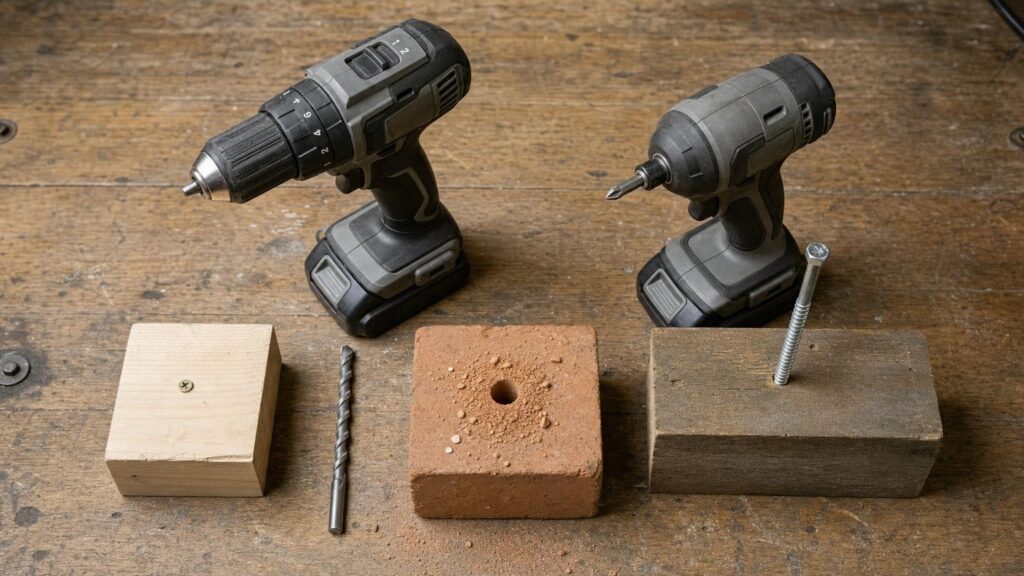
Cordless drill-drivers, hammer drills and impact drivers can all rotate a bit or fastener, but they deliver turning force in different ways. Their internal mechanisms affect control, speed under load, noise, vibration and accessory compatibility.
Understanding those differences is more useful than comparing maximum torque figures alone. A clutch helps control screw depth, a two-speed gearbox changes the balance between speed and turning force, hammer action assists suitable masonry drilling, and an impact mechanism delivers rotational pulses for resistant fasteners.
Why the way torque is delivered matters
Torque is turning force, but the way a tool produces and controls that force matters. A drill-driver normally applies smooth, continuous rotation through its gearbox. Its adjustable clutch can interrupt that drive when resistance reaches a selected level.
A hammer drill adds rapid movement along the axis of the bit. This assists drilling into suitable masonry, but it does not create the rotational impacts used by an impact driver. An impact driver applies repeated twisting blows when fastener resistance rises.
These mechanisms behave differently even when tools have similar-looking specifications. Smooth rotation offers predictable control, while rotational impacts can maintain progress against greater fastening resistance. Axial hammering serves another purpose entirely. The right choice therefore depends on the material, fastener, accessory and required finish.
The clutch: controlling when a drill stops driving
The numbered collar behind a drill chuck normally controls an adjustable clutch. At a low setting, the clutch slips after meeting relatively little resistance. Higher positions allow more torque to reach the chuck before slipping. The slipping action often creates a clicking or ratcheting sound while the motor continues to run.
This feature is particularly useful for screwdriving. If a screw reaches the intended depth and resistance rises, a suitable clutch setting can stop the bit from continuing to drive with the tool’s full available force. That can reduce overdriving, damage to screw heads and unwanted marking of the workpiece.
The numbers on the collar are reference positions, not standardised torque values. A setting of 10 on one drill should not be assumed to match the same setting on another. Results may also change with the selected gear, battery charge, screw dimensions, material density and how firmly the tool is held.
For a new combination of screw and material, begin at a low setting and test the result. Increase the setting gradually until the screw reaches the required depth without the clutch slipping too early. This approach provides more control than starting at the highest position.
A drill clutch can improve consistency, but it is not a precision torque instrument. It should not replace an appropriate torque-controlled tool where a fastener has a formally specified tightening value.
Selecting drill mode generally bypasses the numbered clutch settings and provides continuous drive. That is useful when drilling because the bit needs to keep cutting as resistance changes. Using drill mode for screws removes the clutch’s intervention, so final depth then depends more heavily on trigger control.
Two-speed gearboxes: choosing speed or turning force
A mechanical selector marked with two numbers commonly changes the drill’s internal gear ratio. Low gear provides a lower maximum rotational speed and greater torque multiplication at the chuck. High gear provides a higher rotational speed with less mechanical torque multiplication.
The gearbox selector and variable-speed trigger perform different jobs. The selected gear establishes the tool’s operating range, while the trigger adjusts speed within that range. Partially pressing the trigger in high gear does not give the tool the same mechanical advantage as selecting low gear.
Low gear is useful for controlled screwdriving, larger drilling accessories and tasks that place a sustained load on the tool. The slower rotation can also make it easier to start a screw or drilling accessory accurately. High gear is often better suited to smaller holes and applications where the bit cuts more effectively at greater speed.
Gear selection can explain why a drill sometimes feels weaker or slower than expected. A large accessory used in high gear may slow sharply because the gearbox is providing less torque multiplication. Forcing a stalled or heavily loaded tool does not improve the gear ratio and can generate unnecessary heat. Moving to low gear may provide more controlled progress.
The opposite mismatch is less demanding but inefficient. A small bit may still drill in low gear, although the reduced speed can make the task take longer. Appropriate speed also depends on the accessory and material, so the gear selector should not be treated as a simple power switch.
Greater turning force requires attention to control. If a large bit catches or binds in low gear, the drill body can react suddenly. A balanced working position, secure grip and suitable accessory remain important regardless of the quoted torque.
Drill mode and hammer mode are not the same thing
In ordinary drill mode, the chuck rotates without a deliberate striking action. With the correct bit and speed, this mode is used for materials such as wood, metal and plastics.
Hammer mode adds rapid axial tapping while the bit rotates. The movement is directed forwards and backwards along the length of the bit. Combined with a suitable masonry bit, it helps break and clear material in appropriate brick, block and similar masonry.
This action should not be confused with the mechanism in an impact driver. A hammer drill strikes towards the hole, while an impact driver strikes in the direction of rotation. Hammer mode therefore does not provide the same fastener-driving behaviour as rotational impacts.
The capabilities of hammer drills and rotary hammers also differ. A rotary hammer uses a more substantial percussive system and may be better suited to demanding concrete work or repeated larger holes. Tool type, bit specification and material should be considered together rather than assuming every form of hammer action is equivalent.
Hammer mode should be disengaged when it is not required. Axial tapping offers no drilling benefit in wood or metal and can reduce accuracy or affect an accessory or surface that is not intended for percussion.
Inside an impact driver: pulses rather than continuous torque
An impact driver behaves much like a conventional powered driver while resistance is light. When the fastener becomes harder to turn, an internal hammer-and-anvil mechanism engages. It stores and releases energy in repeated rotational blows at the output shaft.
These brief pulses can keep a long or resistant fastener moving without applying the same continuous twisting reaction that a heavily loaded drill can transmit through its body. The user still needs to control and align the tool, but the sensation at the hand differs from sustained drill torque.
The mechanism brings clear trade-offs. Once impact action begins, the tool becomes considerably noisier and produces repeated vibration. It also offers less delicate feedback as a small screw approaches its final depth. A clutched drill is generally easier to set up for repeatable, controlled screwdriving in softer materials.
Some impact drivers include selectable speed or control modes. These can change how quickly the tool responds, but they should not automatically be treated as equivalents to a drill’s slipping clutch. Trigger technique, bit fit and attention to the fastener remain important.
Chuck, collet and bit compatibility
A cordless drill generally uses an adjustable three-jaw chuck. Its jaws close around round-shank drill bits and can also hold compatible hex-shank driving accessories. The accessory shank must fit within the chuck’s stated capacity and be secured correctly.
An impact driver normally uses a quick-release hex collet, commonly sized for 1/4-inch or 6.35 mm hex shanks. The collet allows rapid bit changes but does not directly grip an ordinary round-shank drill bit. Shank dimensions and retention design should be checked before an accessory is fitted.
Driving bits, holders and sockets exposed to impact action should be intended for that use. Impact-rated accessories are designed to tolerate repeated torsional shocks. They can still wear or fail, particularly if the bit does not fit the fastener correctly or is used beyond its intended application.
Adapters can connect otherwise incompatible accessories, such as a small chuck fitted to a hex collet. However, an adapter adds length, another joint and another possible source of movement. It can increase wobble, reduce access and affect accuracy. A round-shank drill bit held through an impact-driver adapter does not behave exactly like one held directly in a drill chuck.
Compatibility is therefore about more than whether two parts can be connected. The output fitting, shank, accessory design and type of load all need to match the task.
Why headline torque figures can mislead
Maximum torque appears to offer a simple way to rank tools, but figures from drills and impact drivers are not necessarily directly comparable. A drill transmits continuous torque through a selected gear and may limit it through a clutch. An impact driver produces short torque peaks through rotational blows.
Quoted results may also reflect different test conditions, speed settings, battery configurations and manufacturer definitions. A larger number does not by itself establish that a tool will drill faster, control screws more precisely or complete a particular fastening task more effectively.
Real task performance also depends on speed under load, gear ratio, motor behaviour, impact action and accessory quality. The fit between the bit and fastener is especially important. A powerful tool cannot compensate for an unsuitable or poorly fitting bit without increasing the likelihood of damage.
Every part of the connection has its own intended use. Chucks, collets, bits, holders, sockets and adapters do not automatically share the maximum capability claimed for the tool. Check relevant accessory limits rather than treating the tool’s peak torque as a rating for the entire setup.
Torque remains useful when comparing closely related tools under equivalent conditions, but it should be considered alongside low-speed control, gear ranges, speed under load, output fitting and task suitability.
Match the mechanism to the work
Controlled screwdriving
For small screws, hardware and work requiring consistent depth, a drill-driver with an adjustable clutch provides useful control. Select low gear, begin with a low clutch position and increase it gradually after testing in the working material.
General drilling
A three-jaw drill chuck accepts the round-shank bits used for many drilling tasks. High gear can suit smaller holes, while low gear can help larger accessories turn under load. The correct bit type and recommended cutting speed still depend on the material.
Masonry drilling
A hammer drill and suitable masonry bit can handle appropriate brick, block and related materials. More demanding concrete drilling may justify considering a rotary hammer. An impact driver’s rotational blows are not a substitute for axial masonry percussion.
Long or resistant fasteners
An impact driver is suited to fastening tasks where resistance rises substantially. Its rotational pulses can maintain progress without the same sustained reaction feel as a drill. The trade-offs are greater noise, vibration and less delicate final-depth control.
When two tools are useful
A drill and impact driver perform complementary roles. The drill supplies smooth rotation, clutch control and a versatile chuck, while the impact driver supplies pulsed rotational force through a hex collet. Keeping a drill bit in one and a driving bit in the other can also avoid repeated accessory changes.
One drill-driver may be sufficient for occasional general drilling and controlled fastening. A separate impact driver becomes more relevant when resistant or repetitive fastening forms a significant part of the work. The decision should follow the tasks rather than an assumption that either arrangement is universally better.
A better way to choose
Start with the materials and jobs you expect to handle. For general drilling and careful screwdriving, examine the clutch, mechanical gear options, trigger response and chuck capacity. Consider hammer mode when suitable masonry drilling is an actual requirement.
Consider an impact driver when long, resistant or repetitive fasteners are central to the work and the additional noise is acceptable. Confirm that existing bits, holders and sockets have the correct shanks and are intended for impact use where required.
Finally, compare handling, output fitting, speed control and accessory compatibility alongside torque. The clutch, gearbox and impact mechanism determine what happens when resistance rises. That behaviour is often more informative than one isolated maximum figure.
Continue exploring on Frowse
Discover More Frowse Insights
- Why One Glue Cannot Bond Every Household Material
- How Denim Weight, Weave and Stretch Change a Pair of Jeans
- End Grain, Edge Grain and Face Grain Cutting Boards Explained
- Why Mechanical Keyboard Switch Colours Are Not a Universal Standard
- Inside Flat-Pack Furniture: How Boards, Edges and Fasteners Affect Durability