





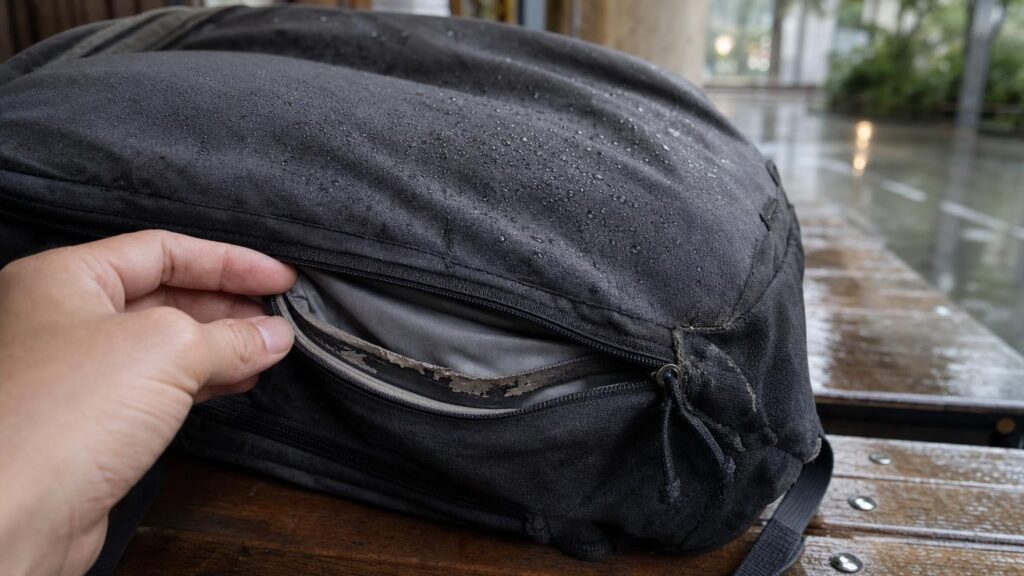
A backpack described as water-resistant may cope well with a short shower yet still let water reach its contents during sustained rain. The difference often lies not only in the main fabric, but also in the seams, zips, openings and way the bag is assembled. Wear and age can change its performance further.
Understanding these details helps you judge whether a backpack suits a daily commute, occasional travel or regular outdoor use. It also prevents a common mistake: assuming that a waterproof material automatically makes the entire finished bag waterproof.
Water-resistant is not the same as waterproof
Water-resistant generally means that a product can slow or reduce water penetration under certain conditions. It does not promise complete protection in every type of rain or for an unlimited period. A water-resistant everyday backpack may be designed to handle splashes and brief showers rather than prolonged exposure.
Waterproof material refers to a fabric or barrier that resists water passing through it. However, a backpack is made from more than a single sheet of material. Stitching creates holes, panels must be joined, and zips or other closures interrupt the protective surface. Water can enter through any of these points even if the main fabric itself provides an effective barrier.
A genuinely waterproof finished bag therefore requires the entire construction to manage water, including its seams and closure. Even then, the intended use matters. Protection against rain is different from protection during immersion, and shoppers should not assume that a rain-focused claim means a bag can safely be submerged.
How backpack fabrics stop water
Backpack fabrics usually resist water through a combination of the face material, a surface treatment and a coating or laminate. Each element performs a different job.
Tightly woven face fabrics
A tightly woven synthetic fabric can slow water by limiting the spaces through which it travels. The face fabric also provides much of the bag’s strength and resistance to everyday abrasion. On its own, however, woven material will not necessarily stop sustained rain. Water can eventually work through the weave, particularly when it is pressed against the fabric.
Internal coatings
Many bags use a polyurethane or similar coating on the inner face of the fabric. This creates a more continuous barrier behind the woven outer layer. The quality and condition of that coating matter: a thin, damaged or ageing layer may offer less protection than it did when new.
Coatings can also affect weight, flexibility and feel. A substantial barrier may improve resistance to penetration but can make a material stiffer or less breathable. For a backpack, breathability of the main compartment is usually less important than it is for clothing, although trapped moisture and drying time can still matter.
Laminated materials
A laminate bonds multiple layers together, potentially combining a durable face with a water-blocking film. Laminates can provide a consistent barrier while keeping weight controlled, but they still depend on sound construction. Cuts, deep abrasion or separation between layers can reduce their effectiveness.
Water-repellent surface treatments
A durable water-repellent treatment encourages droplets to bead and roll from the outer surface instead of soaking into the face fabric. This can help the bag remain lighter and dry more quickly after rain.
Beading should not be confused with waterproofing. The surface treatment manages wetting on the outside, while a coating or laminate is more directly responsible for preventing penetration. A bag may stop beading as its treatment wears down yet retain some resistance from its internal barrier. Conversely, impressive beading does not prove that seams and closures will keep the interior dry.
Why seams, stitching and construction matter
Most conventional backpacks are assembled by sewing panels together. Every line of stitching creates needle holes, and water can follow the thread or collect along a seam. A strongly water-resistant fabric may therefore be undermined by ordinary untreated seams.
Several construction methods can reduce this vulnerability:
- Bound seams cover raw edges and can improve durability and neatness, but binding alone does not necessarily seal needle holes.
- Taped seams use sealing tape over the seam, usually on the inside, to cover holes and reduce penetration. Performance depends on suitable materials, careful application and the tape remaining firmly attached.
- Welded seams join compatible materials using heat, pressure or another bonding process rather than conventional stitching. This can remove many needle holes, although the resulting bag still has closures and other details that need protection.
Look at whether seam treatment applies throughout the bag or only in selected areas. A protected base or main compartment may be useful, but it does not mean every pocket has the same construction. Curved seams, attachment points and places where straps meet the body can be particularly complex.
Zips, flaps and roll-tops: where closures succeed or leak
A standard zip has gaps between its teeth and around its sliders. Rain can enter directly or run along the zip until it finds a gap. A fabric flap over the zip helps shed falling water, especially when the opening is positioned sensibly, but wind and movement can push moisture underneath.
Coated or water-resistant zips reduce exposed gaps by placing a protective layer across the zip tape. They can offer better defence against rain than ordinary exposed zips, but they should not automatically be treated as watertight. The slider junction and the ends of the zip remain potential weak points, and frequent opening can wear the coating.
A roll-top closure avoids a long zip across the main opening. The user rolls the upper section several times and secures it, creating overlapping layers that make it harder for rain to reach the compartment. Correct fastening is important: an under-filled roll or poorly secured closure may provide less protection.
Roll-tops introduce practical trade-offs. They can take longer to open, may provide less immediate visibility and often require items to be stacked vertically. A panel-loading backpack with several zips may offer quicker access and better organisation, but every opening creates another route for water. The better choice depends on whether protection or convenience carries more weight in everyday use.
Making sense of water-resistance specifications
Specifications can provide useful clues, but they need to be read in context. A water-pressure rating, where supplied, normally relates to the tested fabric or material rather than every part of the completed backpack. It cannot by itself describe how zips, seams and openings perform.
When comparing bags, consider the full set of information:
- What is the main fabric, and does it use a coating or laminate?
- Is a water-repellent surface treatment mentioned separately from the internal barrier?
- Are seams described as taped, welded or otherwise sealed?
- Do closure descriptions say merely “coated”, “water-resistant” or something more specific?
- Does the claim apply to the whole bag, the main compartment or only the material?
- Are there care instructions that explain how protection should be maintained?
Broad marketing language is less informative than a clear description of construction. Even detailed component specifications should not be combined into a stronger claim than the manufacturer makes for the finished product. If keeping contents dry is critical, ambiguity should be treated as a reason to use secondary protection.
Match the protection to how the backpack will be used
Start with realistic exposure rather than searching for the strongest-sounding label. For short walks between a station and an office, resistance to splashes and brief showers may be enough. A commuter who cycles for extended periods in frequent rain places greater demands on seams, front-facing zips and areas where water can pool.
Repeated outdoor use introduces abrasion from rocks, branches and the ground, as well as longer exposure to weather. A bag carried on open transport or left on a wet surface faces different risks from one worn mainly in town. Prolonged soaking or immersion is a separate requirement and should never be inferred from ordinary water-resistance wording.
The contents also determine the acceptable level of risk. Damp clothing may be inconvenient, while moisture reaching a laptop, camera, paperwork or passport can have more serious consequences. Think about where sensitive items sit. A laptop compartment next to the back may be less exposed to direct rain than an outer pocket, but water can still enter from above or migrate through the interior.
Protection can also conflict with access. More flaps, tightly protected zips and roll-top closures may slow down entry. For someone who retrieves equipment frequently, that inconvenience may be significant. The right backpack balances likely weather, value and sensitivity of the contents, and the need for quick organisation.
Why water protection deteriorates
Water resistance is not necessarily permanent. Daily use exposes the bag to mechanical and environmental stresses that can change both its surface and hidden barrier.
- Abrasion can wear away water-repellent finishes and thin coatings, particularly on the base, corners and areas that rub against clothing.
- Repeated flexing can stress coatings and laminates where the fabric folds or collapses. Over time, some barriers may crack, peel or separate.
- Dirt and body oils can interfere with surface beading and collect around seams and zip tracks.
- Ultraviolet exposure and heat can contribute to the ageing of fibres, finishes, adhesives and coatings.
- Poor storage, especially when a bag is damp, compressed or kept in excessive heat, can accelerate deterioration or create odours and mildew.
- Frequent zip use can wear protective layers and place stress on sliders, zip ends and surrounding seams.
Warning signs include a face fabric that wets out rapidly, peeling or sticky internal coatings, flaking seam tape, cracked laminated areas and damaged zip coverings. A change in surface beading does not always mean the underlying barrier has failed, but it signals that the bag deserves closer inspection.
Care, maintenance and backup protection
Follow the manufacturer’s care instructions because materials, coatings and adhesives respond differently to cleaning. As a general principle, remove loose dirt gently and avoid harsh detergents, aggressive scrubbing or high heat unless the instructions specifically permit them. Clean zip tracks carefully rather than forcing a dirty slider.
Allow the backpack to dry thoroughly after use, opening compartments so trapped moisture can escape. Store it uncompressed in a dry place away from sustained heat and direct sunlight. If the product has a renewable surface treatment, use only a compatible treatment and apply it as instructed. Adding an unsuitable spray does not repair cracked coatings, failed tape or physical damage.
Backup protection is sensible when the consequences of leakage are high. A fitted rain cover shields much of the backpack from falling rain, though openings near the back and water running down straps can remain exposed. It may also shift in strong wind or snag in confined spaces.
An internal dry bag, waterproof pouch or simple protective sleeve places a second barrier directly around sensitive contents. This can be more dependable than expecting one backpack to manage every condition. Separate protection is especially useful for electronics, documents and spare clothing during uncertain weather.
A practical pre-purchase and ownership checklist
- Define the exposure: distinguish brief showers from sustained rain, repeated outdoor use and possible soaking.
- Inspect the material description: identify the face fabric, internal coating or laminate, and any separate water-repellent finish.
- Check the seams: find out whether they are ordinarily sewn, bound, taped or welded, and whether treatment covers the whole bag.
- Assess every opening: consider main zips, front pockets, cable ports and roll-top fastening, not just the largest compartment.
- Balance access with protection: decide whether quick panel access is more valuable than a simpler, more protected opening.
- Consider the contents: plan secondary protection where moisture could damage electronics, papers or other important items.
- Expect maintenance: clean gently, dry thoroughly and examine coatings, seam tape and closures as the bag ages.
- Avoid over-reading specifications: a waterproof fabric or coated zip is evidence about one component, not proof that the complete backpack is waterproof.
The most useful question is not simply whether a backpack is labelled water-resistant. Ask how it manages water at every layer, how much exposure it will face and what happens when its protection eventually wears. That approach leads to a more realistic purchase and a better plan for keeping important contents dry.
Continue exploring on Frowse
Discover More Frowse Insights
- Digital Piano Actions Explained: Weighted Keys, Hammers and Sensors
- Inside a Duvet: How Fill and Construction Determine Warmth
- Why Paper Weight Alone Cannot Tell You How Printer Paper Will Perform
- Why a Washing Machine’s Kilogram Capacity Is Not the Size of Every Load
- How Self-Watering Planters Move Water from Reservoir to Soil