





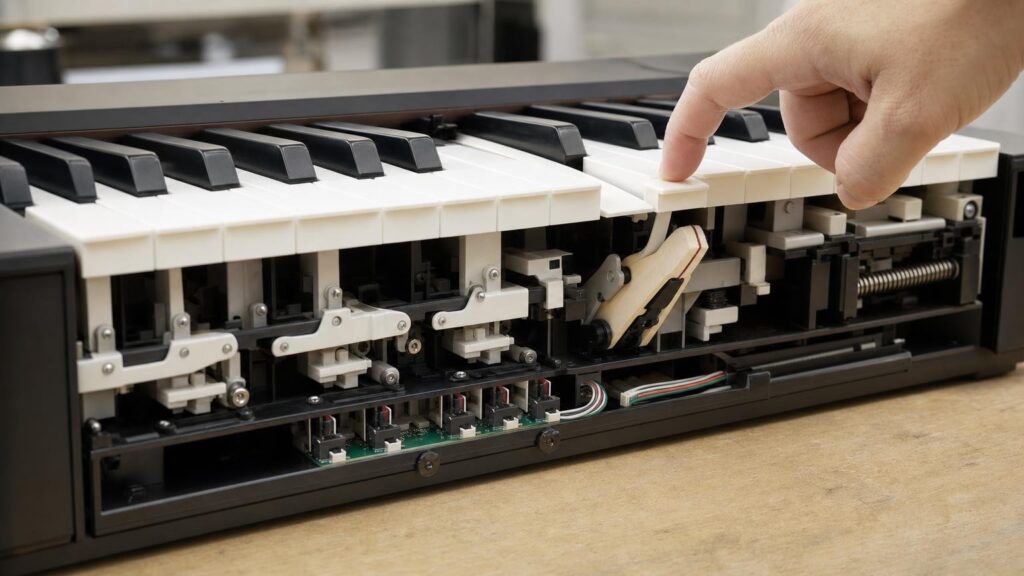
A digital piano’s sound may attract attention first, but its keyboard action largely determines how easily a player can control that sound. The action is not simply the weight of the keys. It is the complete mechanical and sensing system between the player’s fingers and the instrument’s sound engine.
This system includes the keys, pivot points, weights or simulated hammers, return mechanism and electronic sensors. These parts affect soft playing, loud accents, repeated notes, chords and consistency across the keyboard. Similar specification labels can conceal significant differences, so understanding the underlying features is more useful than looking for the heaviest action or the largest sensor count.
Why the action matters as much as the sound
When a key is pressed, the action has two jobs. Mechanically, it must move with predictable resistance and return to its starting position. Electronically, it must give the instrument enough information to decide when to trigger a note and how forcefully that note was played.
A well-matched system helps the player produce deliberate differences between quiet and loud notes. It should also behave consistently during scales, chords and repetitions. If its movement feels awkward or its sensing is poorly matched to the mechanics, the player may struggle to control dynamics even when the sampled or modelled piano sound is convincing.
Terms such as weighted, hammer action and graded describe broad design ideas rather than a universal standard of feel. Two instruments carrying the same description can differ in key travel, leverage, rebound, friction and velocity response. Specifications are therefore useful for narrowing a search, but they do not replace a practical comparison.
Weighted keys and hammer actions are not the same thing
A weighted keyboard adds resistance or mass to create a more substantial feel than a basic unweighted or lightly sprung key. That resistance may come from weights, springs or a combination of components. It can make the keyboard feel firmer, but it does not necessarily reproduce the movement or inertia of an acoustic piano mechanism.
A hammer action uses moving components intended to simulate aspects of a piano hammer mechanism. Pressing the key sets this mass in motion, producing inertia as well as resistance. The sensation can change through the key’s travel rather than remaining uniform from top to bottom.
Neither description guarantees quality. A simple weighted action may suit someone who values a light instrument, quick synthesiser-style playing or frequent use of organ and electronic sounds. A hammer action is generally more relevant to acoustic-piano technique, but its effectiveness depends on its geometry, friction, return behaviour and sensing.
Heavier is not automatically more realistic. Excessive resistance can make quiet playing tiring or make rapid passages harder to control. Conversely, an action that is very light may return quickly but provide little physical feedback. The useful question is whether the resistance feels predictable and allows intentional control at different dynamic levels.
What graded weighting changes across the keyboard
On an acoustic piano, the bass hammers are larger and heavier than those in the treble. This contributes to a keyboard feel that is generally heavier in the lower register and lighter towards the top. A graded digital action attempts to reproduce that progression.
Some actions divide the keyboard into several weighting zones. Others aim for smaller or more gradual changes. A greater number of zones does not by itself establish that an action is more natural. The transitions should feel unobtrusive, and the overall resistance still needs to suit the player.
Grading is particularly relevant for someone learning or maintaining acoustic-piano technique because it changes how the hands respond in different registers. An experienced pianist may notice whether bass chords require appropriately firm control and treble passages remain agile. A beginner may not identify the mechanism directly, but consistent grading can help establish expectations about register and touch.
Players who regularly use strings, organs, synthesisers or percussion may place less importance on acoustic-style grading. For them, a lighter and more uniform action can make some techniques easier. The trade-off is that it may feel less familiar when practising repertoire intended for an acoustic piano.
Pivot length, leverage and where you press the key
Every piano-style key rotates around a hidden pivot point. The distance between the playing area and that pivot affects leverage. A longer effective pivot generally allows the key to remain more manageable when pressed closer to its rear, while a short pivot can make the same area feel noticeably firmer.
This matters because pianists do not always press at the front edge. Chords and passages involving black keys often require the fingers to play farther back on the white keys. If resistance rises sharply there, chord voicing and rapid movement can become more difficult even though single notes played at the front feel acceptable.
Pivot geometry also explains why two actions with apparently similar key weight can feel very different. A simple measurement taken at one point cannot fully describe leverage throughout the usable key surface. Key length visible from the outside is not necessarily the same as effective pivot length, because the relevant mechanism extends inside the case.
When comparing keyboards, play the same chord first near the fronts of the keys and then farther towards the fallboard. Check whether the second position remains controllable rather than merely possible. This is especially useful for players with advanced repertoire, smaller hands or music containing dense chords around the black keys.
Return mechanisms, rebound and repeated notes
After a key is released, it must return reliably so that it can be played again. Digital piano actions may use springs, gravity, counterweights, simulated hammer movement or combinations of these. The design affects rebound, repetition and the sense of connection under the finger.
A fast return is not identical to a light action. A key can have substantial resistance yet recover promptly, while a lighter key may feel vague or sluggish around its return point. What matters is whether the key follows the finger predictably and becomes ready for another note without an awkward delay.
Strong spring assistance can create rapid rebound, but it may also produce an obvious upward push. Added mass can make the action feel substantial, yet more moving mass may influence acceleration and mechanical noise. Designers balance these factors rather than maximising a single quality.
Test repeated notes at several speeds and volumes. Listen for accidental accents or missed repetitions, and notice whether you must lift your finger farther than expected. Also assess rebound during trills and quiet chord changes. Mechanical thumps and clicks are easier to hear through headphones, when the speaker sound is not masking the keyboard itself.
Two sensors versus three: what detection really changes
Sensors detect positions in the key’s travel. By comparing when the key crosses sensing points, the instrument can estimate playing velocity and use that information to shape the note. This is how the same key can produce a quiet tone after a gentle press and a stronger tone after a faster one.
In a typical two-sensor arrangement, the key must pass the relevant sensing points in the required sequence before another note can be registered. A three-sensor system adds another point of detection. This can allow a repeated note to trigger before the key has returned all the way to its resting position, which may support rapid repetition and techniques that keep the key partially depressed.
However, three sensors do not automatically make an action faster or more expressive. Repetition still depends on key return, friction, pivot geometry, sensor placement and the software interpreting the movement. A responsive two-sensor action can feel more controllable than a poorly coordinated three-sensor design.
Sensor count also says little about dynamic smoothness on its own. The instrument must translate timing data into useful velocity values without abrupt jumps or unpredictable accents. Treat sensor specifications as evidence of design intent, not as a complete performance rating.
How mechanics, sensors and sound processing work together
The playing result comes from a chain of connected stages: the key moves, the mechanism shapes that movement, sensors detect it, processing interprets its velocity and the sound engine produces the note. A weakness or mismatch at any stage can affect the experience.
For example, a carefully engineered action can still feel difficult if the selected touch-response curve makes soft notes too hard to reach or causes loud notes too easily. Many digital pianos offer response settings that alter how physical playing translates into sound. Trying these settings is important because the default may not suit every player.
Settings cannot fully overcome mechanical limitations. A response curve can change the resulting volume or tone, but it cannot lengthen the pivot, reduce physical friction or make a slow key return more quickly. Likewise, extra sensors cannot compensate completely for inconsistent movement.
Comparison should therefore use both touch and listening. An action may feel pleasant in isolation but provide poor dynamic control with its sound engine. Another may initially seem firm yet produce a broad and predictable range once the player adapts. The better match is the one that turns deliberate finger movements into dependable musical results.
How to compare actions in person
A short, structured test is more revealing than playing a few loud chords. If possible, compare instruments at similar speaker levels or use suitable headphones. Large differences in volume and tone can make one action seem more exciting even when the keyboard itself is not easier to control.
- Play individual notes as softly as possible. Check whether notes trigger reliably and whether you can repeat the result without occasional loud accents.
- Build a gradual crescendo. Repeat one note, a scale or a simple phrase while increasing force slowly. Listen for a smooth progression rather than sudden jumps.
- Repeat one note. Test quiet, moderate and fast repetitions. Notice how far the key must rise before another note sounds.
- Play trills. Use different finger pairs and check whether the return feels even rather than bouncy or reluctant.
- Try chords in several registers. Assess whether individual notes can be voiced intentionally instead of every note emerging at the same level.
- Move towards the backs of the keys. Play between the black keys and compare the resistance with playing near the front.
- Listen to the mechanism. With headphones on or the volume low, check for distracting clicks, knocks or uneven noises.
Also compare consistency across the keyboard. Some change between bass and treble is expected in a graded action, but individual neighbouring keys should not feel unexpectedly loose, stiff or noisy. Spend enough time to distinguish unfamiliarity from a genuine lack of control.
Choosing the right compromises for your playing
Players focused on acoustic-piano repertoire will usually benefit from close attention to hammer movement, grading, leverage and partial-return repetition. Someone moving regularly between a digital and acoustic piano may value a familiar sense of resistance and predictable control near the backs of the keys.
Beginners need not seek the heaviest keyboard available. An action that encourages relaxed playing and makes dynamics easy to hear may be more useful than one that feels demanding for its own sake. Portability also matters: elaborate hammer systems add moving components and can contribute to an instrument’s overall size and weight.
For quiet practice, mechanical noise deserves extra attention because it becomes more apparent through headphones. Players who often use organ, synthesiser or orchestral sounds may prefer a compromise action that is lighter and quicker for those techniques, even if it is less acoustic-like.
Labels such as weighted, graded hammer and three-sensor provide a starting point, not a verdict. The most suitable action is the one whose leverage, resistance, return and electronic response remain controllable in the way you actually play. Testing soft notes, repetitions, chords and rear-key positions will reveal more than judging weight alone.