





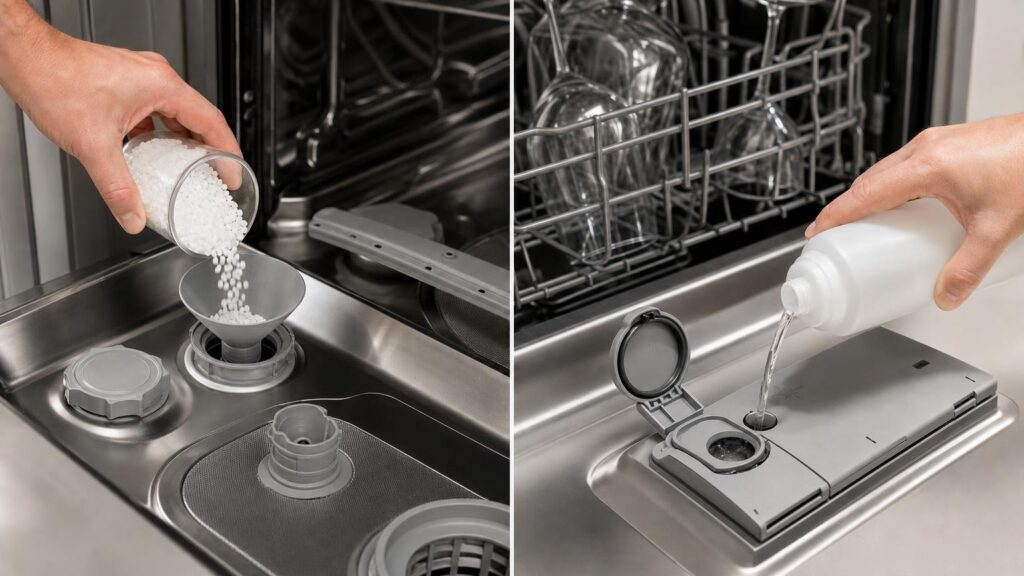
Dishwasher salt and rinse aid are often treated as optional extras or assumed to do roughly the same job. In fact, they act at different stages and solve different problems. Dishwasher salt supports the appliance’s built-in water softener, while rinse aid helps water drain from dishes during the final rinse and drying stage.
Understanding that distinction makes it easier to diagnose limescale, water marks and disappointing drying. It also helps you decide whether an all-in-one tablet is sufficient or whether the separate salt and rinse-aid reservoirs still need attention.
How a dishwasher’s ion-exchange softener works
Many dishwashers intended for areas with hard water contain an ion-exchange water softener. Hard water contains dissolved minerals, particularly calcium and magnesium. These minerals can form limescale when water is heated and can leave visible deposits on the appliance and load.
Inside the softener is a bed of ion-exchange resin. As incoming water passes through it, the resin captures calcium and magnesium ions and exchanges them for sodium ions. The softened water then enters the washing chamber.
This process can help in two ways. It reduces the minerals available to form limescale inside the dishwasher, and it allows detergent to work under more favourable water conditions. Hardness minerals can interfere with cleaning chemistry, so correct softening can contribute to more consistent results.
The important point is that dishwasher salt does not directly scrub, dissolve food or wash the dishes. You do not normally add it to the detergent compartment or scatter it around the washing chamber. It belongs in the dedicated salt reservoir and is used to maintain the softener.
Why dishwasher salt is needed for regeneration
The resin cannot capture hardness minerals indefinitely. Once many of its exchange sites are occupied by calcium and magnesium, the dishwasher must restore its softening capacity. This is known as regeneration.
During regeneration, the machine passes concentrated brine from the salt reservoir through the resin. The sodium in the brine displaces the accumulated calcium and magnesium, allowing the resin to soften incoming water again. The displaced minerals and regeneration water are then drained away as part of the appliance’s controlled cycle.
This is why a dishwasher with a conventional built-in softener can still require reservoir salt even when a detergent tablet advertises a salt function. The physical salt reservoir supplies the brine needed to regenerate the machine’s resin. A tablet placed in the detergent dispenser does not necessarily perform that mechanical maintenance process.
Why ordinary cooking salt is not a direct substitute
Use salt intended for dishwasher softeners unless the appliance manufacturer states otherwise. Dishwasher salt is produced with suitable purity and granule characteristics for the reservoir and regeneration system. Fine table salt, cooking salt, sea salt and salts containing anti-caking agents or other additions may dissolve or behave differently and can introduce substances the softener was not designed to handle.
The issue is not that dishwasher salt is a stronger detergent. It is simply made for a different purpose. Always fill the correct reservoir according to the manual and replace its cap securely.
Water hardness settings matter as much as filling the reservoir
Adding salt is only part of the setup. The dishwasher also needs to know approximately how hard the incoming water is. Its hardness setting determines how frequently, or to what extent, the appliance regenerates the softener.
Check your local water hardness using information from the water supplier, a suitable test method or another reliable local source. Hardness may be expressed in different units, so compare the figure with the conversion table or setting guide in the dishwasher manual rather than guessing.
If the setting is too low for the actual water hardness, the softener may regenerate too infrequently. That can allow hardness minerals through, increasing the chance of limescale or mineral marks and potentially reducing detergent effectiveness. Simply keeping the reservoir full will not correct an unsuitable setting.
If the setting is unnecessarily high, the dishwasher may regenerate more often than needed and consume salt more quickly. Correct adjustment therefore protects the appliance without creating avoidable consumable use. Some models have automatic or simplified controls, but their setup requirements still need to be checked in the instructions.
What rinse aid does during rinsing and drying
Rinse aid deals with the behaviour of water on surfaces rather than the hardness of the incoming supply. It is automatically released in a small dose during the final rinse. Its ingredients lower water’s surface tension, encouraging the water to spread into a thin sheet and run off instead of collecting as individual droplets.
Droplets that remain in place can dry into visible marks, especially where the water contains dissolved material. Helping water drain away can therefore reduce spotting and support more effective drying. It can be particularly noticeable on glassware and cutlery, where isolated marks are easy to see.
Rinse aid does not guarantee that every item will emerge completely dry. Results also depend on the dishwasher’s drying system, the selected programme, water temperature, loading and the material and shape of each item. It improves drainage conditions, but it cannot make an upward-facing hollow empty itself or prevent water collecting in a deep rim.
Salt, rinse aid and detergent are not interchangeable
- Dishwasher detergent provides the cleaning chemistry used to loosen and remove grease, starch, protein and food residue.
- Dishwasher salt regenerates the ion-exchange softener in appliances equipped with one.
- Rinse aid helps final-rinse water sheet off surfaces, supporting drainage, reduced spotting and drying.
Using more detergent will not refill or regenerate an empty softener reservoir. Increasing rinse aid will not remove accumulated limescale. Adding extra salt will not compensate for poor loading or an unsuitable wash programme. When results are disappointing, identify the symptom and the relevant part of the process before changing a dosage.
How all-in-one tablets interact with separate dispensers
Combination tablets may combine detergent with ingredients intended to support water-hardness management and rinsing. They can be convenient, but labels such as all-in-one do not mean that every dishwasher, water supply and programme will produce identical results without separate consumables.
Whether the tablet can reduce the need for separate salt depends partly on local hardness and appliance design. Tablet formulations may manage a limited amount of hardness within the wash, but a dishwasher’s built-in ion-exchange softener may still need salt in its reservoir for regeneration. This distinction becomes more important as water hardness increases.
Check both the tablet instructions and, more importantly, the dishwasher manual. Some machines have a combination-tablet or multi-tab mode that changes programme behaviour or dispenser settings. Others instruct users to keep the salt system active above a specified hardness level. Do not disable indicators or alter hardness settings solely because the tablet has a salt symbol on its packaging.
The same principle applies to rinse aid. A tablet can contain a rinse-aid component, yet its release timing and effect may not match a separately adjustable dispenser in every cycle. If dishes show persistent spotting or remain wetter than expected, separate rinse aid may still be useful where the appliance instructions permit it.
Adjusting rinse aid without overcorrecting
Most rinse-aid dispensers offer several dosage levels. A higher setting releases more product during the final rinse, while a lower setting releases less. Start with the manufacturer’s recommended position rather than assuming the maximum will give the best finish.
If otherwise clean dishes repeatedly retain droplets or show water spotting, consider increasing the dosage by one step. Run several comparable loads before judging the change, because different programmes and items can make one cycle unrepresentative.
If you notice persistent streaking, a film or unexpected foaming, check that the dispenser is properly closed, that spilled rinse aid has been dealt with as directed by the manual, and that the dosage is not excessive. Also review the detergent quantity and product combination, since the rinse-aid setting may not be the only variable.
Small adjustments are more informative than moving straight from minimum to maximum. They allow you to find a setting suited to the appliance, local water and usual load without using more product than necessary.
Materials, programmes and loading can change the result
Not every wet item indicates a rinse-aid problem. Ceramics, glass and metal absorb and retain heat relatively well, which can help residual moisture evaporate. Many plastics hold less heat and may remain noticeably wetter even when the rest of the load is dry. Lightweight plastic items can also turn over and collect water.
Shape matters too. Mug bases, container rims, recessed lids and concave utensils can trap small pools. Place items at an angle where the basket design allows, keeping openings downward and avoiding positions that collect final-rinse water.
Crowding can prevent spray arms from reaching surfaces and can restrict drainage or airflow. Check that spray arms rotate freely, tall items do not block them and dishes are separated rather than nested together. Poor cleaning and drying across a tightly packed area usually point towards loading or spray access rather than an empty rinse-aid reservoir alone.
Programme choice also affects the outcome. Short or lower-temperature cycles may provide less time or retained heat for drying, while an energy-saving programme may use a drying approach that behaves differently from a more intensive cycle. Before increasing chemical dosages, compare the results with an appropriate programme and the loading guidance in the manual.
What to check when choosing and owning a dishwasher
If you live in a hard-water area, find out whether a prospective dishwasher has an integrated water softener and how its hardness level is adjusted. An adjustable system is useful because it can be matched to the incoming supply rather than relying on a one-size setting.
Look at how the salt and rinse-aid levels are communicated. Warning lights or display indicators can make routine refilling easier, while accessible reservoirs and clearly marked controls simplify maintenance. It is also worth checking whether the appliance provides a mode for combination tablets and what limitations the manual places on its use.
Remember that separate reservoirs create an ongoing consumable requirement. How often they need refilling varies with the selected settings, water hardness, dispenser dosage and frequency of use, so a universal refill interval is not particularly useful.
A straightforward decision rule is to set the softener according to verified local water hardness, use dishwasher salt when the appliance requires it, and adjust rinse aid according to observed spotting and drying. Treat detergent as the cleaner, salt as softener maintenance and rinse aid as drainage support. When those three roles are kept separate, it becomes much easier to choose sensible settings and trace the real cause of an unsatisfactory load.
Continue exploring on Frowse
Discover More Frowse Insights
- Why Mechanical Keyboard Switch Colours Are Not a Universal Standard
- The Roof-Rack Fit Problem: Rails, Fixing Points and Clamp Systems Explained
- Why Matt, Eggshell, Satin and Gloss Paint Labels Are Not Universal
- Inside Flat-Pack Furniture: How Boards, Edges and Fasteners Affect Durability
- Phillips, Pozidriv and JIS: Why Cross-Head Drivers Are Not Interchangeable