





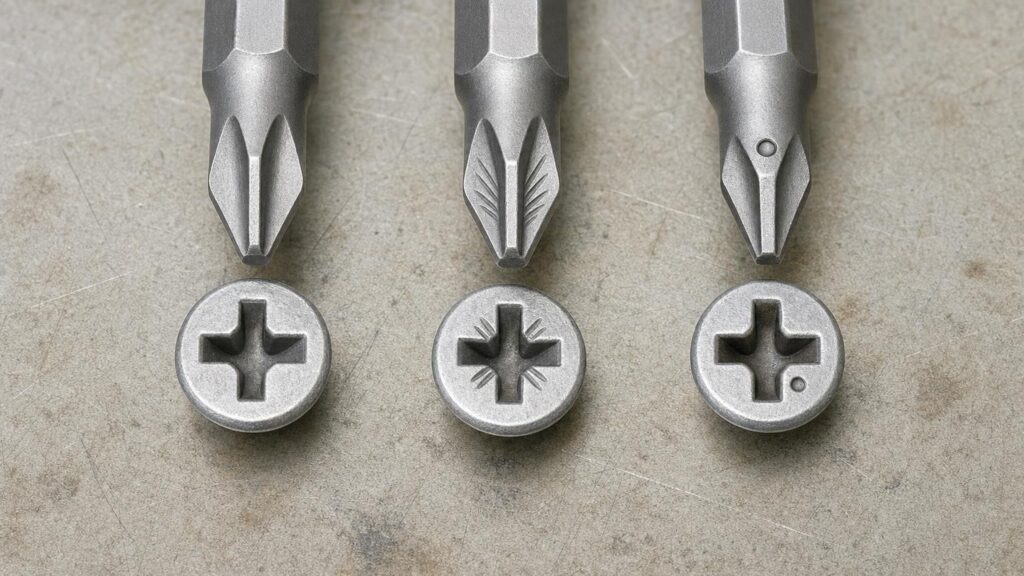
Phillips, Pozidriv and JIS-style fasteners can all look like ordinary cross-head screws. That superficial resemblance makes it tempting to use whichever screwdriver or bit enters the recess. However, the three systems differ in the shape, angle and depth of their working surfaces. A near match may turn an unloaded screw, but it can slip as resistance increases.
Correct identification improves grip and control while reducing the risk of damaging the recess. When choosing tools, both the drive system and the tip size matter. A well-fitting driver should engage the screw positively rather than merely fit inside the cross.
Why similar-looking cross-head screws need different drivers
Torque is transferred through contact between the faces of the driver and the corresponding faces inside the screw recess. The visible cross is only the entrance to that interface. Its flank angles, taper, depth and secondary features determine where the tool makes contact.
If those surfaces do not match, the load may be concentrated on small areas near the top or corners of the recess. This makes the tool feel loose and encourages it to rise out as torque is applied. The result can be slipping, damaged screws and worn driver tips.
This is why a screwdriver that appears satisfactory during a light test may fail when loosening a tight, painted, corroded or thread-locked fastener. It also explains why pressing harder is not a reliable cure for poor engagement.
How the three drive systems differ
Phillips
A Phillips interface uses a simple four-arm cross with tapered working surfaces. The driver and recess are shaped to engage along those surfaces, but the geometry can encourage the tip to rise or cam out when torque increases, especially if the tool is undersized, worn or held at an angle.
Cam-out is sometimes described as an intentional torque-limiting feature. Historical explanations vary, so shoppers should not assume every instance of slipping is expected behaviour. In practical use, repeated cam-out usually indicates excessive resistance, poor alignment, wear or an incorrect tool.
Pozidriv
Pozidriv resembles Phillips but has a distinct interface intended to provide broader engagement and resist cam-out more effectively. A Pozidriv screw commonly has four fine supplementary lines between the main arms of the cross. The corresponding driver has additional ribs that participate in the fit.
Its flanks and angles differ from those of Phillips. A Phillips driver may enter a Pozidriv screw, but it does not properly use all the available contact surfaces. Conversely, the extra features on a Pozidriv driver can prevent it from seating correctly in a Phillips recess. Both combinations can appear workable under light load while still being mismatched.
JIS and JIS-style cross-head interfaces
JIS is commonly used in tool descriptions for cross-head screws associated with Japanese equipment and older Japanese Industrial Standards. These recesses may look particularly similar to Phillips, but their working geometry is different. A compatible driver generally seats more fully and is less inclined to ride out than a near-fitting Phillips tip.
The terminology needs some care. Standards and manufacturing practices have changed over time, while tools may still be marketed as JIS or JIS-style. Not every cross-head screw on a Japanese product is necessarily an older JIS pattern, and country of manufacture alone does not establish the drive type. Explicit specifications and physical fit are more useful than assumptions about origin.
Markings help, but they do not tell the whole story
Pozidriv is often the easiest of the three to recognise. Look for four short radial lines positioned between the main slots, creating an eight-pointed visual pattern. These are part of the recess design rather than scratches made during use.
Some screws associated with JIS patterns carry a small dot, dimple or other mark near the cross. Such a mark can be a useful clue, particularly on older Japanese machinery, motorcycles, cameras or electronic equipment. It is not a universal rule. The mark may be absent, hidden beneath a coating or confused with a manufacturing impression.
Phillips screws usually have the plain four-arm cross without Pozidriv’s secondary lines. Even then, dirt, paint, plating damage and previous tool wear can conceal important details. Small screw heads are also difficult to inspect unaided.
Use markings as supporting evidence rather than a guarantee. Consider the recess shape, the equipment context, any documentation and, most importantly, how the correct-size tool seats before force is applied.
What happens when the wrong driver is used
A mismatched driver contacts the recess in the wrong places. Instead of spreading force over the intended faces, it may bear against the upper edges or a few narrow points. Several warning signs can follow:
- Wobble: the tool moves from side to side even when pressed into the screw.
- Shallow seating: the tip enters but stops near the top of the recess.
- Riding up: the driver lifts as soon as turning force increases.
- Cam-out: the tip slips out of engagement and rotates across the recess.
- Rounding: the sharp internal edges become polished, crushed or torn away.
Geometry-related cam-out should be distinguished from preventable damage. Even a correctly matched driver can slip if it is held off-axis, used at excessive speed or applied to a seized fastener without enough axial control. An incorrect profile makes these problems more likely because it begins with less useful contact.
Once a recess is damaged, identifying it becomes harder and the next tool has less material to grip. Continuing with greater force can turn a recoverable screw into one that needs specialist extraction.
Driver size is as important as drive type
Cross-head tools are normally labelled by profile and size. Phillips sizes use the PH prefix, while Pozidriv uses PZ. JIS-compatible tools may use JIS labelling or manufacturer-specific descriptions. The number that follows indicates a size within that particular system.
A matching number across two systems does not make their profiles interchangeable. A PH2 and PZ2 are both common-looking cross-head tools, but the letters identify different geometries. The same principle applies when comparing JIS-style drivers with Phillips sizes.
An undersized tip may reach the bottom yet leave excessive clearance at the sides. It can twist within the recess and damage the corners. An oversized tip may engage only at the entrance or may not enter at all. The correct size should seat deeply, feel stable and fill the recess without being forced.
Do not judge size only by screw-head diameter. Different fasteners can use different recess sizes despite having similar-looking heads. Test the fit directly with clean, unworn tools whenever possible.
A practical fit check before applying force
- Clean the recess. Remove loose dirt, paint or debris so the internal shape is visible. Avoid damaging the recess while cleaning it.
- Inspect the pattern. Look for Pozidriv’s supplementary radial lines, a dot or dimple that may support JIS identification, or a plain Phillips-style cross.
- Choose the likely profile and size. Start with an explicitly labelled driver rather than an unmarked cross-head tool.
- Insert it by hand. Do not use a drill or impact driver for the initial check. A hand tool makes wobble and shallow seating easier to feel.
- Check engagement. The tip should sit deeply with minimal sideways movement. It should not balance on the upper edges of the recess.
- Keep the tool square. Align the shaft with the screw axis and apply controlled axial pressure while beginning to turn.
- Stop at warning signs. If the tip rides up, clicks across the recess or begins to deform the screw, reassess the profile, size and condition of the tool.
For a stubborn fastener, correct identification comes before greater torque. More pressure, a longer handle or a powered tool cannot correct incompatible geometry.
Choosing hand tools and bits with clear specifications
When shopping, look for explicit PH, PZ or JIS-compatible identification on the tool, holder or packaging. Descriptions such as “cross-head”, “cross-point” or “universal” may not provide enough information to establish compatibility.
Useful buying criteria include:
- Relevant size coverage: choose the sizes used by the equipment you actually maintain rather than the set with the largest piece count.
- Legible identification: clear profile and size markings reduce mistakes when similar bits are stored together.
- Secure storage: a labelled case or organiser makes PH and PZ bits easier to separate.
- Replaceable bits: these can be economical when frequently used tips wear out, provided the holder is stable and appropriate for the work.
- Suitable handle and shaft: a comfortable grip and controllable shaft length can help keep the tool aligned.
Be cautious of claims that one cross-head profile is universally compatible. Some tips are marketed as versatile, and a near match may turn several screw types under light load, but this does not make the underlying interfaces identical. For tight, delicate or frequently serviced fasteners, a dedicated profile is the more dependable choice.
Material, manufacture and tool format affect the result
Drive type is not the only quality consideration. Accurate machining determines whether the tip’s faces and edges match the intended geometry. A poorly formed or heavily worn bit may fit badly even when its label is correct.
Tool steel, heat treatment and surface treatment can influence wear resistance and toughness, but material labels alone do not establish performance. Extremely hard tips may resist wear but can be less forgiving under misuse, while softer tips may deform sooner. Precise manufacture and appropriate use matter alongside the material specification.
Fixed screwdrivers offer direct feedback and good control, making them useful for careful assembly and identification. Multi-bit drivers save space and allow worn tips to be replaced, although the holder and bit must remain secure. Powered-tool bits are convenient for repeated fastening, but speed and torque can turn a minor mismatch into immediate damage. Initial loosening and final tightening often benefit from slower, controlled operation.
No coating, alloy or premium finish can transform a Phillips profile into Pozidriv or JIS geometry. Quality helps only after the correct interface and size have been selected.
Build a small, compatible set instead of forcing a near match
Start with the screws found on the furniture, vehicles, appliances, electronics or machinery you expect to work on. Identify their profiles and sizes, then choose explicitly labelled tools that cover those needs. Someone dealing mainly with European hardware may value several Pozidriv sizes, while a person maintaining older Japanese equipment may need dedicated JIS-style drivers as well as Phillips tools.
Prioritise precise fit over a high nominal piece count. Keep similar-looking profiles separated, and replace tips that have rounded edges, twisted wings or a noticeably loose fit. A worn correct-profile bit can become almost as damaging as the wrong one.
The central rule is simple: a cross-shaped tip is not automatically the correct cross-head tip. Match the system, match the size, test the seating and apply force only when the driver engages securely.
Continue exploring on Frowse
Discover More Frowse Insights
- Speed Class, UHS and V-Rating: How to Read an SD Card
- Suction, Airflow and Floorheads: What Really Determines Vacuum Cleaning Performance
- Why Mattress Firmness and Foam Density Are Not the Same Thing
- Why Matt, Eggshell, Satin and Gloss Paint Labels Are Not Universal
- Why Paper Weight Alone Cannot Tell You How Printer Paper Will Perform