


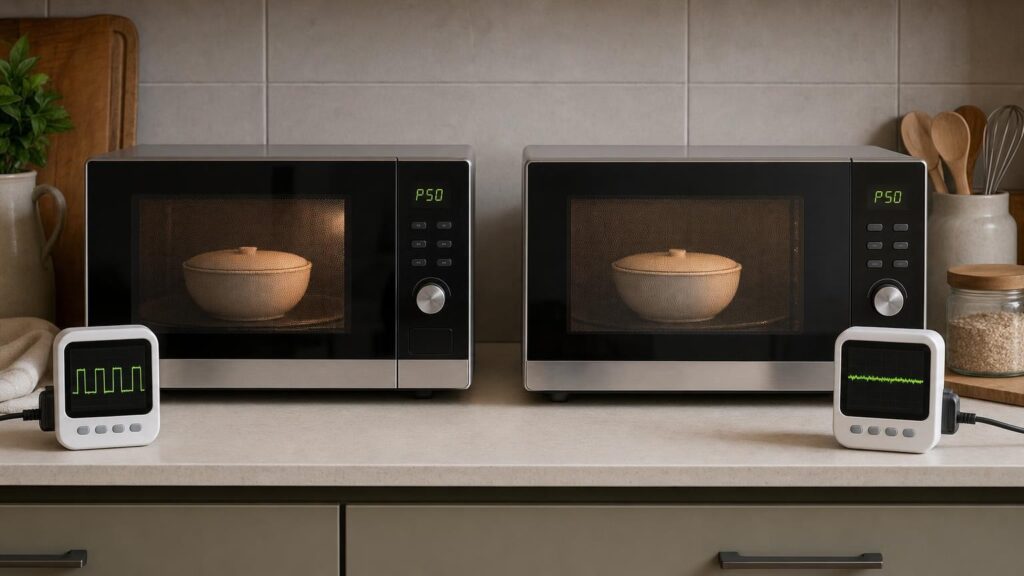
Selecting 50% power on a microwave sounds as though the oven should produce a steady stream of energy at half its maximum output. In many conventional microwave ovens, that is not what happens. The magnetron – the component that generates microwave energy – usually operates at or near full output for part of a repeating cycle, then switches off for the remainder.
This distinction is more than a technical curiosity. The length and timing of those heating bursts can affect defrosting, melting, softening and the reheating of foods that are easily overcooked. It also helps explain why the same power percentage can produce different results in two ovens.
What a microwave’s power percentage really controls
On a conventional microwave, a lower power percentage commonly controls how much of the cycle is spent heating, rather than directly reducing the magnetron’s output while it is active. At a nominal 50% setting, the oven may alternate between a period of full-power microwave generation and a similar period with no microwave energy being produced.
The percentage is therefore best understood as an approximate duty cycle. It describes the intended balance of on-time and off-time over a period, not necessarily the instantaneous power entering the food at every moment.
The oven may still sound as though it is running during an off period. Its fan, turntable, light or control electronics can continue operating even when the magnetron has stopped generating microwave energy. Changes in sound can sometimes reveal the switching, but they are not always obvious.
At full power, the magnetron generally remains active for most or all of the cooking period. At lower settings, the control system introduces increasingly long pauses or shorter heating bursts. Exactly how it divides the time depends on the oven’s design.
Inside the on-and-off heating cycle
Imagine a microwave dividing cooking time into repeating blocks. For a medium setting, it could energise the magnetron for part of each block and leave it off for the rest. A lower setting would reduce the proportion of active heating time further.
This does not mean every oven uses the same cycle length or switching pattern. One model may deliver relatively long bursts followed by long pauses. Another may switch more frequently, using shorter bursts and shorter pauses. Both could label the result as 50% power because the overall ratio of on-time to off-time is broadly similar.
That difference can be noticeable with sensitive foods. A long burst delivers a concentrated period of maximum output before the food has time to equalise. More frequent, shorter bursts may feel gentler even if the average energy delivered over the entire cooking time is comparable.
Power percentages should consequently be treated as control labels rather than universal measurements. They help select a relative setting within one oven, but they are not a reliable basis for expecting identical performance from another model.
Why the pauses change cooking results
Microwave energy does not necessarily heat every part of food at the same rate. Shape, thickness, moisture distribution, composition and placement in the cavity all influence where heating occurs. Rotation and stirring help, but they cannot remove every hot and cold area.
During a pause in microwave generation, stored heat continues to move from warmer areas towards cooler ones. This is ordinary thermal conduction rather than additional microwave heating. The pause gives temperatures within the food an opportunity to become more even before the next burst begins.
That can be useful for tasks where continuous full-power heating would be too aggressive, including:
- softening butter without quickly melting isolated sections;
- melting chocolate or similar ingredients that can overheat locally;
- reheating thick foods whose edges warm before their centres;
- bringing sauces or soups up to temperature with less vigorous local boiling;
- gently warming foods with different layers or moisture levels.
Duty cycling does not guarantee even results. If each burst is long, delicate areas may still become very hot before an off period begins. Stirring, turning, rearranging and allowing standing time can remain important. Container shape and portion size also affect how readily heat spreads.
Why defrosting needs more than simply ‘less heat’
Frozen food presents a particular challenge because exposed edges and thinner sections can begin warming well before a dense centre has thawed. If full power is applied continuously, those warmer parts may start cooking while the interior remains frozen.
An intermittent setting limits the total energy delivered and provides pauses in which warmth can move further into the food. Turning or separating pieces during defrosting can expose colder areas and reduce the shielding caused by overlapping portions. Standing time is especially useful because thawing and temperature equalisation continue after microwave generation stops.
A manual low-power setting and an automatic defrost programme are not necessarily the same. A manual setting usually follows a repeating power pattern for the time selected. An automatic programme may vary its timing or power pattern during the process and may ask for a food weight or category. Some appliances may use additional sensing or programmed assumptions, but the logic differs between models.
Automatic defrost should therefore be viewed as a model-specific convenience, not a standardised performance mode. Instructions to turn, separate or rest the food still matter, and a programme cannot compensate fully for irregular shapes or incorrect information about the portion.
How inverter microwaves produce lower power differently
Inverter microwave ovens use a different approach to power delivery. Instead of relying only on full-output bursts separated by pauses, an inverter system can support a reduced magnetron output more continuously at compatible settings.
At a medium setting, for example, an inverter model may generate microwave energy at a sustained lower level rather than repeatedly moving between maximum output and no output. This smoother delivery can be helpful when a food needs gentle input over time. There may be less opportunity for a vulnerable edge or small section to receive an extended burst at maximum intensity.
The practical appeal is strongest for tasks such as controlled defrosting, softening, melting and warming foods that respond poorly to abrupt heating. However, inverter control is not the same as guaranteed uniform cooking. Microwave energy can still be distributed unevenly within the cavity, and the food’s size, composition and position still matter.
Inverter ovens can also differ from one another. The range of outputs they can sustain, the way their controls map to displayed percentages and the behaviour of automatic programmes are design-dependent. The word inverter identifies a power-control approach, but it does not by itself describe every aspect of performance.
Why the same percentage can behave differently between ovens
A recipe may call for 30% or 50% microwave power, yet identical settings on two ovens can produce different results. Several variables sit behind the displayed number:
- Maximum rated output: A percentage of a higher-output oven can still represent more average energy than the same percentage of a lower-output appliance.
- Cycle length: Long on-and-off periods can affect sensitive food differently from shorter, more frequent cycles.
- Control calibration: The displayed level may be a simplified step rather than an exact measured fraction of maximum output.
- Minimum controllable output: Different systems may have different limits on how gently or continuously they can operate.
- Cavity and energy distribution: Interior geometry, the turntable or other distribution method and food placement influence where energy is absorbed.
- Programme behaviour: A named mode may alter power or timing during operation rather than hold one fixed pattern.
This is why cooking instructions based on percentages often require observation and adjustment. When moving to a different microwave, it can be sensible to begin with a conservative time, inspect or stir the food, and add time as needed. Matching the old percentage does not automatically reproduce the old result.
What specifications and controls can – and cannot – tell shoppers
The microwave’s stated wattage is useful because it indicates its nominal maximum cooking output. It can help shoppers understand why one appliance may heat more quickly at full power than another. Wattage alone, however, does not reveal how gracefully the oven handles low-power tasks.
The number of listed power levels also needs careful interpretation. Ten levels may offer convenient steps on the control panel, but that does not prove the oven creates ten precisely regulated continuous outputs. On a duty-cycled model, those levels may simply represent different on-and-off ratios.
When low-power cooking matters, useful points to investigate include:
- whether reduced settings are duty-cycled or delivered through inverter control;
- whether the instructions explain the approximate purpose of each power level;
- how easily cooking time and power can be changed during operation;
- whether defrosting can be set manually as well as through automatic programmes;
- whether controls make it straightforward to pause, stir, turn and resume;
- whether the available time increments suit short, sensitive tasks.
Specifications may not state the precise cycle duration or the output sustained at every setting. If this detail is important, the appliance manual can be more informative than a short product description. Even then, real-world results will depend partly on the food and the user’s technique.
Choosing the power-control approach that suits your cooking
A conventional duty-cycled microwave can be entirely adequate for straightforward reheating, cooking foods that tolerate strong bursts and occasional defrosting. It is a familiar approach, and good results are possible when food is stirred, rearranged and allowed to stand.
Smoother low-power delivery may be more valuable for someone who frequently defrosts dense or irregular portions, softens butter, melts sensitive ingredients or gently warms small servings. In those cases, inverter control can address a relevant cooking need rather than serving merely as a technical label.
Other buying priorities still matter. Controls should be understandable, the cavity should suit the containers normally used, and the appliance should fit the available space. A shopper may reasonably prefer simpler operation over a larger collection of programmes. Conversely, someone who uses varied power settings regularly may value direct access to power and time adjustments.
No power-control method removes the need for technique. Covering food where appropriate, using microwave-suitable containers, spreading portions evenly, stirring and following standing instructions can have a major effect on the outcome. Lower power usually takes longer, but the extra time is purposeful: it allows heat to spread while reducing the intensity of each stage of heating.
The practical takeaway
When comparing microwave ovens, do not assume that a displayed percentage represents a steady fraction of maximum power. In many conventional models, it represents full-power heating switched on and off in a repeating pattern. Inverter models can provide reduced output more continuously, which may offer gentler control for temperature-sensitive tasks.
Look beyond the number of power levels. Consider maximum wattage, the method of low-power delivery, the usability of manual controls and the types of food you prepare most often. If reheating is the main job, conventional cycling may be sufficient. If defrosting, melting and careful warming are routine, smoother power delivery may deserve greater priority.
Most importantly, expect an adjustment period when changing ovens. Two appliances displaying the same percentage can use different outputs, cycles and programme logic. Understanding what the setting actually controls makes it easier to choose an oven – and to use it with more predictable results.
Continue exploring on Frowse
Discover More Frowse Insights
- Why Hair-Dryer Wattage Does Not Tell You How Fast It Will Dry
- Why Hand-Blender Wattage Does Not Predict Blending Performance
- Why Battery Voltage Does Not Tell You How a Cordless Lawn Mower Will Cut
- Why a Washing Machine’s Kilogram Capacity Is Not the Size of Every Load
- What a Watch Water-Resistance Rating Actually Tells You