


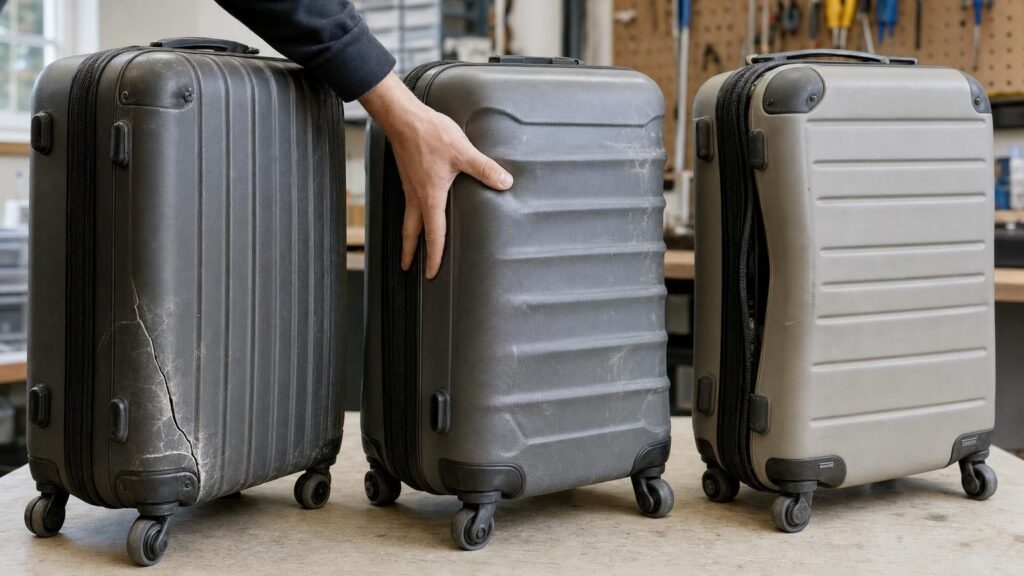
A hard-shell suitcase can crack, dent, flex, scuff or lose its shape, but those outcomes do not mean the same thing. ABS, polycarbonate and polypropylene each have characteristic ways of responding to impact and pressure. None is automatically the best choice for every traveller.
The material name is only a starting point. Shell thickness, panel shape, moulded ribs, corners, closures and hardware mounting can have as much influence on durability as the resin itself. A useful comparison therefore asks not only which plastic is used, but also how the complete suitcase is designed and how its likely failure mode fits the journey.
Why the plastic name does not tell the whole story
Material labels make hard-shell luggage appear easy to rank. In reality, two cases carrying the same description can behave quite differently. A thin, broad panel without much support may deform more readily than a thicker or heavily ribbed panel made from the same plastic. Curved shapes can distribute loads, while sharp transitions, cut-outs and poorly supported mounting points can concentrate them.
Blends complicate the comparison further. ABS may be combined with polycarbonate, and a case described using a familiar material name may use that material in a blend, a laminated structure or only an outer layer. Unless the construction is stated clearly, shoppers should not assume that a reference to polycarbonate means a full polycarbonate shell.
The best question is not simply, “Which plastic is strongest?” It is, “How will this case respond to the loads I expect, and what kind of damage am I willing to accept?” A flexible shell that scuffs may remain usable after an impact that leaves a more rigid shell with a crack. Conversely, a very flexible case may not suit someone who values a firm shape or regularly packs objects that need greater resistance to compression.
Stiffness, flex and toughness are different properties
Several related terms are often treated as if they mean the same thing:
- Stiffness describes resistance to bending or deformation under a load.
- Flexibility describes the ability to bend. It does not by itself reveal whether the material will return to its original shape.
- Elastic recovery is the ability to spring back after the load is removed.
- Toughness concerns how well a material absorbs energy before fracturing.
- Fatigue resistance concerns how a material copes with repeated cycles of flexing or loading.
A shell that feels rigid when pressed in a shop may resist small loads well, but that does not prove it will tolerate a sharp impact. A more flexible panel may feel less substantial while actually absorbing and spreading impact energy more effectively. Equally, flexibility is not an unconditional advantage: severe or prolonged pressure can still produce a permanent dent or distortion.
Temperature, ageing, previous damage and the exact formulation can also affect behaviour. That is why broad material tendencies are useful for comparison, but should not be interpreted as guaranteed performance for every suitcase.
ABS: rigid and economical, but more prone to lasting impact damage
ABS commonly provides the firm, crisp feel many shoppers associate with hard luggage. It can be moulded into defined shapes, ribs and textures, allowing the shell geometry to add useful support. It is often used where a balance of rigidity, weight and cost is wanted.
Its characteristic weakness is that concentrated impacts or repeated flexing can leave more obvious, lasting damage. Depending on the formulation and construction, an ABS panel may dent, develop a split or crack after a severe strike. Areas under strain can also turn visibly pale. This is known as stress whitening and occurs when deformation changes how the material scatters light.
Whitening is not automatically a crack, but it shows that the area has been stressed. A pale mark at a panel centre may remain mainly cosmetic, whereas whitening beside a growing line, corner, wheel housing or handle mount deserves closer inspection. Repeated bending at the same point can turn local damage into a structural problem.
Not all ABS shells should be judged alike. A thicker shell, reinforced corner or well-positioned rib can perform differently from a thin, flat panel. ABS and polycarbonate blends may also be intended to combine rigidity with improved impact behaviour, although the result depends on the actual formulation and construction. A vague blend description does not reveal the proportions or guarantee a particular outcome.
Polycarbonate: impact-tolerant flex with its own compromises
Polycarbonate is valued in luggage because it can flex under impact and often recover rather than fracturing immediately. Pressing a broad panel may therefore produce more movement than some shoppers expect. That movement is not necessarily evidence of poor quality; it can be part of how the shell absorbs energy.
This does not make polycarbonate damage-proof. A sufficiently severe load can cause permanent deformation, and repeated abrasion can leave visible scuffs. Glossy, dark and smooth finishes tend to make surface marks more noticeable, while texture and pattern can disguise them. Finish affects appearance more than the underlying impact response, so a heavily scuffed case can remain structurally serviceable.
Construction still matters. A thin polycarbonate panel may flex considerably, while moulded channels, curved corners and local reinforcement can control movement. The areas around wheels, handles and hinges need particular support because loads enter the shell there rather than being spread evenly over a broad surface.
Material descriptions also require careful reading. “Polycarbonate” may refer to a complete shell, a mixed material or a surface film. If the distinction matters to the buying decision, look for a clear declaration instead of relying on an ambiguous phrase or appearance alone.
Polypropylene: resilient flex and low weight, shaped by shell design
Polypropylene generally combines low density with an ability to flex repeatedly. In a suitcase, this can produce a resilient shell that gives under pressure rather than feeling completely rigid. The trade-off is that broad panels may feel softer, particularly when they lack ribs or internal support.
This makes the moulded design especially important. Ribs, recessed channels, curved edges and changes in panel depth can increase effective stiffness without requiring every area to be equally thick. Local reinforcement can help protect the places where wheels, handles, hinges and latches transfer force into the shell.
Polypropylene’s flexibility can be useful where a case experiences repeated knocks or compression. However, a flexible panel may press further into the packed interior, and poor structural support can allow the case to lose shape. Shoppers should distinguish resilient movement that recovers from uncontrolled distortion that affects closure alignment or hardware.
As with the other plastics, the resin name cannot reveal shell thickness, moulding quality or reinforcement. A thoughtfully structured polypropylene case may feel less rigid than an ABS case yet still be better suited to repeated flexing. The tactile impression alone is not a durability test.
How suitcase construction changes the way a shell fails
Panel geometry and stress concentration
Broad, flat surfaces tend to flex more than curved or ribbed ones. Rounded corners help loads travel around the shell, while abrupt changes in thickness or shape can concentrate stress. Openings for telescopic handles, locks and wheel assemblies interrupt the shell and may become vulnerable points if they are not reinforced.
Extra thickness can improve resistance to deformation, but it may add weight and does not compensate for every design weakness. Strategic support is often more useful than simply making the whole shell heavier.
Zipped and framed construction
A zipped split-shell suitcase normally uses a fabric gusset and zip to join its halves. This connection gives the case some compliance, allowing the two sides to move slightly relative to each other. It can help accommodate minor distortion, although the zip, stitching and surrounding fabric then become important parts of the structure. Overpacking can place sustained tension on them.
A framed case replaces that flexible junction with mating edges, hinges and latches. It can feel more rigid and does not depend on a long zip, but alignment becomes critical. If the shell or frame is distorted, the edges may stop meeting cleanly or a latch may carry an uneven load. A shell that remains uncracked can still become difficult to close if its geometry changes.
Neither closure is universally superior. The useful comparison is between controlled flexibility and alignment-dependent rigidity, together with the quality of the components and how they are integrated.
Read damage signs without jumping to the wrong conclusion
Visible wear should be interpreted according to its location and effect:
- Scuffs and scratches are usually surface wear. They can look severe on a glossy finish without reducing structural function.
- Temporary flex is movement that disappears after the load is removed. Check that the panel recovers and that closures still align.
- Stress whitening indicates local deformation. Watch for an accompanying crack, repeated bending or growth around a loaded fitting.
- Permanent dents show that the shell has not fully recovered. Their importance depends on whether they reduce internal clearance, distort the closure or affect hardware.
- Edge splits and open cracks are structural concerns because they can spread under repeated loading.
- Damage around wheels or handles deserves prompt attention. These areas experience concentrated forces, and movement at a mount can worsen surrounding damage.
Open and close a damaged case on a level surface. Check whether the halves meet evenly, the zip runs without unusual resistance, latches engage correctly and handles or wheels move relative to the shell. Function and alignment often reveal more than appearance alone.
Match the likely failure mode to how you travel
For frequent checked handling, prioritise impact response, protected corners and well-supported wheel and handle mounts. Cosmetic scuff resistance may matter less than a shell that can absorb knocks without cracking or losing closure alignment.
For weight-sensitive journeys, consider the complete empty weight rather than assuming one resin always produces the lightest case. Shell thickness, frame components, internal fittings, wheels and handles all contribute. A light shell is not helpful if the design requires bulky hardware or lacks support where it is needed.
Travellers who pack tightly should examine closure construction and panel shape. Overfilling a zipped case can strain the zip and gusset, while forcing a framed case shut can load its latches and mating edges. A flexible shell may accommodate some pressure, but it can also transmit that pressure to the contents.
For car travel or controlled storage, impact tolerance may be less important than shape, stackability and resistance to compression. Think about where the suitcase will be stored as well: prolonged pressure from other items can cause deformation even without a dramatic impact.
Replaceable wheels, accessible fasteners and modular handles can extend practical service life, because hardware may fail before the main shell. A technically tough plastic does not make a suitcase durable if a damaged wheel assembly cannot be serviced or if its mounting tears away from an unsupported panel.
The useful conclusion: choose the whole structure, not just the resin
ABS, polycarbonate and polypropylene have different characteristic responses. ABS often feels firm but can show lasting dents, whitening or cracks after concentrated stress. Polycarbonate can flex and recover from impacts, although it can scuff or deform under severe loads. Polypropylene can offer resilient flex at low weight, but relies heavily on moulded geometry and local reinforcement to maintain shape.
Before buying, check the declared material and whether it is a full shell, blend or surface layer. Inspect panel ribs, corner curves, closure design and the support around wheels, handles, hinges and latches. Consider whether you would rather accept cosmetic scuffs, visible flex or a greater risk of rigid cracking. The best choice is not the plastic with the strongest reputation, but the complete structure whose compromises match how you travel.
Continue exploring on Frowse
Best Sellers · Top Rated · Under £50 · Fresh Finds
Explore products on Amazon
Looking for products related to this guide? to enter your own search term.
Discover More Frowse Insights
- Why Hair-Dryer Wattage Does Not Tell You How Fast It Will Dry
- Why Cling Film Clings – and Why Some Types Barely Stick
- Why Baking Trays Warp in the Oven and Sometimes Flatten Again
- Hair Clipper Cutting Length Explained: Blades, Taper Levers and Guards
- Why Glasses Turn Cloudy in the Dishwasher and When the Damage Is Permanent