


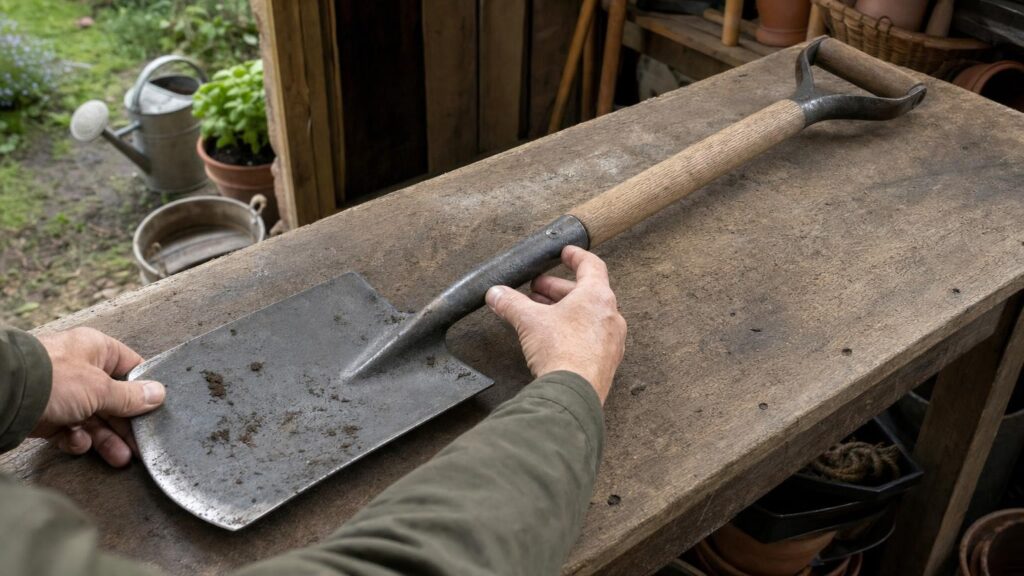
A durable garden spade is not simply one with a thick, heavy blade. Every push, lift and twist sends force through the blade, socket, shaft and handle. If one part is poorly matched to the others, that point may loosen, bend, split or become uncomfortable long before the rest of the tool is worn out.
Longevity also depends on using the right profile for the work. Cutting an accurate lawn edge, opening compacted ground and shifting loose compost impose different loads. Understanding how the components work together is therefore more useful than judging a spade by weight, polish or blade thickness alone.
Spade or shovel: start with the job
The terms spade and shovel are often used interchangeably, but their typical shapes reflect different purposes. A digging spade generally has a relatively flat blade with a straight or only slightly curved cutting edge. It is designed to enter soil, cut roots and turn manageable sections of earth. A narrow, straight-edged blade can also provide the control needed for edging.
A shovel usually has a broader, more dished blade that holds loose material. Its curved or pointed profile may slide readily into compost, sand, gravel or an existing soil pile, but it is less suited to producing a precise vertical edge. A long handle can make repeated scooping and throwing easier, whereas a shorter D- or Y-grip often offers more control when digging and twisting.
Task distinctions matter because tools fail under different types of load. Repeated levering in compacted or stony ground stresses the blade-to-shaft joint. Edging concentrates force along the cutting edge. Moving loose material places greater emphasis on carrying capacity, lifting weight and shaft geometry. Transplanting may favour a narrower blade that disturbs less surrounding soil.
Forged and stamped blades: how forming changes behaviour
A forged blade is shaped under force, while a stamped blade is cut and pressed from sheet metal. These processes can produce different forms, but the manufacturing label does not by itself establish which finished tool will last longer.
Forging can allow material to be distributed where stiffness or reinforcement is needed, including around transitions and load-bearing areas. A forged blade may vary in thickness rather than relying on a uniform sheet. This can create a stiff working section without making every part equally heavy. The process can also produce pronounced shoulders, sockets or ribs as part of the blade form.
Stamped construction can deliver consistent dimensions and a relatively light blade. Pressing can add curves, ribs and dishing that increase rigidity without requiring excessive thickness. A well-designed stamped blade may therefore feel responsive and resist ordinary digging loads effectively. Conversely, a poorly supported sheet can flex excessively or develop stress around abrupt bends and connection points.
Steel composition, heat treatment, blade geometry and the quality of the joint can matter as much as the forming method. A very hard edge may resist wear but can be less tolerant of impacts, while a softer blade may bend or blunt sooner yet be easier to reshape and sharpen. Rather than treating “forged” as an automatic mark of superiority, examine how the complete tool handles the expected load.
Blade profile, edge and tread: where effort meets soil
A flat blade is useful when cutting clean faces, lifting sections of turf or creating a straight edge. A dished blade retains loose material more effectively, although the curve can make precise edging harder. Pointed or rounded cutting edges concentrate force into a smaller initial area, which can help penetration in resistant ground. Straight edges provide a longer, controlled cut and are often convenient for edging and dividing soil.
Width presents another trade-off. A broad blade moves more material per stroke, but it also requires more force to push into the ground and produces a heavier load when full. A narrow blade can penetrate with less resistance and work between established plants, though digging a large area may require more strokes.
The shoulders or treads at the top of a digging blade determine where a boot can apply pressure. A broad, clearly defined tread spreads pressure over more of the sole and makes foot placement easier. Rolled or reinforced edges may also reduce discomfort during repeated digging. However, large treads add bulk and may catch vegetation or interfere when working close to borders. Check that there is enough usable tread for your footwear rather than assuming the largest design is necessary.
Sockets and straps: the critical blade-to-shaft joint
The transition between blade and shaft is often the most heavily stressed area of a spade. It must carry straight pushing force as well as the bending and twisting created when the user levers soil from the ground.
In an open socket, formed metal wraps partly around the shaft. A closed socket encloses it more completely. Longer sockets spread load over a greater section of the shaft, while strapped designs extend metal up one or both sides. These features can provide additional support, but their effectiveness depends on fit, material thickness, fastener placement and the smoothness of the transition. No single joint style is universally strongest in every implementation.
Look for close contact between the shaft and socket, secure rivets or other fasteners, and a transition that does not concentrate all movement at one short point. Warning signs include visible gaps, movement when the blade is held and the grip is gently twisted, distortion around fasteners, or splitting in a timber shaft near a rivet. Surface finishing should not conceal whether the joint is properly fitted.
Shaft materials: flex, feel and failure modes
Timber
Timber shafts can combine moderate weight with controlled flex, which may make digging feel less harsh. Wood also tends not to feel as cold in the hands as exposed metal. Its durability depends on the timber, grain direction, seasoning, dimensions and protection from prolonged damp.
Where the grain is visible, it should run predominantly along the shaft rather than cutting sharply across it. Cross-grain, knots in highly stressed areas and splits around fasteners can create weak points. One practical advantage is that some timber shafts and handles can be replaced, provided compatible parts and accessible fastenings are available.
Steel
Steel shafts can provide high stiffness in a relatively slim form. They do not split like timber, but they can dent, bend or corrode if their surface protection is damaged. A rigid steel shaft may transmit more shock and vibration, and bare or minimally covered metal can feel cold. Hollow steel construction also needs well-designed joints because local dents or corrosion near a fixing can weaken a concentrated area.
Composite and glass-fibre-reinforced construction
Composite shafts can resist moisture and corrosion while offering a designed balance of stiffness and flex. Their surfaces may require less routine treatment than timber or unprotected steel. However, internal damage or separation can be difficult to inspect, and repair is not always straightforward. If a composite shaft is permanently bonded into the socket or grip, replacement may be impractical even when the blade remains serviceable.
Handles and overall geometry: leverage without false assumptions
Shaft length, blade angle and grip design influence posture as well as durability. A shaft that suits the user and task can reduce the temptation to apply excessive sideways force. Too short a tool may encourage stooping, while an overly long one can reduce control during close digging or edging.
D- and Y-style grips provide a defined hand position and help the user rotate the blade when loosening soil. Their enclosed or forked shapes can be useful for close control, although grip size must leave enough room for gloved hands. A long straight shaft permits varied hand placement and is common on tools intended for scooping or throwing loose material.
Extra length can increase leverage, but leverage also increases stress at the socket and blade. Additional weight may make a tool feel substantial while causing fatigue during repeated lifting. Balance and alignment are usually more informative than weight alone: the blade, shaft and handle should sit in line, without an unintended twist that forces the wrists to compensate.
Corrosion, wear and repairability over years of use
Carbon steel blades can take a serviceable edge and are generally straightforward to sharpen, but exposed surfaces need protection from moisture. Stainless steel offers greater resistance to ordinary rusting and may shed sticky soil readily when smoothly finished, although it is not immune to staining, pitting or damage. The exact behaviour of either depends on the alloy and treatment, so material names should not be treated as complete performance guarantees.
Paint, powder coating and other finishes isolate steel from moisture and can reduce initial surface drag. They eventually wear at the cutting edge and other contact points. Local wear is normal, but chipped coating should not be ignored if corrosion begins beneath it.
Basic care helps any construction last:
- Remove clinging soil after use, particularly around the socket and fasteners.
- Dry the tool before storing it in a sheltered, ventilated place.
- Inspect timber for roughness or splits and maintain its finish where appropriate.
- Remove light surface rust before it develops into deeper pitting.
- Keep the cutting edge functional without grinding away unnecessary material.
- Check grips, rivets, screws and other fasteners for movement.
Repairability deserves attention before purchase. A replaceable shaft, removable grip or conventional fastening can extend the useful life of a sound blade. Permanently bonded assemblies may resist loosening, but they can make one damaged component uneconomical or impossible to replace.
A practical durability check before choosing
- Define the main task. Choose a flat, controlled profile for digging or edging and a broader, dished profile for moving loose material. Consider a narrower blade for confined planting work or resistant ground.
- Account for the soil. Compacted, stony or root-filled ground creates greater penetration, impact and levering loads than loose cultivated soil.
- Assess blade behaviour. Look for suitable stiffness, sensible reinforcement and a smooth transition into the socket. Do not assume that the heaviest blade is the most durable.
- Inspect the joint. Check socket length, fit and fastening. Avoid obvious gaps, loose components, sharp stress transitions or splitting around fixings.
- Examine the shaft. Check alignment and surface condition. On timber, inspect visible grain and knots. On steel, look for dents or damaged coatings. On composites, look for cracking, whitening or separation.
- Test tread and grip comfort. Make sure a boot can sit securely on the tread and that the handle accommodates the intended hand position and gloves.
- Consider ownership. Match the material to your willingness to clean, dry, sharpen and protect it, and establish whether worn shafts or grips can realistically be replaced.
Choose the construction that matches the load
A lasting spade is a balanced system. Appropriate blade geometry puts force where it is useful, a well-supported socket distributes the resulting load, and a suitable shaft provides the required blend of stiffness, flex and control. Maintainable materials and replaceable parts can extend service life further.
The best construction for repeated digging or accurate edging may not be the best for shifting compost, gravel or loose soil. Start with the task and ground conditions, then assess the complete force path from cutting edge to grip. That approach reveals more about likely durability than any single label such as forged, stainless or heavy-duty.
Continue exploring on Frowse
Discover More Frowse Insights
- Full-Grain, Top-Grain, Split and Bonded Leather Upholstery Explained
- What Makes an Umbrella Resist Turning Inside Out?
- Why Scissors Stop Cutting Even When the Blades Still Feel Sharp
- Why Battery Voltage Does Not Tell You How a Cordless Lawn Mower Will Cut
- How Frost-Free Refrigerators Manage Heat, Air and Moisture