


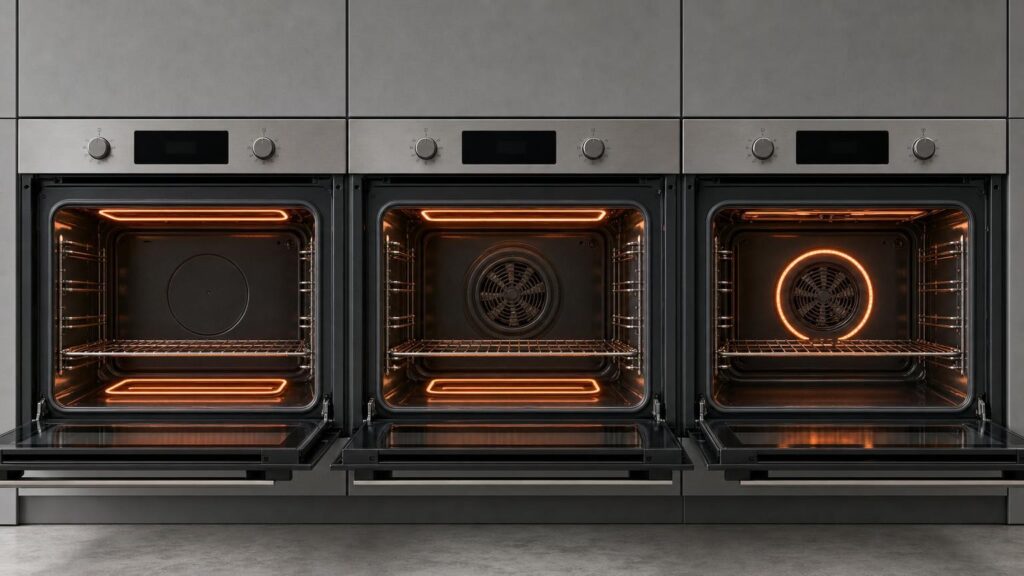
Fan-assisted, convection and true convection ovens are often presented as though they describe the same feature. In practice, the terms can refer to different arrangements of heating elements, fans and operating modes. Those differences influence how an oven preheats, how effectively it cooks on several shelves and how food browns.
The difficulty for shoppers is that the name on the control panel does not always reveal what is happening inside the appliance. A fan may simply circulate heat produced by top and bottom elements, or it may sit beside a dedicated rear heating element that warms the air before circulating it. Understanding that construction is more useful than choosing an oven solely because its description includes the word “convection”.
The heating parts that define each oven design
Most electric ovens use some combination of top, bottom and rear heating components. The way these components work with the fan determines the cooking environment.
Conventional ovens
A conventional electric oven usually heats with elements at the top and bottom of the cavity. Heat rises naturally, so the upper and lower parts of the oven may behave differently. The bottom element can provide useful base heat for pastry, bread or pizza, while the top element supports browning. A separate grill element may provide more intense heat from above.
This natural variation is not necessarily a fault. Some cooks deliberately select a shelf position according to whether a dish needs a firmer base or stronger colour on top. However, the temperature may be less even across multiple shelf levels, particularly when large cookware disrupts the movement of hot air.
Fan-assisted ovens
A fan-assisted oven adds a fan, usually at the rear, to circulate heat generated by other elements. Depending on the selected mode, these may be the top and bottom elements, a grill element or a combination of heaters.
Moving the air can reduce hot and cool areas and expose food surfaces to heat more consistently. However, the presence of a fan does not prove that there is a heating element around it. This is the important distinction between a basic fan-assisted arrangement and what is commonly described as true convection.
True convection ovens
A true convection oven generally has a heating element positioned around or close to the rear fan. It can therefore introduce heated air from the back of the cavity instead of relying only on air warmed by top and bottom elements. This design is also called third-element convection or, in some markets, European convection.
The rear element and fan can support more uniform heating across shelf levels, but construction alone does not guarantee identical results between ovens. Element power, fan speed, cavity shape, insulation, venting and control programming all affect performance. Some models also combine the rear element with top or bottom heat in particular modes.
Why “convection” does not mean the same thing everywhere
Oven terminology varies between countries and manufacturers. In some markets, “convection” means almost any mode that uses a fan. Elsewhere, “fan oven” may imply a rear ring element, while “fan-assisted” describes a fan circulating heat from conventional elements. “True convection” is often used to highlight the presence of a dedicated rear heater, but it is still worth checking the specification.
Mode names can be equally ambiguous. Settings labelled hot air, fan bake, convection bake, fan cooking or multi-level cooking may activate different components. Even two modes on the same appliance can use the fan differently.
Rather than relying on the headline description, look for an element diagram or an explicit statement that the oven has a rear or circular heating element. The instruction manual can be particularly informative because it should explain which mode is intended for baking, roasting, grilling or multi-level cooking.
How airflow and control cycles affect cooking
A fan changes cooking partly by moving away the thin layer of cooler, moist air that forms around food. This can increase heat transfer to the surface and encourage moisture to evaporate. The result may be faster browning, drier surfaces and improved crisping, depending on the food and mode.
Oven elements do not normally remain fully powered throughout cooking. A thermostat or electronic control system switches or varies them to keep the cavity near the selected temperature. The measured temperature naturally moves within a range as heat is added, retained and lost. Opening the door, adding cold food or filling the cavity with heavy cookware changes that cycle.
A well-designed fan mode can distribute returning heat efficiently after the door is opened, but a fan cannot create heat by itself. Recovery still depends on the available elements and the oven’s control strategy. Similarly, true convection does not automatically mean faster preheating. Some ovens use several elements during preheat and then change to a different combination for cooking, while others use a more limited arrangement.
Air movement also affects exposed food more than food inside a lidded casserole or covered baking dish. This is why the benefits of convection are especially noticeable when roasting vegetables, crisping pastry or cooking several uncovered trays.
Preheating, tray placement and multi-level cooking
Fan circulation can help the cavity approach an even cooking environment, but the preheat indicator should still be treated as the main guide unless the appliance instructions say that preheating is unnecessary for a particular mode. Placing food in too early may affect rise, setting and browning, especially for cakes, breads and pastries.
Multi-level cooking is one of the strongest reasons to consider a rear-element convection design. Heated air delivered from behind can reduce dependence on a single upper or lower heat source. Biscuits, roasted vegetables or similar foods may therefore cook more consistently across two or more levels than in a conventional mode.
Even so, airflow needs a clear route. Wide trays, high-sided roasting tins and tightly packed shelves can block circulation. For more predictable results:
- Leave space between food, cookware and the cavity walls where possible.
- Avoid covering an entire shelf with foil, which may obstruct airflow and affect heat distribution.
- Use the shelf positions recommended for the selected mode.
- Stagger trays if the instructions advise it rather than placing them directly above one another.
- Rotate or swap trays when visible browning shows that the load is cooking unevenly.
Usable cavity space matters more than the total number of shelf guides. A fan housing may reduce depth, while a large roasting tin may leave too little clearance for another shelf. Shoppers who expect to cook on several levels should compare the internal layout as well as the quoted capacity.
Browning, baking and the limits of stronger airflow
Circulating heat is useful for many roasting and crisping tasks. It can help dry the surface of potatoes and vegetables, encourage colour on exposed pastry and distribute heat around several smaller items. A rear convection element can be particularly practical when cooking batches that need similar conditions.
Stronger airflow is not always desirable, however. Delicate batters, light toppings and sheets of baking paper may be disturbed. Cakes can set or colour too quickly at the edges if the temperature and shelf position are not suitable. Foods that depend on concentrated base heat may perform better with a conventional or bottom-heat mode, while gratins and other dishes needing a deeply browned top may benefit from upper heat or a final grilling stage.
Covered casseroles and braises gain less from increased surface drying because their cooking environment is enclosed. A fan setting can still distribute cavity heat, but it may not transform the result. Likewise, cooking one dish on the centre shelf may not justify choosing convection if a conventional mode already produces the texture required.
This makes mode flexibility valuable. An oven that offers conventional top-and-bottom heat, a rear fan mode, grilling and useful combination settings gives the cook more control than an appliance that forces every task through one type of airflow.
Recipe temperatures and times: adjust by observation, not assumption
Recipes written for conventional ovens may need a lower setting, a shorter cooking time or simply an earlier check when cooked with a fan. There is no universal conversion that suits every appliance, recipe and load. Differences in calibration, cookware, food quantity and mode programming can all change the outcome.
Start with the recipe’s instructions when they specify a fan temperature. If they do not, consult the oven manual for its recommended adjustment and begin checking before the end of the stated cooking time. Avoid changing both temperature and time aggressively on the first attempt, because that makes it harder to understand how the oven behaves.
Visible doneness cues are often more useful than the clock alone. Look for the expected colour, surface texture, rise, bubbling or separation from the sides of a tin, depending on the food. Use an appropriate food thermometer where a recipe calls for one. Keeping brief notes about mode, shelf position, temperature and timing can make repeat cooking much more reliable.
What to inspect in specifications and controls before buying
A meaningful comparison should start with the physical heating arrangement and available modes, not the most prominent marketing label. Useful points to check include:
- Rear heating element: Look for clear confirmation of a circular or rear element around the fan if true convection is important to you.
- Mode explanations: Check which settings use the rear element, top heat, bottom heat, grill and fan. Symbols alone may be difficult to interpret.
- Conventional mode: Confirm whether the fan can be switched off for recipes that benefit from gentler natural circulation.
- Multi-level guidance: Look for recommended shelf positions and any limits on using several trays.
- Cavity layout: Consider fan housing depth, shelf spacing and whether your usual roasting tins and baking trays will fit with adequate clearance.
- Control clarity: Clear mode names, an understandable display and visible temperature feedback can be more useful in daily cooking than a long list of poorly explained programmes.
- Accessories: Check the dimensions and style of supplied shelves and trays rather than assuming that every level accepts every accessory.
If the product page is vague, the manual or technical diagram may resolve whether “convection” means fan-assisted circulation or a dedicated rear element. This detail is more informative than claims of faster or more even cooking without an explanation of the mode being compared.
Choosing the design that suits how you cook
People who frequently bake batches, roast several trays or prepare food across multiple levels may value a dedicated rear convection element. Those who bake delicate cakes, use strong base heat or grill regularly should also look for flexible conventional, bottom-heat and upper-heat modes.
For mostly single-dish cooking, the practical difference between fan-assisted and true convection may be less important than control simplicity, cavity dimensions and suitable shelf positions. A fan cannot overcome overcrowding, unsuitable cookware or a poorly chosen mode, and the most elaborate heating arrangement is not automatically best for every meal.
The most useful question is therefore not simply whether an oven has convection. Ask where the heat comes from, how the fan is used and whether the available modes match the way you actually cook. Clear controls and a versatile element arrangement will usually support better decisions than an impressive but ambiguous label.