


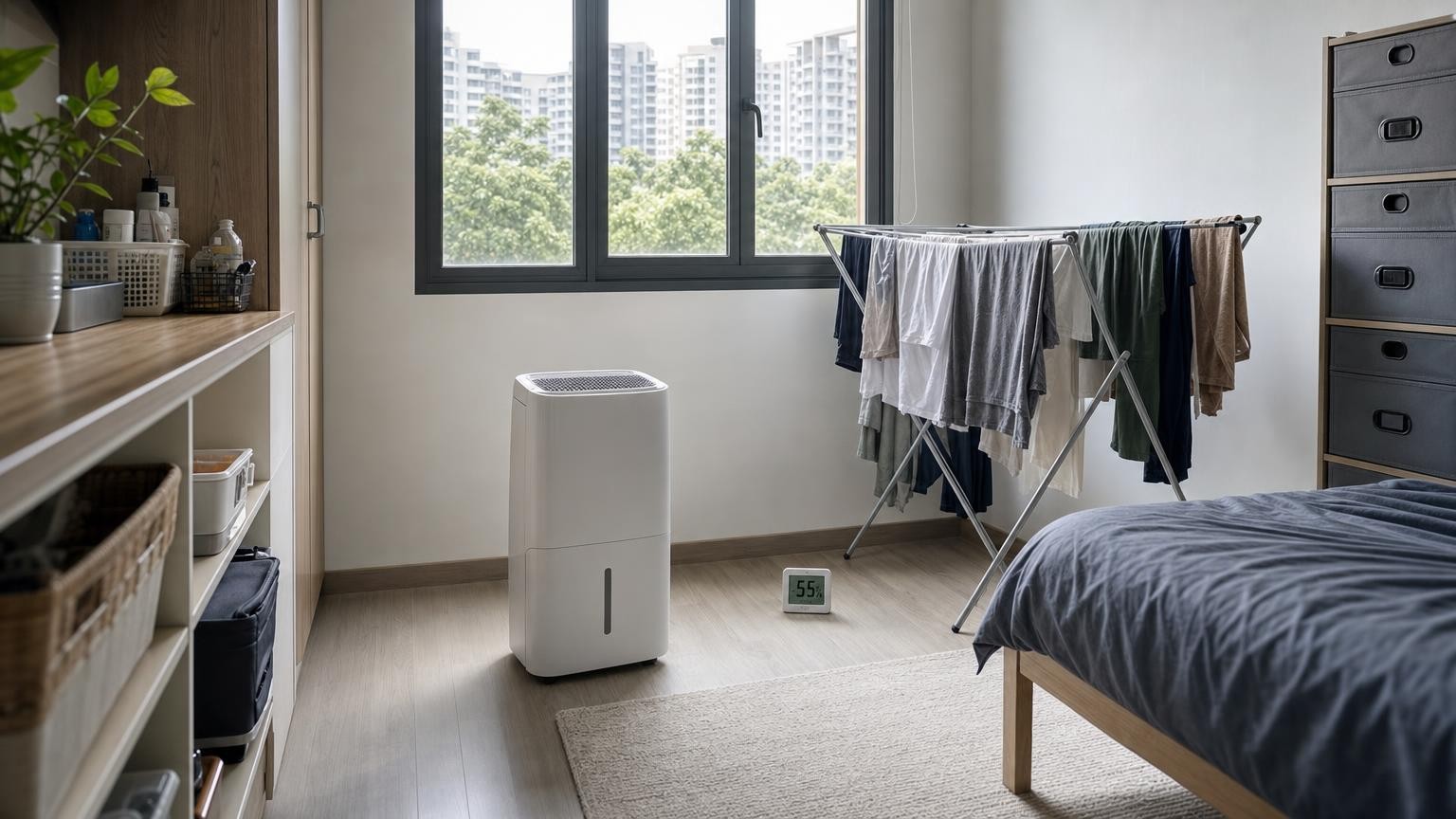
In Singapore, high humidity is often a persistent condition rather than an occasional seasonal problem. A dehumidifier can help manage moisture in bedrooms, wardrobes, utility areas and other enclosed spaces, but the largest or most powerful-looking model is not automatically the best choice.
The right dehumidifier depends on the room’s volume, how moisture enters it, whether doors and windows stay closed, and how long the appliance will run. Noise, heat, drainage and electricity use can matter just as much as the headline extraction figure.
Why dehumidifier choice is different in Singapore
Warm air can hold substantial amounts of water vapour, while outdoor humidity can continually enter through open windows, doors and ventilation gaps. This means a dehumidifier may face an ongoing moisture load rather than simply drying a room once.
Room use also changes the task. A closed air-conditioned bedroom presents different conditions from a naturally ventilated living room. An indoor laundry area, bathroom-adjacent space or room with frequently opened doors may gain moisture much faster. Damp building materials, leaks and water penetration create yet another type of problem that an appliance alone cannot resolve.
Before comparing models, define the intended job. Are you trying to keep an enclosed room within a comfortable humidity range, reduce condensation, help laundry dry, or control musty conditions inside a storage area? This determines which specifications deserve priority.
What a dehumidifier can – and cannot – do
A dehumidifier draws in room air, removes some of its water vapour and returns drier air. The collected water enters a tank or leaves through a drain hose. Repeated circulation gradually lowers the room’s relative humidity, provided moisture is not entering faster than the appliance can remove it.
A dehumidifier is not an air conditioner. Its exhaust may feel warm, and its electrical operation ultimately adds heat to the room. It can make humid conditions feel less clammy, but it does not provide active cooling in the same way as an air-conditioning system.
It is not a substitute for ventilation where fresh-air exchange is required, either. Closing a room usually helps the appliance control humidity, but that does not mean the room should remain permanently unventilated. Ventilation and dehumidification perform different functions and may be used at different times.
In a suitably enclosed space, a dehumidifier may help limit condensation and reduce conditions associated with persistent damp smells. A laundry mode or continuous high setting can also assist indoor drying by keeping the surrounding air able to accept more moisture. Results depend heavily on room size, airflow and how much wet laundry is present.
If moisture comes from a plumbing leak, damaged seal, roof problem or water entering through a wall, the source needs attention. A dehumidifier may assist drying, but it should not be treated as a repair.
Compressor or desiccant: which mechanism suits a hot climate?
Compressor dehumidifiers
A compressor model passes air over a cold surface so that moisture condenses into liquid water. This process generally works well in warm, humid conditions, making it a common fit for typical indoor environments in Singapore.
Compressor units are often attractive for regular use because they can remove moisture efficiently in warm rooms. However, they contain a compressor as well as a fan, so buyers should consider operating noise, vibration, weight and the sound of the compressor switching on and off. Performance may decline in unusually cool spaces because condensation becomes more difficult at lower temperatures.
Desiccant dehumidifiers
A desiccant model uses a moisture-absorbing material and then applies heat to release the captured water into its collection system. It can maintain useful moisture removal at lower temperatures, where some compressor models become less effective.
That low-temperature advantage is less important in a consistently warm room. Desiccant models may also use more electricity for an equivalent task and can release noticeably warmer air because heat is part of the regeneration process. On the other hand, they may be lighter and avoid compressor cycling noise, although fan and airflow noise remain.
For a normal warm room, a compressor model is often the practical starting point. A desiccant unit may make more sense for an unusually cool air-conditioned space, a specific drying task or where low-temperature performance and portability matter more than energy efficiency. Compare actual specifications rather than assuming every model of one type behaves identically.
Match extraction capacity to the actual space
Dehumidifier capacity is commonly expressed as the amount of water the machine can remove in a day. This number is useful for broad comparison, but it is not a promise that the tank will contain that amount after every 24 hours.
Published extraction figures are measured under stated temperature and humidity test conditions. Warm, very humid test air can produce a higher result than an ordinary room that is already approaching its target humidity. Comparisons are most meaningful when ratings use the same test conditions.
Floor area is only part of sizing. Ceiling height determines room volume, and adjoining spaces increase the amount of air the unit must process. Other factors that raise the moisture load include:
- frequently opened doors or windows;
- outdoor air entering through ventilation gaps;
- several occupants using the room;
- wet laundry drying indoors;
- steam moving in from a bathroom or kitchen;
- damp furnishings or building materials;
- water ingress or unresolved leaks.
A model with too little capacity may run almost continuously without reaching the selected humidity. Excess capacity can provide faster drying and more reserve, but usually brings trade-offs in purchase price, dimensions, noise or power demand. Sensible sizing means allowing for the real moisture load without choosing purely by the largest headline figure.
Also check the suggested room coverage, but read how the manufacturer defines it. Coverage figures are not necessarily calculated in the same way. Room volume, test conditions and intended humidity level provide better context than area alone.
Tank size, drainage and humidity controls
Extraction capacity and tank capacity are separate specifications. A unit might be capable of removing substantial moisture over a day while having a much smaller internal tank. If the tank fills, an automatic shut-off should stop collection until it is emptied. In a humid room, this could happen at an inconvenient time.
Consider how easy the tank is to remove, carry and pour without spilling. A visible water-level indicator and full-tank alert can improve daily usability. For long running periods or laundry drying, continuous drainage may be more convenient.
Continuous drainage usually relies on gravity unless a pump is provided. The hose therefore needs a steady downward route to a suitable drain, with no kinks or raised sections that trap water. Check where the outlet is located on the appliance and whether the planned placement allows secure, safe routing. Never assume a hose or pump is included.
A built-in humidistat lets the user select a target relative humidity. The appliance can then cycle moisture removal on and off rather than operating at maximum continuously. Sensor readings may differ from a separate meter because sensors occupy different positions and experience different airflow, so small variations do not necessarily indicate a fault.
Useful controls may include multiple fan speeds, a laundry setting, a timer and a display-dimming option. If the appliance will be used with a timer plug or home automation, verify its restart behaviour after power is interrupted. Some units resume their prior settings, while others remain off or return to defaults.
Account for heat, noise and electricity use
Long operating periods make small ownership compromises more noticeable. All dehumidifiers generate some sound from moving air. Compressor models add mechanical and cycling noise, while desiccant units still require a fan. A sound rating can help comparison, but the character of the noise and whether it changes as the compressor cycles can be equally important in a bedroom or study.
Placement affects perceived noise. Hard floors and nearby walls can transmit or reflect vibration, while an unstable surface may cause rattling. The unit should remain upright and level, following the manufacturer’s installation guidance.
Expect the discharged air to be warmer than the intake air. This can be welcome for drying laundry but uncomfortable in an occupied room. Desiccant operation may add more noticeable warmth, although the experience varies by design and setting.
Rated power indicates electrical demand under specified operation, but it does not by itself reveal total consumption. Actual energy use depends on fan speed, selected humidity, room conditions, compressor cycling and operating time. When comparing models, look at power information alongside extraction performance measured under similar conditions. A lower-wattage appliance that runs continuously is not necessarily cheaper to operate than a more capable unit that reaches the target and cycles off.
Plan around air conditioning, room layout and placement
Air conditioning removes some moisture while cooling, but the amount varies with system operation and room conditions. A separate dehumidifier can provide dedicated humidity control when cooling is unnecessary or when an air-conditioned room remains more humid than desired. Running both appliances can increase electricity use, so choose settings according to the actual problem rather than assuming both must always operate together.
In a naturally ventilated room, open windows can continually admit humid outdoor air. The dehumidifier may collect water while making little progress towards a stable target. For focused drying, close external doors and windows where practical, then ventilate separately when needed.
Do not hide the appliance tightly behind furniture or inside a closed cabinet unless it is specifically designed for that installation. Intake and exhaust grilles need the clearances stated by the manufacturer. Central placement can improve circulation, but practical concerns such as walking routes, socket access and drainage often determine the final position.
One portable unit may serve different closed rooms at different times, but it cannot control several separated spaces effectively merely because their combined floor area falls within a quoted coverage figure. Walls and closed doors prevent free air circulation.
Maintenance and long-term practicality
A washable air filter protects internal airflow from dust and lint. If it becomes clogged, moisture removal may fall while fan effort and noise increase. Inspect and clean it at the intervals given in the manual, with extra attention when the unit is used near drying laundry or in a dusty room.
Empty and rinse the tank regularly rather than allowing collected water to stand for long periods. Wipe accessible surfaces and let components dry before reassembly. For continuous drainage, inspect the hose for kinks, blockage, loose connections and residue.
Keep intake and outlet areas clear. Do not attempt to open sealed refrigeration components or clean internal electrical parts unless the manufacturer specifically provides a safe user procedure.
Portability involves more than the presence of castors. Check weight, handle design, dimensions and thresholds between rooms. Compressor appliances should be kept in the orientation specified by the manufacturer, particularly after transport. Before extended storage, drain the unit, clean the filter and tank, and allow them to dry.
A practical decision checklist
- Define the space. Measure floor area and ceiling height, then note adjoining rooms, door use and ventilation.
- Identify the moisture source. Separate normal ambient humidity and laundry drying from leaks or building defects that need repair.
- Choose the mechanism. Start with compressor models for warm rooms, while considering desiccant units for cooler spaces or specialised drying needs.
- Compare realistic capacity. Review extraction ratings under comparable test conditions and allow for occupants, laundry and moisture ingress.
- Plan water disposal. Decide whether regular tank emptying is acceptable or continuous drainage is essential.
- Check daily comfort. Compare noise, warm exhaust air, controls, dimensions and power information.
- Confirm placement and maintenance. Allow grille clearance, safe drainage and convenient access to the filter and tank.
A well-matched dehumidifier is not simply the model with the highest daily extraction number. For Singapore’s climate, the most useful choice is one that can handle the room’s continuing moisture load while fitting realistically into daily life. Capacity, drainage, heat, noise, controls and maintenance should all be considered before buying.
Continue exploring on Frowse
Discover More Frowse Insights
- Why Some Induction Pans Heat Evenly – and Others Only Pass the Magnet Test
- Clumping Clay, Silica and Plant Fibre: How Cat-Litter Materials Behave Differently
- Why Replacement Zip Sliders Are So Difficult to Match
- Inside Flat-Pack Furniture: How Boards, Edges and Fasteners Affect Durability
- Why Thicker String-Trimmer Line Is Not Always Better