





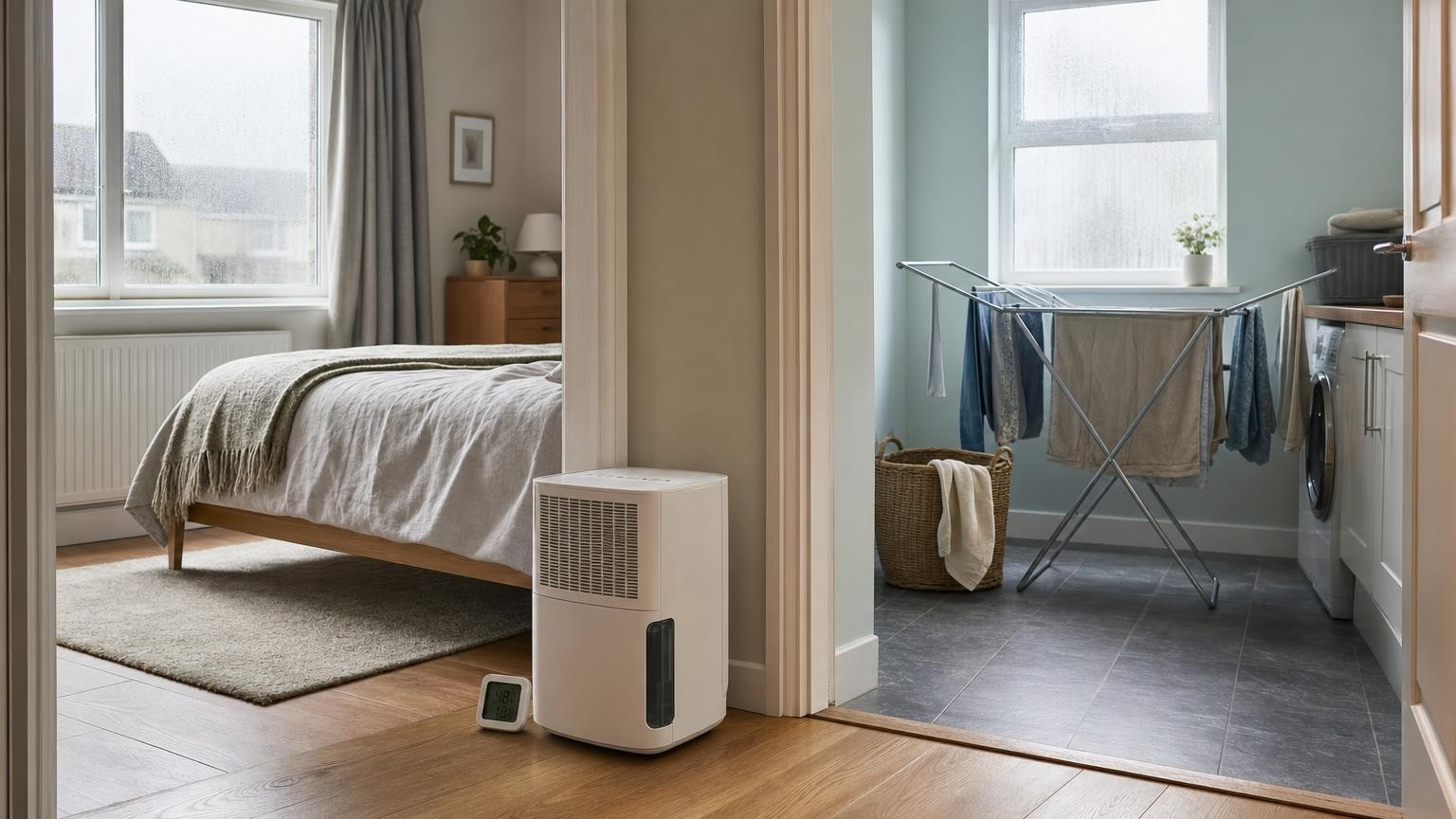
A dehumidifier can help control condensation, support indoor clothes drying and make a persistently humid room easier to manage. Choosing one is not simply a matter of buying the model with the largest extraction figure, however. Room temperature, the source of the moisture, airflow, noise and drainage all affect how useful an appliance will be in everyday life.
Before comparing specifications, decide where the dehumidifier will operate and what you expect it to achieve. A machine intended for a heated bedroom has different demands from one used in a cool utility room, garage or landing. The following considerations will help you narrow the choice without paying for features or capacity you are unlikely to use.
Start with the moisture problem, not the appliance
First identify when and where excess moisture appears. Condensation on bedroom windows in the morning may be linked to overnight occupancy and limited ventilation. A utility room may become humid mainly when clothes are drying. Persistent damp patches, peeling finishes or water marks may point to a leak, water ingress, plumbing fault or another building issue.
A dehumidifier removes moisture suspended in indoor air. It does not repair leaking pipes, defective gutters, penetrating damp or inadequate bathroom and kitchen extraction. If moisture continues to enter the building, the appliance may run for long periods without resolving the cause. Visible mould or substantial, recurring damp also deserves investigation rather than being treated solely as an appliance problem.
Consider ventilation at the same time. Opening windows can be useful in suitable weather, while functioning extractor fans help remove moisture close to its source. A dehumidifier is most valuable when used as part of a broader moisture-management routine rather than as a substitute for maintenance and appropriate ventilation.
Compressor or desiccant: which suits the room?
Most domestic dehumidifiers use either compressor or desiccant technology. The difference matters because their performance changes with temperature.
Compressor dehumidifiers
A compressor model draws moist air across a cold surface, causing water to condense and collect in a tank or flow through a drain hose. It generally suits heated living areas, bedrooms and utility spaces where temperatures remain reasonably comfortable.
Compressor units often offer an appealing balance between extraction and electricity use in warmer indoor conditions. They contain a compressor as well as a fan, so their sound can include a mechanical hum and changes in tone as the compressor switches on or off. They also tend to be relatively heavy.
As a room becomes cooler, condensation on the internal coils may become less efficient and frost can form. Many models include automatic defrost, but extraction can still fall substantially compared with the headline test figure.
Desiccant dehumidifiers
A desiccant machine passes air through a moisture-absorbing material and uses heat to release the collected moisture into its internal water-removal system. This approach usually maintains more useful extraction in cooler conditions, making it worth considering for unheated rooms or other spaces where a compressor model may struggle.
Desiccant models typically release noticeably warmer air and often have a higher power draw. They may be lighter because they do not use a conventional compressor, although the fan remains audible. The extra warmth can be welcome in a cold room but less desirable in an already heated space.
The practical rule is to choose according to the normal room temperature, not merely the technology name. A compressor unit is often the more economical fit for a heated home, while a desiccant model may justify its energy trade-off where low-temperature performance is the priority.
Choose capacity for real Irish-home conditions
Dehumidifier capacity is usually expressed as litres of water extracted per day. This is useful for comparing models only when the figures are based on similar test conditions. Laboratory ratings are recorded at specified temperature and humidity levels, which may be warmer and more humid than a typical room. Actual collection in a cool home can therefore be much lower without indicating a fault.
Room volume matters more than floor area alone. A large room, high ceiling or open-plan layout gives the appliance more air to process. Capacity requirements also rise with frequent indoor clothes drying, several occupants, repeated cooking or showering, and substantial moisture entering from adjoining spaces.
A small unit can be appropriate for a modest enclosed room with a limited condensation problem. It may be frustrating in a large or open space because it has to run continuously while making slow progress. At the opposite extreme, choosing the biggest available unit may bring unnecessary purchase cost, bulk and noise.
When comparing capacities, check the stated test conditions and recommended room guidance, but treat both as reference points rather than guarantees. Allow some margin where the space is cool, frequently used for laundry or connected to other rooms.
Decide between single-room and wider-home use
A dehumidifier works most predictably in an enclosed area. If the aim is to dry laundry in a spare room, closing the door keeps the moisture load and treated air together. For overnight bedroom use, the machine needs to be appropriately positioned in that room or run beforehand if its noise would be disruptive.
Trying to serve several rooms is more complicated. Air must move between the rooms and the dehumidifier, so open doors and an unobstructed central position can help. Even then, closed bedrooms, multiple storeys and long corridors limit circulation. One unit should not automatically be expected to control humidity throughout an entire home.
If you plan to move the appliance, check its weight, handle design and castors. Wheels that are useful on a level floor do not solve the problem of stairs. A lighter unit may be more practical than a slightly more powerful one if it needs to be carried between a utility room and upstairs bedrooms regularly.
Compare controls that make moisture management easier
An adjustable humidistat is one of the most useful controls. It lets the dehumidifier work towards a selected relative-humidity level and reduce or pause operation when that level is reached. This is generally more practical than relying on uninterrupted manual operation.
A clear humidity display helps you observe how a room changes after showering, clothes drying or overnight occupancy. Consumer sensors are best treated as guidance rather than precision instruments. Readings can vary with sensor position, airflow and the warm or dry air immediately around the appliance.
Other worthwhile features depend on your routine:
- Automatic operation reduces unnecessary running once the selected level is reached.
- Multiple fan speeds allow a choice between faster air movement and quieter operation.
- A timer can suit planned laundry sessions or daytime use.
- Auto-restart may restore operation after a power interruption, although settings retained can vary.
- Automatic defrost or low-temperature operation is important for compressor models used in cooler spaces.
Complex app controls or numerous modes are not automatically more useful. Prioritise controls that are easy to read and set, especially if several people will use the appliance.
Tank size, drainage and laundry mode
Collected water normally enters a removable tank. A larger tank needs emptying less often, but it is heavier when full and adds to the appliance footprint. Check that the tank is easy to remove, carry and replace without spilling. A full-tank shut-off is important because it stops extraction when no more water can be stored.
Continuous drainage can be convenient for frequent use. This generally requires a hose leading to a suitable drain, often relying on gravity. The hose must descend appropriately without kinks or raised sections that trap water. Confirm that the proposed location provides safe, practical drain access rather than assuming any nearby sink will work.
A laundry mode commonly increases fan speed, runs continuously or sets a more aggressive humidity target. It does not turn the dehumidifier into a tumble dryer. Results depend on room size, temperature, how wet the clothes are and whether air can pass between them.
For effective indoor drying, use a relatively small enclosed room where suitable, space garments apart and position the appliance so its airflow circulates around the rack without being obstructed. Follow the manufacturer’s placement guidance rather than directing the outlet too closely at fabrics.
Check noise, heat and placement before buying
Noise specifications are helpful, but a single figure cannot describe the character of the sound. A steady fan may be easier to ignore than a compressor cycling on and off. Higher fan settings and laundry modes are usually more noticeable, so compare noise figures at equivalent settings where possible.
For a bedroom, consider whether the unit will operate while you sleep or mainly before bedtime. In a living room, cycling sounds may be more intrusive during conversation or television viewing than they would be in a utility space.
All dehumidifiers return some heat to the room, with desiccant units generally producing warmer outlet air. This can change comfort in a compact room. Check the physical dimensions too, allowing the clearances specified around air inlets and outlets. A unit squeezed behind furniture or covered by laundry cannot circulate air effectively.
Place the appliance upright on a stable indoor surface and keep the tank accessible. Suitability for bathrooms, garages or other demanding locations should never be assumed – follow the product instructions and stated operating conditions.
Estimate running costs beyond headline wattage
Power rating is only one part of running cost. Electricity use depends on power draw, operating mode and how long the machine runs. A basic estimate can be made by converting watts to kilowatts, multiplying by hours of use and then multiplying by your electricity unit rate.
Real operation is less simple because a humidistat-controlled machine may cycle once the room reaches its target. Temperature, moisture load, fan speed, open doors and laundry all affect runtime. A higher-rated appliance that removes moisture quickly and then reduces operation may not always consume more over a full day than an undersized model running almost continuously.
Compare like with like: similar technology, similar extraction test conditions and the setting you expect to use. Avoid judging efficiency from maximum wattage or litres-per-day capacity in isolation.
Plan for cleaning, storage and long-term ownership
Dust on the air filter restricts airflow and can reduce performance, so check how easily the filter can be removed and cleaned. Empty and clean the tank regularly to prevent stale water and residue building up. If using continuous drainage, inspect the hose occasionally for kinks, blockage or poor connections.
Before seasonal storage, empty and dry the tank and hose, clean the filter and allow the appliance to dry as directed. Store it upright in a clean, dry place. Models with specialist or replaceable filters may create an ongoing consumables requirement, so check availability and replacement instructions before buying.
Small ownership details also matter: cable reach, access to the tank, readability of controls, retained settings after a power interruption and ease of carrying. These practical points often determine whether the dehumidifier fits naturally into a household routine.
Match the dehumidifier to the home and routine
Begin with the moisture source and address any leak, ingress or extraction problem separately. Note the normal temperature of the intended room, then choose compressor technology for typical heated spaces or consider desiccant technology where dependable cool-room performance is more important.
Select capacity using the real room size, layout and moisture load rather than the headline extraction figure alone. Finally, prioritise the features that affect daily use: manageable noise for bedrooms, continuous drainage for extended operation, portability for several rooms and straightforward humidity controls for automatic use. The best choice is not necessarily the largest or most feature-rich model, but the one suited to the home, location and routine in which it will actually operate.
Continue exploring on Frowse
Discover More Frowse Insights
- Why Lower Microwave Power Usually Means Switching Full Power On and Off
- What a Sleeping Mat’s R-Value Reveals – and What It Leaves Out
- Why Dimmable LED Bulbs Flicker, Buzz or Refuse to Dim Properly
- Foil vs Rotary Electric Shavers: How the Cutting Mechanism Changes the Shave
- Conventional, Beam and Hybrid Wiper Blades: What Changes Against the Glass