





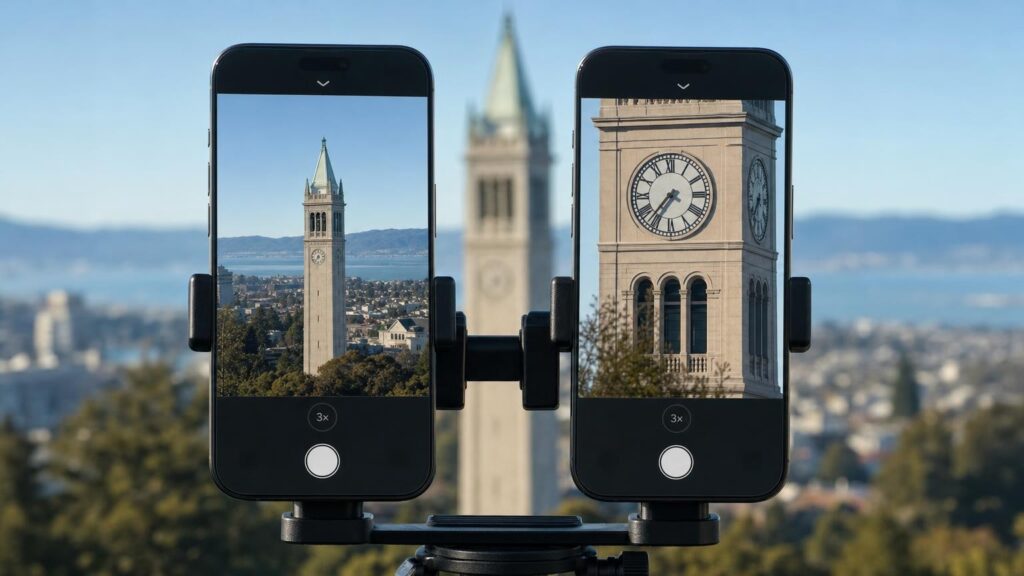
A smartphone described as having 3×, 5× or 10× zoom can appear easy to compare with another carrying the same label. Yet the multiplier alone does not provide a universal measure of reach, detail or image quality. It normally describes magnification relative to that particular phone’s main camera.
The tighter view might come from a separate telephoto camera, a crop from a high-resolution sensor, digital enlargement, computational processing or a combination of methods. Separating these techniques helps you judge how a camera may perform for portraits, travel, events and distant subjects instead of choosing solely by the largest number.
What “1×” actually means on a smartphone
On most smartphones, 1× refers to the main rear camera. Other zoom settings are measured relative to its field of view. A 3× setting is intended to frame a scene roughly three times more tightly than 1×, but that comparison applies within the individual phone’s camera system.
The complication is that 1× does not necessarily represent the same field of view on every device. Main cameras can use different combinations of lenses and sensors. Two phones displaying 3× may therefore frame a subject differently when photographs are taken from the same position.
The 35 mm-equivalent focal length is a more useful comparison. It translates the field of view created by a lens and sensor combination into a common photographic reference. A larger equivalent focal-length figure indicates tighter framing. It does not prove that a camera captures better images, but it makes actual reach easier to compare.
Where equivalent focal lengths are unavailable, photographs of the same scene taken from the same position can help reveal differences in framing. For a fair comparison, check that the images use the same aspect ratio and have not been cropped, resized or compressed in different ways.
Optical zoom, fixed telephoto lenses and multi-camera handoffs
The term optical zoom can suggest a single lens that moves smoothly from wide angle to telephoto. Although variable optical systems are possible, many smartphones instead rely on several separate camera modules. Each module typically has its own sensor and a lens with a fixed focal length.
A phone might have ultra-wide, main and telephoto cameras. Tapping a zoom control can cause the phone to switch between these modules. The on-screen scale may look continuous, but the dedicated optical hardware often covers only particular points along it.
If a camera system has native 1× and 3× modules, for example, the 2× position may use a central crop from the main sensor. Settings beyond 3× may crop and enlarge the telephoto image. Software may also combine several frames or information from more than one camera.
These handoffs can cause visible changes because the modules may differ in:
- sensor dimensions and resolution;
- lens aperture and optical performance;
- autofocus speed and minimum focusing distance;
- colour, contrast and exposure response;
- optical or electronic stabilisation.
The selected zoom button does not always reveal which camera captured the image. In dim conditions, software may decide that a crop from the main camera will produce a more usable result than switching to a smaller telephoto module. This can be a reasonable choice, but it means a labelled zoom setting is not necessarily tied to one piece of hardware in every situation.
Sensor cropping: when zoom uses only part of the image
Sensor cropping creates tighter framing by using the central portion of an image and discarding the surrounding area. A high-resolution main sensor may provide enough pixels for a useful intermediate zoom setting without requiring another camera module.
An in-sensor crop can retain good detail in favourable light, particularly when the lens resolves enough information and the subject is in accurate focus. It can also be cleaner than enlarging a low-resolution finished image. However, a sensor’s headline resolution does not show how much meaningful detail will remain after cropping.
Results also depend on sensor design, readout mode, exposure, lens quality, processing and noise reduction. Because a crop uses a smaller active sensor area, it begins with less total image information than the full frame. In poor light, noise reduction may erase subtle texture before sharpening is applied.
A crop should not automatically be treated as equivalent to a dedicated longer lens. From the same position, both methods can create similar framing and perspective. A suitable telephoto module may still put more of its available sensor resolution onto the distant subject, while the cropped camera throws away the pixels outside the chosen area.
Digital zoom and computational enlargement
Basic digital zoom crops an image and enlarges what remains. The subject occupies more of the finished picture, but enlargement cannot recover details that were never recorded.
Computational zoom can do more than straightforward resizing. A phone may align multiple exposures, use tiny differences between frames, reduce noise and enhance edges. These methods can produce a cleaner result when the camera and subject remain relatively steady.
Physical limits still apply. Hair, foliage, fabric, distant lettering and architectural textures may look smoothed, oversharpened or reconstructed incorrectly. An image that appears convincing on a small display can reveal weak fine detail when viewed at full size, cropped again or printed.
Sharpening can also create an impression of detail by increasing contrast around edges. When examining samples, look beyond bold outlines. Halos, repeated textures and painted-looking surfaces can indicate that processing is substituting for genuine captured information.
Why two 3× cameras can produce very different photographs
A 3× label describes relative framing rather than the quality of the complete imaging system. Several connected factors determine the final photograph.
Equivalent focal length
If two main cameras have different 1× fields of view, their 3× settings can also differ. Equivalent focal length gives a clearer indication of how tightly each camera frames a subject from the same location.
Sensor size and resolution
A larger active sensor area can generally collect more light under comparable conditions, while sufficient resolution helps preserve detail. Neither specification settles the comparison alone. Pixel arrangement, sensor readout, lens performance and processing all affect how much useful information reaches the photograph.
Lens aperture and optical quality
Aperture influences how much light reaches the sensor, but the number needs context. Telephoto modules must fit within a thin device, which can impose optical and physical constraints. Sharpness, contrast and consistency across the frame matter alongside the stated aperture.
Autofocus and stabilisation
Small focusing errors become easier to see at tighter fields of view. Optical image stabilisation can reduce blur caused by hand movement and can support longer exposures when photographing static scenes. It cannot freeze a moving child, pet or performer. Moving subjects still require a sufficiently short exposure.
Image processing
Processing controls frame combination, noise reduction, sharpening, colour and exposure. Camera systems with apparently similar specifications can therefore produce different texture, detail and consistency. Aggressive processing may look striking at first while sacrificing natural fine detail.
Reach is not the same as perspective, detail or low-light quality
Several separate photographic qualities are often grouped under the word zoom.
Reach describes how tightly a camera frames a distant subject. Perspective depends on the camera’s physical position relative to the scene. If the shooting position remains unchanged, a crop and a longer lens can show the same spatial relationships, even though their resolution, noise and depth-of-field rendering may differ. Moving closer changes perspective because the relative distances between objects change.
Captured detail concerns how much genuine subject information survives in the final image. A large zoom multiplier might only enlarge a small crop. A moderate telephoto camera with accurate focus, effective stabilisation and suitable optics can sometimes provide a more useful photograph than a higher digital setting.
Low-light performance is another distinct issue. A telephoto module may gather less usable light than the main camera, while tight framing makes hand movement more noticeable. In poor light, the phone may use longer exposures, stronger noise reduction or a crop from a different camera. Strong daylight reach does not guarantee reliable indoor or evening results.
How to interpret zoom specifications before buying
Treat the advertised multiplier as the start of the comparison. A structured check can reveal what each zoom position represents.
- Find the equivalent focal lengths. Compare the main and telephoto fields of view using a common reference rather than relying only on multiplier labels.
- Identify the native camera points. Determine which settings use dedicated camera modules and which rely on sensor crops or digital enlargement.
- Assess each module in context. Consider sensor resolution, aperture, autofocus and optical stabilisation without using one specification as a shortcut for overall quality.
- Examine full-resolution samples. Look at native, intermediate and maximum zoom positions, not just one selected photograph.
- Compare different lighting conditions. Daylight can reveal potential detail, while indoor and evening photographs expose noise, blur and module-switching behaviour.
- Check consistency across the range. Look for changes in colour, exposure, focus, white balance and texture as the camera moves between modules.
- Consider your output. Weaknesses in digital enlargement are less obvious in small shared images than in heavy crops, large displays or prints.
Useful sample comparisons should show the same scene from the same position. Check that the files have not been resized differently, and include moving subjects where relevant. Static signs and buildings may not reveal autofocus delays, subject blur or inconsistent camera handoffs.
Match the zoom system to what you photograph
For portraits, a dependable moderate telephoto can allow comfortable framing without placing the camera very close to a face. Accurate autofocus, natural texture and reliable indoor performance may matter more than maximum reach.
Travel photography can benefit from access to wide views, normal framing and tighter details. Consistency between cameras is particularly useful when a set of photographs needs similar colour and exposure. A long numerical range is less helpful if image quality drops sharply between its native camera positions.
Pets and children demand responsive autofocus and short exposure times. Stabilisation reduces the effect of the photographer’s movement, but it cannot stop an active subject. A responsive moderate telephoto may be more practical than an extreme setting intended mainly for static scenes in strong light.
Concerts and distant events combine movement, low light and long shooting distances. Examine relevant samples closely because digital enlargement can make a performer occupy more of the frame without preserving facial or clothing detail.
For landmarks, wildlife and other distant subjects in daylight, a dedicated telephoto camera may provide valuable reach. Even then, hand movement, focus accuracy and atmospheric haze can restrict visible detail. Prioritise performance at the focal lengths you expect to use regularly rather than the most dramatic setting on the interface.
Treat the zoom label as a starting point
A smartphone zoom multiplier becomes meaningful only when it is tied to the reference camera and the method used to create the tighter view. The same 3× label can represent different equivalent focal lengths, sensor crops or dedicated telephoto modules.
Compare framing first, then consider captured detail, aperture, autofocus, stabilisation, low-light behaviour and consistency across the zoom range. By separating optical reach from sensor cropping and computational enlargement, you can choose a camera system based on the photographs you intend to take rather than the largest number on a specification sheet.