





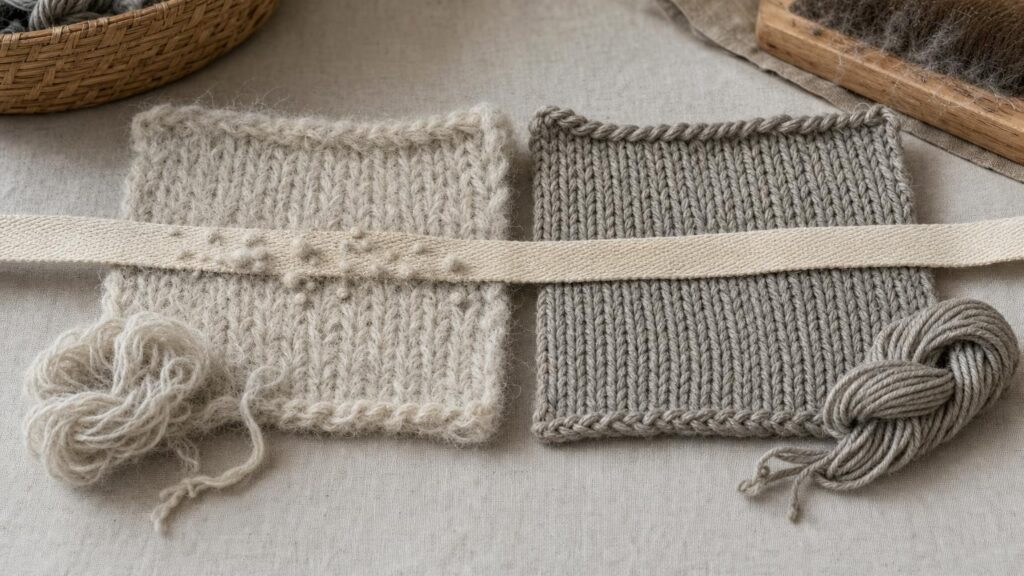
Pilling is often treated as proof that a jumper or cardigan is poorly made, but the reality is more complicated. Pills form through a mechanical process: loose fibre ends emerge from the yarn, rubbing causes them to tangle, and fibres that remain anchored to the fabric hold the resulting ball in place. A garment can therefore pill even when it is made from an expensive fibre or feels exceptionally soft.
How readily this happens depends on several interacting details, including fibre length and strength, yarn twist, surface finish, knit density and the amount of friction the garment encounters. Fibre names and price can provide context, but neither predicts performance on its own. Understanding the construction behind the label makes it easier to choose between softness, durability and the maintenance a garment may require.
How a pill forms on knitted fabric
Pilling usually begins when fibre ends migrate towards the surface of a knitted fabric. These ends create a layer of fuzz. As the fabric rubs against itself or another surface, the exposed fibres become tangled and compacted into small balls. Some fibres then act as anchors, keeping each pill attached to the yarn.
A pill is therefore different from loose lint. Lint and shed fibres have detached from the fabric, while a pill remains connected. It is also different from a snag, where a yarn or loop has been pulled out of position. General surface wear may include thinning, flattening or loss of texture without producing distinct pills.
Friction supplies much of the energy behind the process. It occurs during normal movement, when sleeves brush against the body, and where a bag, coat or seat belt repeatedly touches the garment. Washing can add more rubbing, especially when knitwear moves against other items. Pilling is often most noticeable early in a garment’s life because loose surface fibres are being worked out, although continued abrasion can produce further pills over time.
Fibre length: why shorter fibres can work loose more readily
Many textile fibres are spun as staple fibres, meaning finite lengths are twisted together to make yarn. A yarn made with shorter staple fibres generally contains more fibre ends than an otherwise comparable yarn made with longer fibres. More ends create more opportunities for fibres to protrude, migrate and contribute to surface fuzz.
Longer fibres can be held over a greater part of the yarn and may require more movement before they escape. This can help create a smoother, more stable surface. It does not mean that every long-staple yarn will resist pilling: a low-twist yarn, brushed finish or loose knit can still expose fibres, while wear and washing remain important.
Fibre length is also difficult to evaluate when shopping online. Product descriptions commonly disclose fibre composition but may say nothing about staple length or spinning quality. Broad descriptions such as “premium wool” do not reveal enough to predict pilling. When fibre length is not specified, surface appearance, yarn loft and fabric density may offer more practical clues, though photographs cannot provide certainty.
Fibre type and blends: formation is not the same as persistence
Two garments may initially develop similar fuzz but look different later because their fibres have different strengths. Some natural fibres can break or shed after a pill forms, allowing the pill to detach. Stronger synthetic fibres may be less likely to break, so they can keep pills firmly anchored to the surface. This can make pills more persistent and conspicuous even if the fabric did not produce dramatically more loose fibres at the start.
Wool is not a single, uniform material. Different wool fibres vary in fineness, length, crimp and strength, while processing and yarn construction change how they behave. Other animal fibres and plant fibres also have their own characteristics. It is therefore unreliable to assume that all-natural knitwear will pill less, or that any garment containing synthetic fibre will necessarily pill more.
Blends can be useful because they combine properties. A manufacturer might seek softness from one component, shape retention or resilience from another, and greater strength from a third. The trade-off is that a strong component may help retain pills made partly from weaker fibres. Composition percentages alone do not show how the fibres were blended, spun or finished, so they should be treated as one part of the assessment rather than a verdict.
Yarn twist and construction: softness has a mechanical trade-off
Twist helps bind staple fibres into yarn. In general, a firmly twisted yarn restrains fibre ends more effectively and presents a smoother surface. A loosely spun yarn allows fibres to project more easily and often feels lofty, airy or soft. That inviting hand feel can come with greater potential for fuzzing and pilling, particularly in areas exposed to repeated rubbing.
Yarns may be made as singles or by twisting two or more strands together. A well-constructed plied yarn can be more balanced and resistant to abrasion than a delicate single yarn, but the number of plies alone is not enough to predict performance. The amount and direction of twist, fibre characteristics and final knit all matter.
Brushing and other surface treatments can deliberately raise fibres to create a soft, haloed or fluffy appearance. Such a finish is not necessarily a defect, but it places more fibre at the surface from the outset. Shoppers who value a cloud-like texture should expect that the garment may need more attentive care than a smooth, firmly spun alternative.
These details are hard to judge from marketing terms. Words such as “luxurious”, “cosy” and “soft-touch” describe an experience rather than a measurable yarn structure. Close-up photographs may reveal a fuzzy halo or clearly defined strands, but lighting and image processing can conceal the true surface.
Knit structure and density control fabric movement
A compact, stable knit generally restricts yarn movement and limits the amount of surface-on-surface rubbing within the fabric. A loose or open structure gives loops and fibres more room to shift. This does not make open knits inherently inferior – they may offer drape, ventilation and a relaxed appearance – but they can be more vulnerable to abrasion, distortion or snagging in demanding use.
Texture also changes contact. Raised stitches, brushed areas and three-dimensional patterns may encounter more rubbing than a flat, smooth surface. However, stitch pattern cannot be considered separately from yarn. A textured knit made with a firm, smooth yarn may behave differently from a plain knit made with very lofty, low-twist yarn.
Thickness is a poor shortcut. A thick jumper can be loosely knitted from airy yarn, while a thin knit can be compact and stable. Gauge, loop size, yarn diameter and finishing all contribute to density. If a product image shows large gaps between stitches or an especially fluffy surface, that may indicate a garment designed more for softness and visual texture than maximum resistance to friction.
Where and when pilling is most likely
Pilling often appears first where friction is concentrated. Common locations include the underarms, sides of the torso, cuffs and the area where a sleeve rubs against the body. Shoulder bags, backpacks, outerwear edges and seat belts can create local patches. A long cardigan may also experience abrasion where it contacts a chair or seat.
Fit affects this pattern. A close-fitting garment may experience regular fabric-to-fabric contact around the arms and body, while a very loose garment can fold and rub against itself. Layering a knit beneath a rough coat creates different demands from wearing it over a smooth shirt indoors.
Frequency of wear matters as well. Repeated use without rest subjects the same areas to continuing friction and moisture. Laundering adds another source of mechanical action, particularly if a garment is washed with coarse or heavy items. Localised pilling does not necessarily mean the entire fabric is deteriorating; it may simply map the places where the garment encounters the most abrasion.
How to assess pilling risk before buying
No online listing can guarantee how a knit will age, but shoppers can make a more informed assessment by combining several clues:
- Read the full composition. Use it to understand likely strengths and trade-offs, not to rank natural and synthetic fibres simplistically.
- Examine the surface. A pronounced halo, brushed finish or loose fuzz may indicate that many fibres are already exposed. A smooth surface with clearly defined yarn can suggest firmer construction.
- Look at knit compactness. Small, stable-looking loops generally allow less movement than a very open structure, although photographs may not reveal stretch or weight accurately.
- Consider yarn loft. Bulky but airy yarn can feel softer than a dense yarn of similar thickness, yet it may release surface fibres more readily.
- Match the garment to its use. Knitwear worn under a backpack or coat faces more friction than an occasional indoor layer.
- Check care instructions before purchase. A garment that needs careful handling may not suit someone seeking easy, frequent wear.
Avoid relying on weak shortcuts. High price may reflect fibre rarity, design, labour or branding rather than pilling resistance. Heavy weight does not guarantee density. Natural composition does not guarantee a pill-free surface, and exceptional softness may result from a construction that deliberately exposes more fibre.
Physical inspection can reveal more than a listing. If possible, gently examine whether the knit feels compact or easily disturbed and whether loose fibres are already collecting on the surface. Even then, long-term performance cannot be known with certainty because laundering, layering and individual wear patterns have a major effect.
Choosing among softness, durability and maintenance
The right choice depends on how the garment will be used. An especially soft, lofty cardigan worn occasionally in low-friction settings may justify regular surface care. A frequently worn work jumper or travel layer may be better served by smoother yarn, firmer twist and a denser, more stable structure, even if it feels less cloud-like at first touch.
Care can reduce unnecessary abrasion, although it cannot remove the underlying tendency of a fabric to pill. Follow the garment’s care label, wash only when needed, use a gentle method where instructed and avoid mixing delicate knitwear with rough fasteners or heavy fabrics. Turning a garment inside out may help protect its visible face during suitable washing. Allowing knitwear to rest between wears can also reduce repeated stress on the same fibres.
Pills can often be removed carefully with a suitable knitwear comb or fabric shaver, but aggressive treatment may cut sound fibres, thin the surface or catch loops. Work lightly on a flat garment and avoid pulling pills by hand, as this can draw more fibre from the yarn. Delicate, open or highly textured knits require particular caution.
Maintenance should be part of the buying decision rather than an afterthought. A garment that needs occasional depilling may still be a good choice if its warmth, softness and appearance are priorities. Conversely, someone who dislikes surface care may prefer a smoother, compact knit designed for regular wear.
Judge knitwear as a system, not by its fibre label
Pilling reflects an interaction between fibre length and strength, yarn twist, surface finish, knit structure, friction and care. Shorter fibres may migrate more readily, while strong fibres can make pills persist. Loose, lofty yarns and open structures can enhance softness and drape but may expose more fibre to abrasion. Firm yarns and compact knits may offer a smoother, more stable surface, though often with a different feel.
No single label detail settles the question. The most useful approach is to consider the whole garment alongside the way it will actually be worn. Choose the balance of softness, wear resistance and maintenance that fits the intended use, rather than expecting one fibre name, price point or marketing claim to guarantee a pill-free knit.
Continue exploring on Frowse
Discover More Frowse Insights
- Why a Tent’s Waterproof Rating Is Only Part of Its Rain Protection
- Why Staples That Look the Same Do Not Fit Every Stapler
- Why One Glue Cannot Bond Every Household Material
- Why Replacement Zip Sliders Are So Difficult to Match
- Inside a Fishing Reel: What Drag, Gear Ratio and Spool Design Actually Change